

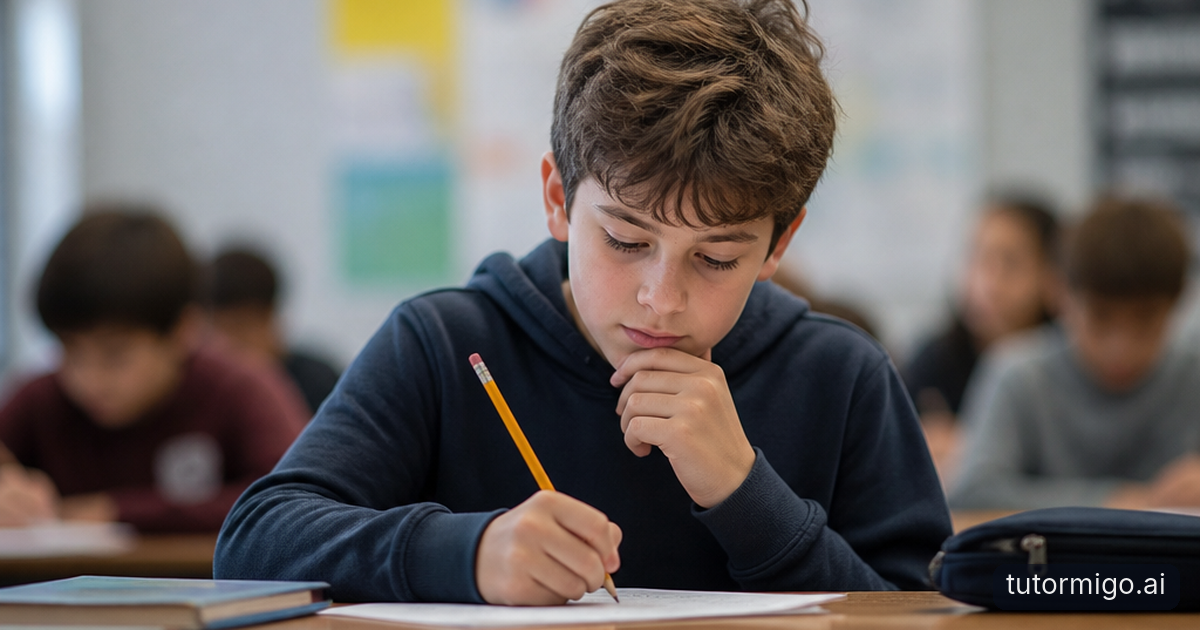
When Good Grades Hide Math Gaps

Few moments worry parents more than this: a child earns B's on weekly, multiple-choice math assignments, then freezes on a cumulative exam. The issue may not be effort. It may be that correct answers have been rewarded without checking whether the student can explain the method.
Guessing can look like progress when every question offers several choices. A child may recognize a familiar diagram, eliminate two options, and choose correctly without knowing why. That result gets recorded as success, while the missing concept remains available to cause trouble later. When fractions, equations, and geometry begin to build on one another, the gap becomes harder to hide.
This is the difference between performance and understanding. Parents looking for adaptive learning for kids should ask more than, “What score did you get?” Ask, “Which step felt uncertain?” and “Could you solve a similar problem without the choices?” A short conversation like that can reveal more than another worksheet score. It also helps you respond to a child falling behind in math without turning homework into an accusation.
The Illusion of Competence in Everyday Math
Consider a student who sees and selects the correct answer because it looks familiar. If the same student cannot explain why multiplication is handled before addition, the skill is fragile. The problem becomes more serious when later work includes parentheses, fractions, or variables. A lucky result can conceal an order-of-operations gap until the problems no longer resemble practice examples.
Fractions create a similar trap. A child might choose the right answer for $ rac{1}{2} + rac{1}{4}$ by recognizing a picture, but struggle when asked to explain the common denominator. Negative numbers can create another blind spot: a student may remember that is “less than” but hesitate when comparing and on a number line.
These are STEM learning gaps, not character flaws. They often appear when practice emphasizes completion, speed, or answer selection instead of reasoning. A helpful response is to ask for a worked example and listen for the decision points: What did your child notice first? Why did they choose that operation? Where would they check the answer? A blank-page understanding check can make this invisible uncertainty easier to see.
How Mastery Checks Reveal What Scores Miss

A stronger learning routine separates “I got it right” from “I can do it reliably.” It looks at the path to the answer: whether the learner can explain a step, recover after an error, and solve a new version without relying on familiar choices. That is the purpose behind mastery tracking software and other forms of adaptive learning for kids.
Imagine two practice summaries. One student answers correctly of the time, retries several questions, and needs prompts to identify the operation. Another reaches accuracy, explains the method, and solves changed examples independently. Those numbers are not just grades. They describe different next steps. The first learner needs targeted practice with the underlying concept; the second may be ready to apply it in a mixed problem set.
TutorMigo’s personalized AI Tutor Workspace can support this kind of review by keeping session history and allowing a student to work through questions conversationally rather than simply collecting final answers. A parent can focus on the reasoning shown during a session instead of assuming a worksheet score tells the whole story. For a student falling behind in math, that shift matters: the goal is not to rush past a lesson, but to identify the specific idea that needs another explanation and another chance to stick.
Sage Makes Methodical Reasoning Feel Safer
For many children, guessing is not laziness. It is a way to escape the uncomfortable feeling of being wrong in public. If speed is praised and mistakes are treated as failure, a student may choose an answer quickly rather than risk showing unfinished thinking. Over time, that habit can make math anxiety look like a lack of ability.
Working step by step with Sage, TutorMigo’s AI Tutor persona, gives the learner room to slow down, describe the plan, and revisit a confusing step. A student solving an equation such as can first explain what must be undone, then check whether subtracting from both sides preserves the relationship. The point is not to reward a fast guess; it is to make a sound method visible.
This approach also gives parents better language for encouragement. Instead of saying, “You got the answer wrong,” try, “Your first step made sense; let’s inspect the step where the signs changed.” That keeps the conversation focused on a fixable choice. For more ideas on reducing pressure around mathematics, read this guide to how AI can help quiet math anxiety. Confidence grows when students experience mistakes as information, not verdicts.
A Practical Parent Check Before the Next Report Card
You do not need to recreate a classroom assessment at home. Start with three short prompts from a current topic. Ask your child to solve one familiar problem, explain a similar problem without answer choices, and correct a deliberately made mistake. For fractions, that might mean solving $ rac{2}{3} + rac{1}{6}$, explaining why the denominators must be related, and identifying the error in a sample solution.
Notice more than correctness. Does your child begin confidently, or wait for a hint? Do they retry after an error? Can they explain why a strategy works, or only repeat a procedure? Write down the exact sticking point, such as “chooses the operation incorrectly” or “loses the negative sign,” rather than labeling the child as weak at math.
Then use a focused TutorMigo session to revisit that one idea with Sage and return to it later. Session continuity helps keep the conversation connected instead of starting from zero each time. Parents can also use the Parent Dashboard to maintain visibility into progress and support co-learning. This is more useful than checking only whether an assignment was submitted: it helps you see where encouragement, practice, or a teacher conversation may be needed.
What to Do Next: Replace Guessing With Evidence
Before the next report card, choose one recent math unit and look for evidence of understanding. Ask your child to solve a problem without choices, narrate the first two decisions, and explain how they would check the result. If the explanation breaks down, treat that moment as a useful starting point, not proof that your child cannot learn the topic.
For families comparing AI learning tools, the practical difference is how the tool supports the learning process. A general-purpose chatbot may offer an explanation when asked, while a dedicated AI Tutor Workspace is designed around personalized tutoring, session history, and an ongoing study conversation. TutorMigo can be paired with interactive study tools such as a math step editor when a learner needs to see and revise the work, rather than only read an answer.
The benefits of TutorMigo are clearest when adults use the information to make a small, timely decision: review one prerequisite, schedule another practice session, or contact the teacher with a specific question. Set up a free session with Sage to identify hidden gaps before the next report card, then use what you learn to replace lucky guesses with steady, explainable progress.
| Approach | What it can show | What to check next |
|---|---|---|
| Multiple-choice worksheet | Whether a student selected the correct option | Ask for a choice-free explanation and a changed example |
| Answer-focused chatbot session | A possible solution or explanation | Check whether the student can reproduce the method independently |
| TutorMigo AI Tutor Workspace | A personalized tutoring conversation with session history | Review the reasoning, revisit the sticking point, and plan the next practice step |
Pros and cons
Pros
- Makes hidden prerequisite gaps easier to discuss
- Encourages methodical reasoning instead of answer-only completion
- Gives parents a clearer starting point for focused support
Cons and limitations
- A short session is not a complete academic assessment
- Parents and teachers still need to interpret progress in context
- Students may need repeated practice before a concept becomes reliable
Frequently asked questions
Ask your child to solve a similar problem without multiple-choice options and explain the first step. Hesitation, changing operations, or an inability to explain a correct answer can signal fragile understanding.
Adaptive learning adjusts practice or support based on what a learner demonstrates, rather than moving every student forward at the same pace. In practice, it means identifying a specific gap and returning to that concept when needed.
TutorMigo’s personalized AI Tutor Workspace gives students a private place to work through questions step by step. Using a calm, methodical process can make mistakes easier to inspect and discuss.
Record the exact skill causing difficulty, practice that prerequisite in short sessions, and check whether your child can explain a new example without answer choices. Share the specific observation with the teacher when appropriate.
Related reading
Enjoyed this read?
Like, share, or comment below.



Comments
0Sign in required · respectful discussion · replies supported
Loading comments…