

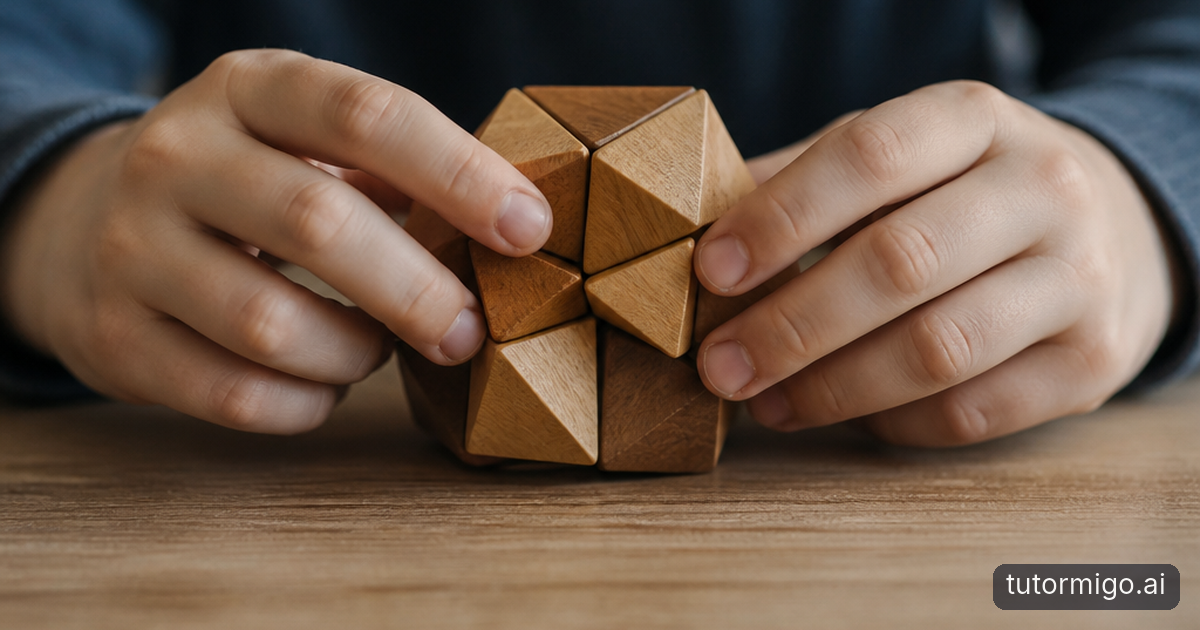
Tutoring strategies: Pause when explanations reduce thinking
The signal to switch is not simply a wrong answer. Listen for a mismatch between what your student can repeat and what they can do. They might say, “Do the same thing to both sides,” yet change only one side of an equation. Or they might name the planets correctly but struggle to describe how their paths relate to the Sun. Another verbal explanation may leave that mismatch untouched.
Before changing tools, ask a small question: “Show me the part that stops making sense.” Give the student time to point, sketch, or attempt a step. If they cannot identify it, offer a choice: “Is the difficulty what we are doing, or why that keeps the relationship true?” You are locating the obstacle, not asking them to prove that they listened.
Then make the pause explicit: “My explanation isn’t giving you a useful picture yet. Let’s try another way.” That wording keeps the difficulty shared rather than making the student the problem. If asking for clarification is itself difficult, these approaches to helping students ask for help in class can support the conversation. Keep the next move small: change one representation, not the entire task.
Choose the representation that exposes the relationship

Choose by asking what your student needs to notice. A balance makes equality visible. A spatial model makes position and movement easier to inspect. Spoken practice makes timing and sound available to the ear. The most elaborate option is not necessarily the most useful; the right one brings the hidden relationship into view without adding unnecessary detail.
For an equation such as , use a balance model with two identical covered containers and three unit blocks on one side, balanced by eleven unit blocks on the other. Explain that each container holds the same unknown amount. Ask what could be removed while keeping the balance level. Let the student remove three unit blocks from each side, then share the remaining eight equally between the two containers.
What does this reveal that words missed? “Subtract from both sides” becomes an action that preserves a relationship, rather than a rule attached to moving symbols. Connect each physical change to the written equation, ending with . Then name the model’s limit: this simple version is less convenient for negative quantities. Before changing examples, ask, “What changed in your understanding?” Listen for a connection to equality, not just “The blocks helped.”
Use a three-dimensional model to make space discussable
A student may know that planets orbit the Sun yet imagine their paths as a single line of objects moving together. A three-dimensional solar-system model gives you a shared object to inspect from different positions. Use a physical model or a suitable model you already have access to; you do not need an elaborate demonstration to make the spatial relationship visible.
Start with one question: “If we look from above, what path would this planet trace?” Let the student move the planet, then view the model from the side. Ask what changed in their view and what stayed the same in the system. The movement helps separate an object’s position at one moment from the path it follows over time—something a verbal description can leave blurred.
Be explicit about distortion. Many tabletop models exaggerate planet sizes and compress distances, so they should not be used to infer actual scale. State what this model is helping you examine: arrangement and orbital movement. Then ask the student to sketch the relationship without looking at it. Follow with, “What changed in your understanding?” A useful response might be, “I was treating the row in the picture as their actual arrangement.” That gives you a specific idea to revisit.
Switch to spoken practice when the obstacle is sound
Sometimes the missing representation is not visual. A student may understand the meaning of a language phrase on paper but struggle to recognize or use it in conversation. Consider the French phrase “Je voudrais un café, s’il vous plaît.” Explaining its meaning again will not necessarily help the student hear where the words connect or find a comfortable rhythm for saying it.
Say the phrase naturally, then in two meaningful chunks. Invite the student to listen once before repeating. Next, take the other role in a brief exchange so the phrase answers a real conversational need. Let them try again without reading. Spoken practice reveals sound, pacing, and the difference between recognizing written words and retrieving a phrase while someone waits for a response.
Keep the purpose narrow: you are making the phrase usable, not demanding a perfect accent. Ask, “Which part became easier when you heard it?” Then use the broader prompt: “What changed in your understanding?” If you use TutorMigo.ai’s AI Tutor Workspace, its text chat can help you prepare a short written exchange. Treat that as preparation for human-led speaking practice, not as a claim that the workspace demonstrates audio or pronunciation feedback.
Return the model—and the reasoning—to the student
A representation has not done its job if you perform every action while the student watches. After one demonstration, hand over the blocks, the model, or the conversational turn. Ask for a prediction before an action: “What will happen if you remove these?” or “What would you see from the other side?” Then let the student test the prediction and explain any surprise.
Move between representations rather than abandoning words altogether. After the balance activity, ask the student to connect each move to a line of algebra. After the solar-system model, ask for a sketch and a spoken explanation. After language practice, return briefly to the written phrase and have the student mark useful chunks. The goal is a connection the student can use, not dependence on a particular prop.
When monitoring assigned work, look for those connections in the student’s explanation. Keep your own notes specific: “Explained why removing equal amounts preserves balance” is more useful than “Understands equations.” A teacher dashboard can support class management, student monitoring, knowledge base assignment, and reporting; the interpretation of this tutoring exchange remains your professional work. In progress discussions, describe the observed action and the next task rather than turning one successful demonstration into a broad claim of mastery.
Plan one deliberate switch for your next session
Before your next session, choose one concept that has already resisted explanation. Write down the relationship you want the student to notice, the representation most likely to expose it, and one limitation you will name. Prepare only what that switch needs: matching blocks for a balance, a movable solar-system model, or a short phrase you can practice together. Avoid assembling several alternatives that compete for attention.
Build the follow-up into the assignment. After working with the representation, ask the student to complete a similar task without your demonstration and explain the connection in their own words. If your preparation includes an AI Tutor conversation, use it to rehearse alternative wording or a written prompt; do not mistake a fluent chat response for evidence of the student’s understanding. TutorMigo.ai’s session history lets you revisit that preparation later.
Finish your plan with the question you will ask aloud: “What changed in your understanding?” Leave space in your own notes for the student’s answer and the next thing to revisit. Your practical next-session action is simple: when explanation stalls, stop after one unsuccessful rephrasing, introduce your prepared representation, and let the student make the first meaningful move.
Frequently asked questions
Try a brief check that asks the student to use the idea. If they can repeat your explanation but cannot connect it to an action or relationship, another representation may help more than another rephrasing.
Name what the model shows and what it leaves out. For example, a tabletop solar-system model can show orbital arrangement without accurately representing sizes or distances. Ask the student to explain that limitation.
Choose it based on the concept and the obstacle instead. Use a balance to expose equality, a spatial model to inspect positions and movement, or spoken practice to make sound and timing available.
Record what the student did independently, the connection they explained, and what still needs revisiting. Keep the note tied to the task rather than making a broad claim about their overall understanding.
Explore TutorMigo
Enjoyed this read?
Like, share, or comment below.



Comments
0Sign in required · respectful discussion · replies supported
Loading comments…