

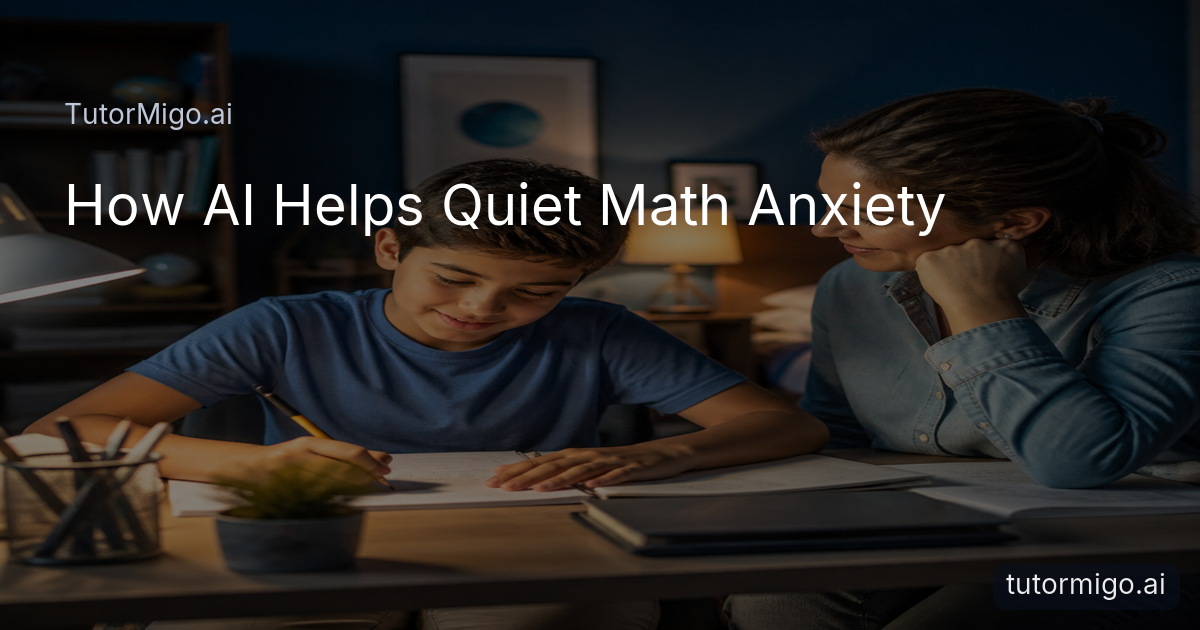
When Math Anxiety Makes Silence Feel Safer

Math anxiety often begins with a small moment: the teacher moves to the next example, but one step did not make sense. You look around, notice that other students seem ready, and decide not to interrupt. Saying nothing feels safer than risking a wrong answer in front of everyone.
That choice can become a pattern. You copy the next step without understanding it, then struggle with homework, quizzes, and the next lesson. A lower grade may look like a lack of effort, but underneath it may be uncertainty, embarrassment, or the belief that everyone else is naturally better at math.
The first TutorMigo benefits are emotional as well as academic: you get a private place to ask the question you were afraid to ask in class, try an answer, and make a mistake without an audience. You can write, “I do not understand this at all,” or ask for the same explanation again. There is no eye-rolling, rushed classroom transition, or pressure to pretend.
Being confused is not proof that you cannot learn math. It is information about where the next explanation should begin.
A Patient Explanation Can Change the Whole Lesson

When a concept feels impossible, the problem is not always the concept itself. Sometimes the explanation simply did not match the way you were ready to learn it. An AI Tutor can revisit the same idea in several forms: a plain-language explanation, a worked example, a visual description, a short practice question, or a comparison with something familiar.
Imagine you are learning how to solve a two-step equation. The first explanation may show the order of operations. The second may frame each operation as undoing an action. The third may use a balance-scale example. You can stop after each step and ask, “Why did we subtract here?” or “Can you use smaller numbers?” That back-and-forth makes confusion visible instead of allowing it to pile up.
Infinite patience matters because confidence grows through successful attempts. You can ask the same question five different ways and take a break before returning. A general-purpose chatbot may answer a prompt, but TutorMigo’s personalized workspace is designed around tutoring conversations, session history, and returning to the learning thread rather than starting from zero each time.
Takeaway: the best explanation is not the most advanced one. It is the one that helps you take the next step independently.
From One Big Problem to Manageable Steps
Large math problems can trigger an instant “I cannot do this” reaction. Breaking the task into small actions gives your brain something specific to do. Instead of staring at a full page of algebra, begin by identifying what the question is asking, listing the information you know, and choosing one operation to try.
TutorMigo’s interactive study tools can support this slower process. You might use a math step editor to work through a problem one line at a time, or use a whiteboard to organize a diagram and label important information. The goal is not to make the work disappear. It is to make your thinking visible, so you can see exactly where your understanding changes.
Try this routine when you feel stuck:
- Name the task: What must you find or explain?
- Circle the known information: Which details are useful?
- Choose one next move: What operation, diagram, or definition might help?
- Check the step: Does the result make sense before continuing?
If you make an error, treat it as a location marker. The mistake tells you where to review, not what kind of learner you are. This is one reason interactive work can feel less intimidating than a blank page.
A Confidence Rebuild in One Student’s Story
Consider Maya, a ninth-grade student who had started failing algebra. She understood examples when watching the teacher, but froze during independent work. At home, she erased answers repeatedly because she was afraid of practicing the wrong method. Her parents first saw missing assignments and assumed she needed to work harder; Maya was actually avoiding the subject because every problem felt like a public test.
Maya began using a private tutoring session to ask very specific questions: “Why do I move this number?” and “Can you show me a version with easier numbers first?” She used the math step editor to complete one line at a time and saved the explanation that finally made sense. After each session, she created a few flashcards for vocabulary such as coefficient, variable, and inverse operation.
Progress was gradual. Her first goal was not an A; it was completing three problems without quitting. Then she checked her work and explained one step aloud. After several weeks of short, consistent practice, Maya was still making mistakes, but she could locate them and ask for help earlier. Her grades began to rise because her behavior had changed: she was practicing instead of hiding.
Confidence did not arrive before the work. It grew because the work became safe enough to begin.
Turn Small Wins Into Lasting Progress
One encouraging session can help, but lasting confidence comes from returning to important ideas before they disappear. Spaced-repetition flashcards make that review more manageable. After learning a difficult topic, you can create cards for definitions, steps, common errors, or a short example. Reviewing a few cards on several days is often less overwhelming than trying to relearn an entire unit the night before a test.
Use flashcards to strengthen memory, not to replace understanding. A useful card might ask, “What does the slope represent in this context?” Another might show a short problem and ask you to identify the first step. If you miss a card, that is useful feedback. Return to the tutoring workspace, ask for another explanation, and then review the idea again later.
For students preparing for a structured exam, TutorMigo’s exam preparation area combines practice sets with progress tracking for supported tests such as the SAT, ACT, AP, and IELTS. Keep the emotional goal in view: progress tracking should show you what to practice next, not become another reason to judge yourself.
Try this: set a ten-minute review habit. End by writing one sentence about what you understand better now.Let Supportive Adults See Progress, Not Just Grades
Students need privacy to ask honest questions, and parents and teachers need enough visibility to offer useful support. Those needs can work together. A parent who notices a sudden drop in grades can look for patterns in progress and learning activity, then begin with curiosity: “Which part feels hardest?” is more helpful than “Why did you not study?”
TutorMigo’s Parent Dashboard gives families visibility into a child’s progress, learning controls, and co-learning options. That can help a parent sit beside a student for ten minutes, review a challenging topic, and celebrate a completed practice goal without taking over the work.
Teachers can also use the Teacher Dashboard for class management, student monitoring, assignments, and reporting. If a student repeatedly struggles with the same prerequisite, that information can support a more focused conversation or a small-group review. Visibility should never become surveillance or embarrassment. The purpose is to notice changes early and connect the learner with the right next step.
If you are a student, tell a trusted adult what kind of help feels useful: quiet review, encouragement, a worked example, or help planning practice. If you are a parent or teacher, praise specific behaviors such as asking a question, checking a step, or returning to a missed concept. Those behaviors are the foundation of independent learning.
A Safer Next Step Starts With One Question
You do not need to wait until you feel confident to ask for help. Start with the smallest honest question you can name: “What does this word mean?” “Which information matters?” or “Can you explain the first step without giving me the answer?” Clear questions give an AI tutor something useful to respond to and help you stay involved in the reasoning.
Before a session, gather one problem that confused you and write where you got stuck. During the session, ask for a slower explanation, a simpler example, or a chance to try the next step yourself. Afterward, save one key idea and schedule a short review with flashcards. This creates a repeatable cycle: ask, practice, notice the mistake, review, and try again.
For parents and teachers, make the invitation specific. Offer to help a student choose one question rather than demanding that they “fix math.” A calm ten-minute start can be more productive than an anxious hour of forced practice.
Your confidence does not have to be permanent before you begin. Build it through small, private attempts with TutorMigo.ai, then carry those wins back into class, homework, and future challenges.
For more practical support, explore this guide to rebuilding student confidence around math anxiety or read about making homework time feel less overwhelming for families.
Pros and cons
Pros
- Private, judgment-free practice for questions you may hesitate to ask aloud
- Explanations can be revisited and broken into smaller steps
- Interactive tools and flashcards support both understanding and review
- Parents and teachers can use progress visibility to provide targeted support
Cons and limitations
- An AI tutor works best when you remain actively involved in solving and checking the work
- Students may still need a teacher or trusted adult for classroom context and emotional support
Frequently asked questions
Yes. You can use the personalized tutor workspace to ask questions privately, request simpler explanations, and revisit a concept without worrying about classmates’ reactions.
You can ask for different approaches, such as a plain-language explanation, a worked example, a visual description, or smaller practice steps. You can also ask the question again when the first explanation does not help.
No. It can provide additional practice, explanations, and review between lessons. Teachers and parents remain important sources of context, encouragement, and guidance.
Look beyond grades. Notice whether the student starts work sooner, asks more specific questions, checks steps, reviews missed concepts, and keeps trying after an error. The Parent Dashboard can add visibility into progress and learning activity.
Related reading
Enjoyed this read?
Like, share, or comment below.



Comments
0Sign in required · respectful discussion · replies supported
Loading comments…