


TutorMigo.ai Benefits by Question Type
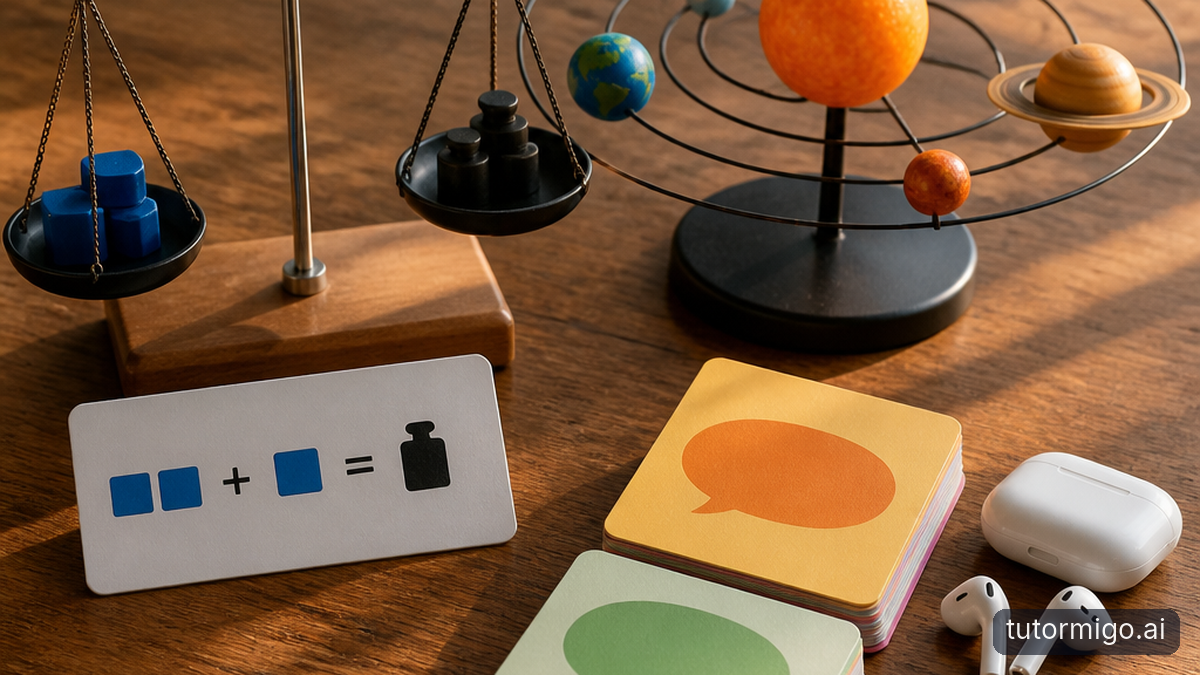
You do not need a tour of every feature to decide whether a learning tool interests you. A better starting point is a small uncertainty you can put into words. Perhaps you can solve an equation but cannot explain why the method works. Perhaps you recognise planet names but struggle to picture their arrangement. Or perhaps you have read a Spanish greeting but hesitate to say it aloud. Each question points toward a different demo.
Choose the algebra balance model if you want to understand a relationship through a visual analogy. Choose the solar-system demo if you want to build a clearer spatial picture. Choose Arabic or Spanish voice practice if your curiosity is about speech and pronunciation. There is no required order: the most useful starting point is the one that connects with something you actually want to understand.
When comparing an AI Tutor with a general-purpose chatbot, bring the same question to both rather than assuming one will suit you better. Consider how clearly each helps you examine the idea and form a follow-up question. The TutorMigo benefits worth looking for are practical: does the learning format fit your question, and can you explain something more clearly afterward? Treat your first visit as a small exploration, not a verdict on an entire platform.
Try the algebra balance model to understand equality
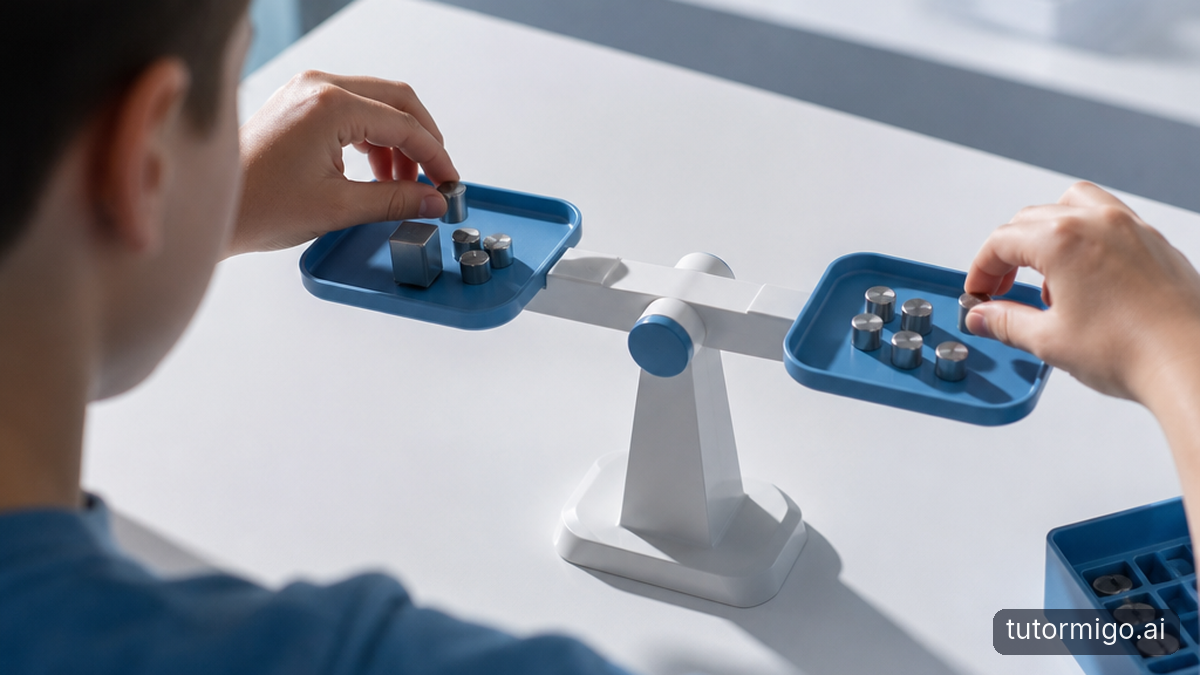
The algebra balance model is a good match if your question starts with “Why do I have to do the same thing to both sides?” A balance gives you a concrete way to think about equality: the two sides represent equal amounts. Your goal is not simply to remember a rule. It is to connect each algebraic step with the idea of preserving that equality.
Take the equation . Imagine that the unknown amount and three matching units balance seven units. Removing three units from each side leaves the unknown amount equal to four units, written as . The important question is why removing the same amount preserves the relationship. Removing something from only one side would change what the two sides represent relative to each other.
As you explore the model, use a question such as, “Why does subtracting the same amount from both sides keep an equation balanced?” Then test your explanation with another example, such as . Can you describe the reasoning without relying on “move it across and change the sign”? That distinction helps you judge whether the visual example is clarifying the concept rather than merely accompanying a calculation.
Keep the model’s limits in mind, too. A physical-balance analogy is a starting point, not a complete explanation of every algebra topic. For this first visit, understanding one equality-preserving step is a worthwhile focus.
Try the 3D solar-system demo to picture the arrangement
Choose the 3D solar-system demo if you know individual planet names but want a clearer picture of how they fit together. A useful first question is, “How are the planets arranged around the Sun?” That gives your exploration a purpose beyond identifying familiar objects. You are looking for relationships: which planets are nearer the Sun, which are farther away, and what order connects them.
Begin with a prediction before studying the representation. For example, do you expect Mars to be closer to the Sun than Earth? After exploring, describe the arrangement in your own words. You might explain that Earth lies between Venus and Mars in the order outward from the Sun. This turns looking at a model into a check of your understanding, rather than a test of whether the scene looks impressive.
Be careful about what you infer from any solar-system illustration. Unless a representation explicitly says otherwise, do not assume that planet sizes and the gaps between them share an accurate scale. Likewise, a displayed arrangement should not automatically be treated as the planets’ positions at this moment. “What does this model show, and what might it simplify?” is an excellent follow-up question.
If you are exploring together, let each person offer one observation and one uncertainty. Our guide to a family solar-system science night offers a related way to keep that shared curiosity going.
Try Arabic or Spanish voice practice to explore a phrase
The Arabic or Spanish voice-practice demos are a natural choice when your question is about saying something rather than recognising it on a page. Keep the first attempt small: choose a greeting or another short phrase you genuinely want to use. Your starting question could be, “How do I pronounce this phrase?” A narrow target makes it easier to notice which part feels unfamiliar.
For Spanish, consider the greeting hola. Its written form can tempt an English speaker to pronounce the initial letter, but the Spanish h is silent. A useful question is, “How should I say hola, and which part might an English speaker misread?” That is more specific than asking to improve your Spanish generally. It gives your exploration a clear sound-related focus.
For Arabic, you might start with the greeting مرحبًا, often transliterated as marhaban. Ask how to pronounce the greeting rather than treating its English-letter spelling as a complete pronunciation guide. If you have a particular situation in mind, name it in your question. You can also ask whether the pronunciation or phrasing you are exploring belongs to Modern Standard Arabic or a particular dialect, rather than assuming all spoken Arabic is identical.
You do not need to judge your overall speaking ability from one phrase. Instead, identify one uncertainty you want to resolve. For more ideas about choosing manageable speaking goals, see our guide to practising a language without a speaking partner.
Choose one demo and prepare your first question
Before you begin, finish this sentence: “I want to understand…” If your answer concerns keeping two sides equal, choose the algebra balance model. If it concerns the arrangement of planets, choose the solar-system demo. If it concerns how a phrase sounds, choose Arabic or Spanish voice practice. You can explore the others later; you do not need to sample everything to make a useful start.
Prepare one main question and one possible follow-up. For algebra, pair “Why must both sides stay equal?” with “What would change if I subtracted from only one side?” For the solar system, pair “What is the planet order?” with “Does this representation show distances to scale?” For language practice, pair “How do I pronounce this greeting?” with “Which sound should I pay attention to?”
If you also explore the AI Tutor Workspace, its personalized tutoring chat and session history offer a place for continued questions. Do not assume that a separate demo automatically becomes part of that history. Carry over your question and a short description of what remains unclear so the next conversation has useful context.
Afterward, write one sentence about what you understand and one about what you still wonder. Those notes give you a grounded way to assess TutorMigo benefits without expecting a single visit to settle every learning need. Your next step is simple: choose the demo that interests you most, and arrive with one question ready.
Frequently asked questions
Choose algebra for questions about equality, the solar-system demo for planetary arrangement, or Arabic or Spanish voice practice for pronunciation. Start with whichever matches a question you already have.
Use the same focused question with each tool. Consider whether the explanation or representation helps you understand the idea and identify a useful follow-up.
No. Unless scale is explicitly stated, do not assume that displayed planet sizes and distances are proportional.
The workspace has session history, but automatic transfer from these demos is not established here. Bring a short summary of your question into the tutoring chat.
Related reading
Enjoyed this read?
Like, share, or comment below.



Comments
0Sign in required · respectful discussion · replies supported
Loading comments…