


Set a learning goal and gather material for your flashcards study routine
Turn a small breakthrough into knowledge you can retrieve without help. Start with a learning goal and material to practise, then use TutorMigo.ai to investigate one difficulty, build focused flashcards, and review after a delay. Repeat the routine to make confidence depend on demonstrated understanding rather than familiar-looking answers.
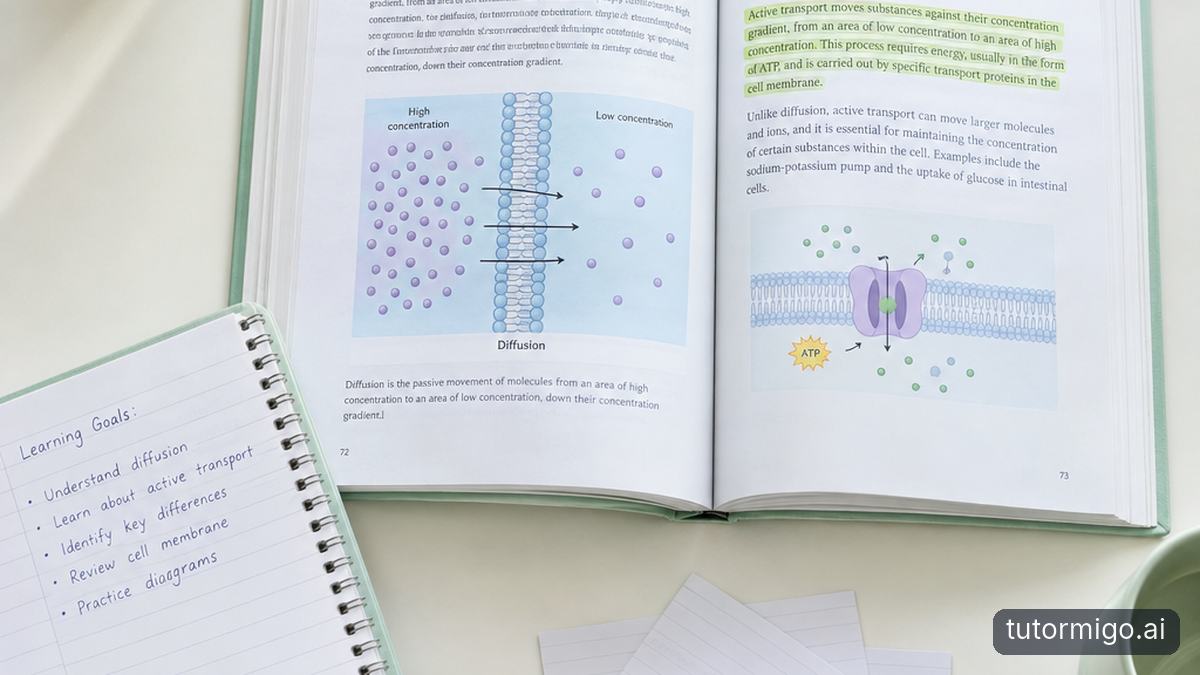
Define the goal as something observable. Replace “understand cell biology” with “explain how diffusion differs from active transport without checking my notes.” Gather the relevant textbook passage, lesson notes, or marked practice question. Keep the source available so you can check explanations and card answers against the material you actually need to learn.
Choose a scope small enough to revisit. One confusing distinction or recurring error gives you a clearer starting point than an entire chapter. Record what you currently believe, even if uncertain; that initial explanation becomes a useful comparison later.
Prepare a simple record with the target, the sticking point, and evidence of independent recall. A teacher can model this with one shared example before students try it alone. Keep the routine consistent across topics: investigate, retrieve, space, and check again.
Compare TutorMigo benefits with general-purpose chatbots for tutoring and retention

Evaluate TutorMigo benefits by the learning actions they support, not by how quickly an answer appears. The AI Tutor Workspace combines personalized tutoring chat with session history. Flashcards provide spaced-repetition decks, AI-assisted card creation, and review scheduling. Interactive tools give you ways to work through a difficulty rather than only discuss it.
A general-purpose chatbot may also explain concepts, ask questions, or help draft cards. Its usefulness depends on the product and how you direct it. The practical distinction here is having tutoring, dedicated flashcard review, and interactive practice available within TutorMigo.ai; do not assume that availability alone produces understanding.
Use the AI Tutor to request a hint matched to your attempted explanation. Then close the explanation and test yourself. Session history lets you revisit the earlier exchange, identify the misconception, and select what deserves reinforcement. It is a reference for reflection, not proof that you remember.
For example, a fluent explanation of diffusion can feel convincing immediately. A delayed question asking you to predict movement in an unfamiliar situation supplies stronger evidence. Judge the workflow by whether it helps you answer that question independently.
Step 1: Identify a sticking point and set a practice or exam-preparation target
Begin with a short attempt before seeking help. Explain a concept aloud, answer a practice question, or reproduce a process from memory. Stop where your reasoning becomes vague. Name the obstacle precisely: an unfamiliar term, a confused distinction, a missing step, or difficulty applying a rule to a new example.
Separate the error from its cause. Getting a transport question wrong might reflect confusion about energy use rather than failure to remember the vocabulary. Write a diagnostic sentence such as, “I recognize both terms, but I cannot explain when energy is required.” This gives tutoring a useful starting point and prevents an oversized deck.
Set a success condition before continuing. Aim to explain the distinction and justify an unfamiliar example without notes. If preparing for an exam, use the relevant practice material and learning objectives to structure preparation around that weakness. Keep the target tied to the reasoning required, not merely the answer to one question.
Save your original attempt for comparison. A brief, imperfect explanation makes later improvement visible and keeps confidence grounded in a specific change you can demonstrate.
Step 2: Work through the difficulty with personalized tutoring and interactive tools
Bring your attempted explanation and sticking point into the tutoring conversation. Ask the AI Tutor to give one hint, ask a diagnostic question, and let you respond before revealing a complete explanation. State what you already understand so the exchange can focus on the missing connection rather than restarting the whole topic.
Choose an interactive tool only when it clarifies the obstacle. Use the whiteboard to sketch movement across a membrane and explain each arrow. For a mathematical difficulty, use the math step editor to examine your reasoning. For a programming difficulty, use the code sandbox to test a prediction. You do not need every tool in every session.
After receiving help, restate the idea in your own words without copying. Then change one condition in the example and predict what happens. This transfer check distinguishes a genuine breakthrough from recognition of the tutor’s explanation. Verify important details against your source material, particularly when terminology or marking expectations matter.
End by naming the correction: “I was treating all movement across membranes as energy-dependent.” That statement identifies the misconception your flashcards should challenge later.
Step 3: Build focused flashcard decks and reinforce breakthroughs with spaced repetition
Build a small deck around the correction, not the entire tutoring transcript. Use AI-assisted card creation as a starting point, then inspect every prompt and answer. Check accuracy against your material, remove unnecessary wording, and ensure each card asks for one clear retrieval task. Split cards that demand several unrelated facts.
Mix direct recall with explanation and application. Ask, “What distinguishes active transport from diffusion?” Then add a separate scenario requiring you to identify the process and justify your choice. Keep each answer concise enough to evaluate, but include the reason when reasoning is the learning goal.
During review, produce an answer before revealing it. Say it aloud, write it, or sketch it; silent familiarity is easy to mistake for recall. Judge your response honestly against the answer. If you remembered the label but not the explanation, treat that gap as unfinished learning.
Follow the spaced-repetition review schedule instead of repeatedly rehearsing the deck immediately. Use a practical spaced-repetition schedule to plan a sustainable review habit. Revisit your source and repair a card when repeated failure exposes ambiguity or a missing prerequisite.
Step 4: Review session history and recall progress, using parent and teacher visibility where appropriate
Review progress by comparing your first attempt with a fresh answer after a delay. Reopen session history to locate the original misconception, then set it aside while answering. Look for a clearer explanation, fewer hints, and successful application to a changed example. Time spent chatting or cards completed does not establish those outcomes.
Keep a brief manual record of what you recalled independently, what needed prompting, and what still failed. If structured exam preparation is relevant, revisit a suitable practice question from your material and check whether the corrected reasoning transfers. Do not infer broad readiness from one successful response or one completed deck.
Make parent and teacher visibility purposeful through a shared review of selected session history, card prompts, and independent attempts. Show the starting difficulty and ask the learner to explain the correction. This provides a practical view of learning without assuming automatic dashboard access or reporting beyond the features described here.
A teacher can use that conversation to choose a follow-up question; a parent can help protect review time. Keep support focused on evidence and encouragement rather than taking over answers.
Avoid quick-answer dependence, weak flashcards, and missed reviews to sustain the routine independently
Interrupt quick-answer dependence by attempting the task before opening tutoring and trying again after closing the explanation. If you can follow a solution but cannot reconstruct its reasoning, return to a smaller question. Request a hint instead of another complete answer. Understanding requires something you can produce, not only something you recognize.
Repair weak flashcards rather than repeatedly failing them unchanged. Replace vague prompts such as “Explain transport” with a specific distinction or scenario. Remove clues that reveal the answer, check doubtful claims against your source, and split overloaded cards. If a card remains difficult, investigate whether the underlying concept needs another worked example.
Respond to missed reviews with a manageable restart, not a punishing catch-up session. Prioritize scheduled review before adding more cards, and reduce new material when the workload grows. Attach review to an existing habit so returning does not depend on remembering a separate intention every day.
Finish each cycle by choosing the next action: continue spaced review, revise a card, or revisit a misconception. Repeat independently with another narrow target. Let confidence grow from increasingly reliable recall across time and examples.
- Identify one sticking point
Attempt a question unaided. Name the obstacle and set a specific practice or exam-preparation target.
- Work through the difficulty
Request targeted tutoring hints. Use an appropriate interactive tool, then explain a changed example independently.
- Reinforce the breakthrough
Build focused flashcards, verify their answers, and retrieve before revealing during scheduled spaced-repetition reviews.
- Review progress and repeat
Compare delayed recall with session history. Share evidence where appropriate, revisit relevant exam practice, and choose the next target.
Frequently asked questions
Create only enough to test the current sticking point clearly. Add cards when they address a distinct retrieval need.
Return to tutoring, compare the situations, and add an application prompt that tests the missing reasoning.
Compare delayed, unaided answers with your first attempt. Look for accurate explanations, fewer hints, and transfer to unfamiliar examples.
Related reading
Enjoyed this read?
Like, share, or comment below.
Comments
0Sign in required · respectful discussion · replies supported
Loading comments…