
Can an AI tutor help students remember what they learn?

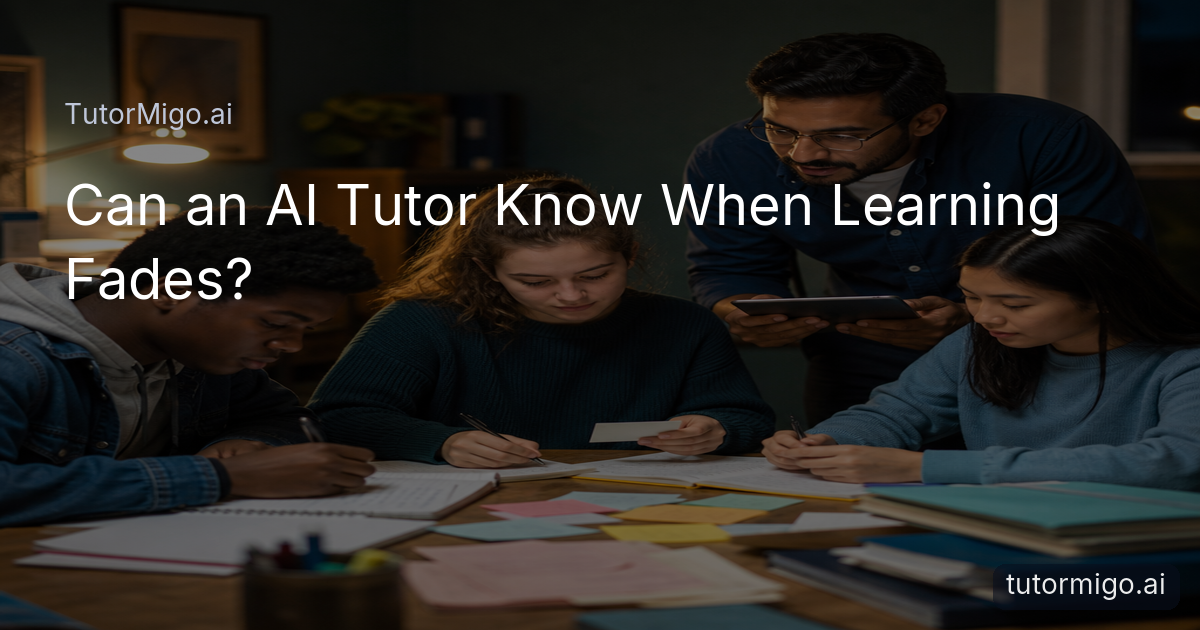
An AI tutor can help students remember material by combining quizzes, practice, and revision based on prior performance, but it cannot magically predict the exact time each learner will forget something. Its value lies in identifying gaps, prompting retrieval, and keeping revision active rather than relying only on rereading.
The question matters as AI tutoring moves beyond one-off answers. A general-purpose chatbot may explain a difficult concept in seconds, but a tutoring system with session history and study records can potentially connect today’s mistake with an earlier lesson. That continuity gives students, parents, and teachers a clearer view of whether a problem is new or recurring.
Forgetting is a normal part of learning, not evidence that a student has failed. Research summarized by the American Psychological Association points to the importance of retrieval and practice in strengthening memory. An AI tutor may make those activities easier to schedule, although the quality of the prompts and the student’s engagement still matter.
TutorMigo.ai illustrates this direction through an AI Tutor Workspace with session history, alongside spaced-repetition flashcards and interactive study tools. Those features do not establish a perfect memory forecast. They create a record from which revision can be made more responsive.
What is an AI tutor, and how is it different from a chatbot?

An AI tutor is a learning system designed to provide explanations, guided practice, and continuity around a student’s learning goals. Unlike a general-purpose chatbot, it is typically organized around tutoring sessions, study history, feedback, and structured progress rather than isolated conversation.
The difference is practical. A student working through algebra might ask a chatbot to solve an equation and receive a correct response, but a tutoring workspace could instead preserve the session, ask a follow-up question, and revisit the same skill later. That does not guarantee better learning, but it can support a more coherent sequence of instruction.
Personalization also has limits. An AI tutor may adjust explanations after a wrong answer or offer another practice question, yet it can misread a rushed response, accept an uncertain answer, or provide an explanation that needs teacher review. Students should therefore treat its feedback as support for learning, not as an infallible assessment.
TutorMigo.ai’s workspace is one example of a platform built around personalized AI tutoring, with expert personas and session history. Its distinction from a standalone chat window is the surrounding learning context: practice, revision, and records can be connected rather than left in separate conversations.
That distinction is especially relevant when comparing the future of personalized learning with AI tutors. The strongest systems may be those that make continuity visible without pretending to understand every aspect of a learner’s memory.
What is active recall, and why does it matter?
Active recall is a learning method in which students try to retrieve information from memory before looking at the answer. It matters because recalling a concept, definition, process, or method can reveal whether knowledge is usable rather than merely familiar.
A simple example is a biology student closing a textbook and explaining how photosynthesis works. If the explanation stops at one stage, that gap becomes useful information for the next revision session. An AI tutor could turn the gap into a short quiz, ask for a worked explanation, or present a related problem through an interactive study tool.
Practice should remain appropriately difficult. If every question is too easy, the system may generate a reassuring record without meaningful retrieval. If questions are far beyond the student’s current understanding, repeated failure can reduce motivation. Good AI tutoring tools could vary prompts while preserving the central requirement that the learner does some of the thinking.
The Education Endowment Foundation’s guidance on metacognition and self-regulated learning emphasizes planning, monitoring, and evaluating learning. Active recall fits that broader pattern because students can see what they know, what they cannot yet retrieve, and what needs another attempt.
For this reason, quizzes and practice are more than assessment add-ons. They can become signals that help organize personalized study, provided the system presents results cautiously and leaves room for human judgment.
Why are flashcards useful for students?
Flashcards are useful for students because they make retrieval brief, repeatable, and easy to revisit. They work particularly well for facts, vocabulary, formulas, dates, definitions, and short explanations, although they are not a complete substitute for problem solving or extended reasoning.
Spaced repetition adds timing to the method. Instead of reviewing every card at the same interval, a study system may schedule difficult cards sooner and familiar cards later. The schedule is an estimate based on performance, not a direct measurement of memory. A student who recognizes an answer may still struggle to produce it independently in an exam or conversation.
AI-assisted card creation could reduce the time needed to turn notes into a review set, but the cards still require checking. Poorly worded prompts, missing context, and incorrect answers can reinforce confusion. Students may also create too many cards and spend their time reviewing fragments instead of understanding a larger idea.
TutorMigo.ai includes spaced-repetition flashcard decks with assisted card creation and review scheduling. In a broader AI learning platform, flashcards can sit alongside a tutor session, a math step editor, a whiteboard, or a code sandbox. That combination potentially helps students move between recall and application rather than treating memorization as the entire learning process.
The most useful flashcard routine is therefore selective: identify important knowledge, retrieve it without looking, check the answer, and use a different study tool when the task requires explanation or practice.
How can progress tracking support personalized study?
Progress tracking can support personalized study by showing patterns across sessions, practice attempts, and revision tasks. It may help identify a topic that appears understood during conversation but repeatedly causes errors in quizzes or structured exam preparation. The record is useful, but it remains an imperfect representation of learning.
For students preparing for SAT, ACT, AP, or IELTS assessments, structured practice and progress tracking can provide a clearer route than random question selection. A learner might see that reading questions are improving while a particular mathematics skill remains inconsistent. An AI tutor could then recommend another explanation, a short retrieval set, or a worked example rather than simply repeating a full lesson.
Parents and teachers may also need visibility, especially when a student’s activity changes over time. TutorMigo.ai provides a parent dashboard for progress visibility and a teacher dashboard for student monitoring, assignment, and reporting. Such dashboards can support conversations about effort and needs, but they should not be treated as a complete picture of motivation, wellbeing, or understanding.
There is also a practical difference between a tutoring platform and a general-purpose generative chatbot. A chatbot can be useful for brainstorming an explanation, while a platform organized around tutoring may connect explanations with sessions, flashcards, interactive study tools, and exam practice. Neither approach removes the need to verify information or involve teachers when the stakes are high.
The emerging benefit of an AI tutor is therefore not perfect prediction. It is the possibility of making revision more visible, timely, and connected to evidence from a learner’s own work.
Enjoyed this read?
Like, share, or comment below.
Comments
0Sign in required · respectful discussion · replies supported
Loading comments…