

Maya’s exam preparation: rereading the same page
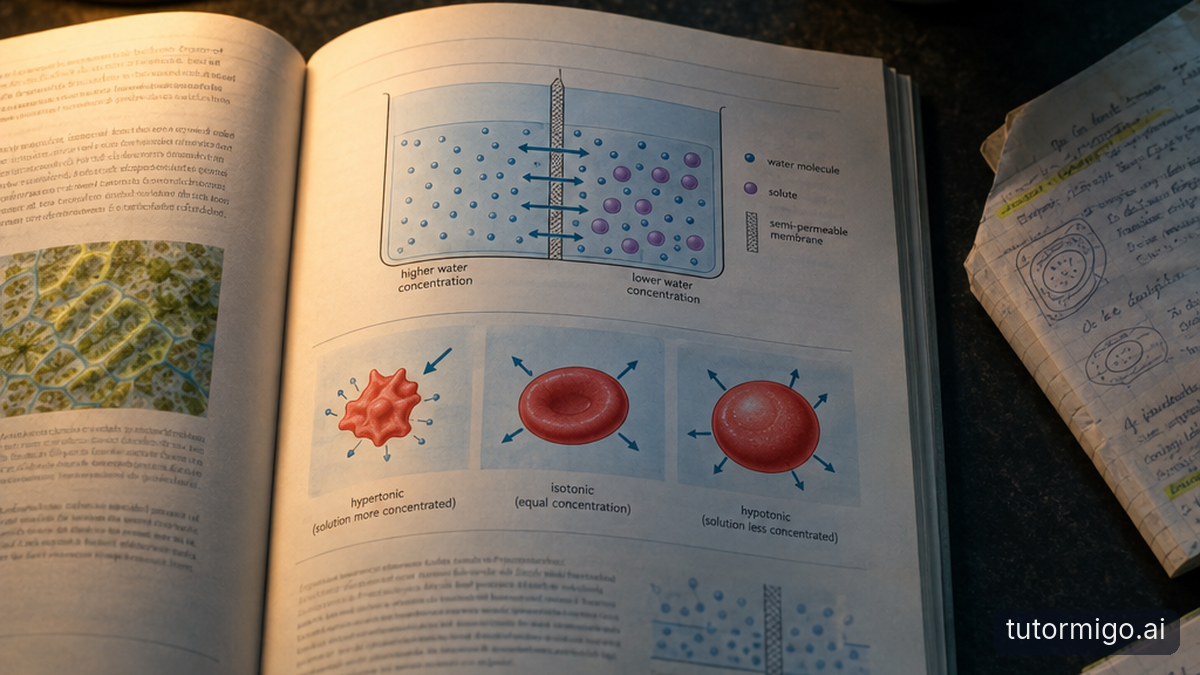
On the night before the exam, Maya had been looking at the same diagram long enough for the desk lamp to feel hot against her wrist. She knew the page by sight. She could not explain it with the book closed, and that was what frightened her.
Her science notes covered most of the kitchen table. There were highlighted definitions, a revision sheet folded into quarters, and a mug with a cold skin of tea. Every time she reached the bottom of the page, she returned to the top, hoping the next pass would make it stick.
Earlier, she had promised herself she would review every topic. Now the evening was shrinking, and that promise had become a threat. Anything she chose to study meant leaving something else alone. Even getting a glass of water felt like spending time she could not spare.
She checked the clock, then turned her phone facedown beneath a notebook. The room was quiet except for the refrigerator. On the page, arrows showed water moving across a membrane. Maya traced one with her finger. She recognized the picture from class, remembered copying it carefully, and realized she was using that memory as evidence that she understood it. She pulled a practice sheet from the bottom of the pile.
A Practice Question Revealed What She Didn’t Understand
The question described potato strips left in a concentrated sugar solution. Maya had to predict what would happen to their mass and explain why. She wrote that the strips would lose mass, then stopped. Her explanation was a circle: they would lose water because water would leave them.
She nearly reached for the answer key. Instead, she underlined the part asking her to explain. She could remember the outcome from a classroom experiment, but remembering an outcome was not the same as understanding the movement behind it. The gap was smaller than “I know nothing,” though it felt uncomfortable to see it so clearly.
With her textbook open beside her, Maya drew a potato cell and the surrounding solution. She checked which side had the higher concentration of dissolved substances, then followed the explanation of net water movement across a partially permeable membrane. This time, the arrows had a reason.
She closed the book and tried again aloud, stumbling over the first sentence. On her second attempt, she explained that water would move out of the cells into the more concentrated surrounding solution, reducing the strips’ mass. It was not polished. It was hers. One question had shown her exactly what to work on next, which was more useful than another pass through the entire chapter.
One Focused Hour Replaced Her Plan to Study Everything
Maya turned over an old worksheet and wrote down three shaky areas: water movement, interpreting experimental results, and explaining a fair test. She chose them because they had caused trouble in recent homework, not because they were the first topics in the book. The rest of the syllabus stayed on the table, but it no longer got to decide the evening.
She gave herself one focused hour, with a short pause in the middle. For each area, she would attempt a question without notes, check it, and write a brief correction explaining what she had missed. She set an end time before she could negotiate herself into another late night.
The work was slower than rereading. On one question, she confused keeping conditions consistent with repeating the experiment. Checking the answer helped her separate their purposes: controlling other factors made a comparison fairer; repeating measurements helped her assess consistency and spot unusual results.
Halfway through, she stood at the sink and drank water. When she returned, she answered the potato question again without looking. Then she tried a different example involving cells in a dilute solution. She still hesitated, but she could reason through the change. That small transfer mattered: she was no longer relying entirely on a remembered picture.
A Conversation Helped Her Put the Exam in Perspective
Her older sister, Leena, came into the kitchen looking for the lunch container she had left behind. She noticed the spread of paper and asked how it was going. Maya almost said “fine.” Instead, she said, “I think I left it too late to feel ready.”
Leena put the container down. She did not tell Maya the exam would be easy or promise a good result. She asked what Maya had managed to do that evening. Saying it aloud sounded different from the running commentary in Maya’s head: she had found a gap, understood it better, and practised explaining it.
“But there’s still loads I haven’t checked,” Maya said. Leena nodded. “What would count as enough to stop tonight?” Until then, Maya had treated stopping as something she would be allowed to do only when the worry disappeared. She could see how that might keep her at the table for hours.
“I don’t think I need to feel ready for everything,” Maya said eventually. “I need to know what to do when I get stuck.” Leena stayed while Maya described her plan: read the question carefully, identify what it was asking, and begin with something she could explain. The conversation did not change the syllabus. It made the next few hours feel less like a verdict.
Closing the Books Meant Leaving Some Questions Unanswered
When her planned hour ended, Maya found another question she could not answer confidently. For a moment, it seemed like proof that stopping would be irresponsible. She read it twice, felt the familiar urge to reopen every chapter, and then wrote a small note beside it: review later.
She checked the explanation once, enough to understand the main point, but did not turn it into a new revision session. There would be material she had not mastered by morning. Staying awake could not guarantee otherwise, and she was already making mistakes she would normally catch. She had copied a question incorrectly and spent several minutes solving the wrong problem.
She packed her pens, checked the exam time and location, and put her bag beside the door. Then she moved the books off the kitchen table. The ordinary actions helped: washing the mug, setting out clothes, plugging in her phone away from the bed. Each removed one small decision from the morning.
In bed, she remembered a definition she had not reviewed. She wanted to get up. Instead, she let the thought remain unfinished. Sleep did not arrive immediately; she turned her pillow over and listened to a car pass outside. But she stayed in bed, allowing rest to be the thing she was doing now.
The Next Morning, She Found a Place to Start
The next morning, Maya still felt nervous. At breakfast, she broke a piece of toast into smaller pieces without noticing. Outside the exam room, someone mentioned a topic she had barely revised. Her stomach tightened, and for a moment she wished she had stayed at the kitchen table longer.
Then she remembered how tired she had been, and how little another anxious pass through the book had been giving her. She did not join the last-minute comparison of notes. She checked that she had her pens and waited for the door to open.
The first page contained a question she could answer. She read the instruction twice and began. Later, an unfamiliar experiment made her pause. Rather than searching for a matching diagram in her memory, she identified what had changed, what had been measured, and which scientific idea might explain the result. She wrote a sentence, reconsidered it, and made it more precise.
She left one part incomplete. She was unsure about another. Walking out, she could not predict her mark, and the story did not resolve into certainty. But she had found ways to begin, even when an answer was not immediately available. The night before the exam had not made her know everything. It had helped her use what she knew—and arrive rested enough to try.
I don’t think I need to feel ready for everything. I need to know what to do when I get stuck.
Enjoyed this read?
Like, share, or comment below.
Comments
0Sign in required · respectful discussion · replies supported
Loading comments…