


Does each AI tutoring explanation answer the question?
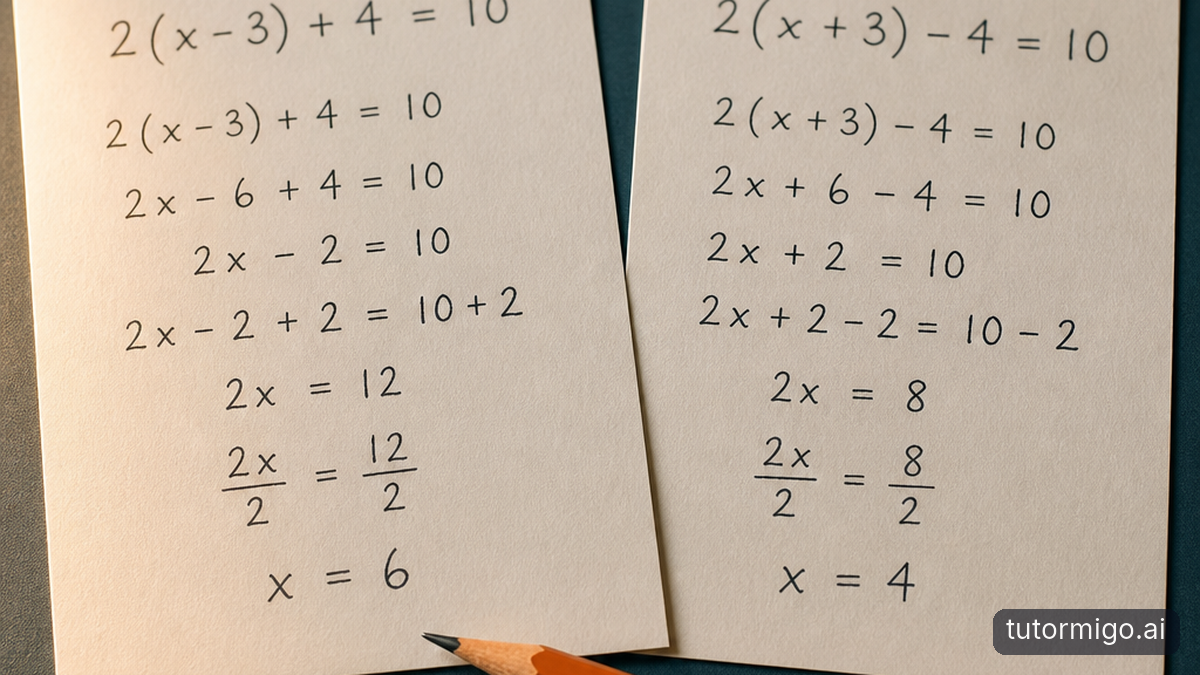
Start by restating the task before reading either answer closely. Suppose the question is to solve . You need a value of that makes the original equation true. An explanation of what parentheses mean might help, but it does not finish the task. Neither does an answer that quietly solves a different equation.
Now consider two responses. Explanation A says: distribute to get , subtract to get , then divide to get . Explanation B says: distribute to get , subtract to get , then divide to get . Both look organized. Both claim to solve the equation. Only one preserves the original relationship.
Before deciding which is right, check that both responses started with the exact question. A copied sign, missing parenthesis, or changed number can send otherwise sensible reasoning in the wrong direction. If you are helping someone else, ask them to read the original equation aloud and point to the matching expression in each response.
This first question checks relevance, not correctness. Both explanations attempt the requested task, so both deserve a closer look. You have not yet earned a reason to trust either final answer.
Does each explanation justify its steps?
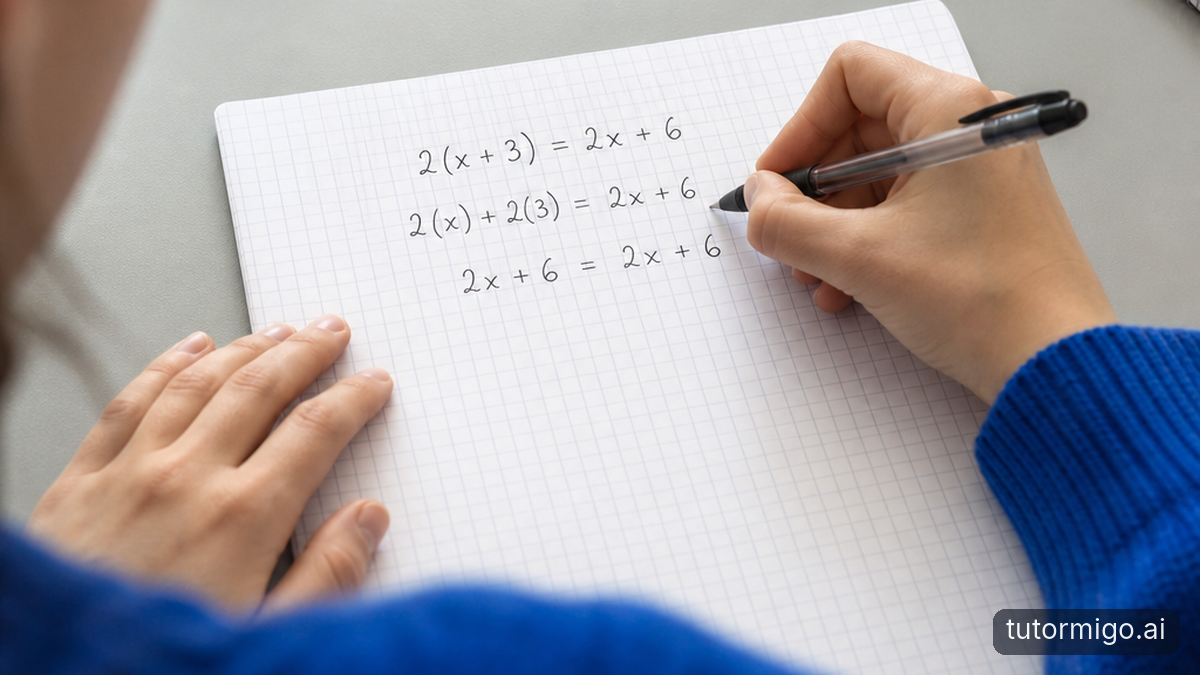
Compare the first place where the explanations differ. Here, it is the distribution step. Explanation A multiplies both terms inside the parentheses by the outside factor: . Explanation B multiplies only the first term and leaves the second unchanged: . That is the plausible error. The layout looks familiar, but the operation is incomplete.
A useful justification names what happens and why it is allowed. The distributive property applies the outside factor to every term inside the parentheses. Subtracting the same quantity from both sides preserves equality. Dividing both sides by the same nonzero quantity also preserves equality. You do not need a long lecture at every line, but you should be able to supply the reason.
Notice that Explanation B’s later steps are consistent with its incorrect intermediate equation. Subtracting and dividing correctly afterward cannot repair the earlier change. This is why checking only the last calculation is not enough: a solution can contain several valid operations and still answer the wrong problem.
Finally, test both proposed answers in the original equation. For Explanation A, , which is true. For Explanation B, , not . Substitution confirms which answer satisfies this equation. It also gives you a specific explanation of the failure, rather than a vague feeling that one response seems less reliable.
Ask your AI Tutor: “Explain the first step where these solutions differ, and name the rule that supports it.” Then check that rule yourself.
Does it agree with trusted class materials?
Next, compare the disputed step with a relevant worked example in your textbook, class notes, or teacher-provided materials. Look for the same mathematical structure, not just similar numbers. A worked example of distributing a factor across a sum is more useful here than an unrelated equation with the same final answer.
Suppose your notes explain distribution as multiplying every term inside the parentheses by the outside factor. That directly supports Explanation A’s first step. If you are unsure how the rule applies, mark the two terms inside the parentheses and show where each product appears. This turns “my notes say so” into a connection you can explain.
Agreement does not require identical wording or an identical route. Another valid explanation could divide both sides first, giving , and then subtract to get . That method differs from Explanation A without contradicting it. Judge whether the transformations preserve equality, not whether the response copies your teacher’s preferred sentence structure.
Trusted materials are an anchor, not a reason to stop thinking. Notes can contain copying errors, and an example may depend on conditions that do not apply to your question. If a disagreement remains, show your teacher or another knowledgeable person the original problem, the disputed line, and the rule you checked. A focused question is easier to resolve than “Which AI is right?”
Use a short checklist, not a confidence contest
You can turn these three questions into a repeatable comparison routine. Read each explanation independently before placing them side by side. Otherwise, the first response may become your default, and you may judge the second only by how closely it resembles the first. Write a brief note about the evidence for each answer instead of rating how persuasive it sounds.
For the algebra example, your note might say: “Explanation A distributes to both terms, and its answer works in the original equation. Explanation B misses one product, and its answer fails substitution.” That is a supported decision. “Explanation A sounds more professional” is not. Neat formatting and confident wording can make an explanation easier to read without making its reasoning valid.
Use the checklist below whenever two responses disagree. If you are a parent or teacher, ask the learner to show one piece of evidence for each check rather than simply announcing the winner. If you are studying independently, write those observations before asking for another response. This keeps the decision grounded in your own inspection of the work. For a broader routine, this checklist for a useful AI study session can help you keep the session focused on understanding.
- Did both explanations use the original question accurately?
- Where is the first meaningful difference?
- What rule supports that step?
- Does a relevant trusted example support the reasoning?
- Can you check the result independently?
What to do next when you are still uncertain
If a step still feels unclear, narrow the question. Instead of requesting another complete solution, ask, “Why does the outside factor multiply both terms?” or “Show how dividing both sides first reaches the same answer.” A different explanation can help, but repetition alone is not confirmation. Two AI responses can repeat the same mistake, so agreement between them is weaker evidence than a valid rule and a successful check.
This is where TutorMigo benefits fit the process: TutorMigo.ai offers personalized tutoring and session history in its AI Tutor Workspace. You can ask follow-up questions about the exact point you do not understand, then revisit the conversation later. Session history provides continuity, so you can return to an earlier explanation and reconsider the reasoning rather than relying on memory.
Those benefits support your checking process; they do not establish that an answer is correct. Do not treat the workspace as a built-in comparison or fact-checking system. Bring the two explanations into your question, request a reason for the disputed step, and verify that reason against the original equation and trusted materials.
Finish by explaining the accepted method in your own words and trying a similar problem without looking back. If you still cannot justify the disputed step, take that specific uncertainty to a teacher or knowledgeable helper. Your goal is not to find the most confident-sounding response. It is to choose an explanation whose reasoning you can support.
| Check | Explanation A | Explanation B |
|---|---|---|
| First transformation | ||
| Distribution rule | Multiplies both terms inside the parentheses. | Multiplies only the first term. |
| Remaining work | , then . | , then . |
| Check in the original equation | : passes. | : fails. |
| Supported conclusion | Valid steps and a verified answer. | Reject: the first transformation changes the equation. |
Frequently asked questions
Check the reasoning anyway. An invalid step can occasionally lead to the correct result. Each transformation still needs a valid justification.
Yes. Distributing first and dividing both sides first both work in this example. Different methods are acceptable when their steps preserve equality.
Find the exact disputed step and check that the example in your notes uses the same rule under the same conditions. Ask your teacher if the disagreement remains.
The features described here are personalized tutoring and session history, not built-in comparison or fact-checking. Use follow-up questions to explore reasoning, then check it independently.
Related reading
Enjoyed this read?
Like, share, or comment below.



Comments
0Sign in required · respectful discussion · replies supported
Loading comments…