


AI literacy: Is this algebra step valid?
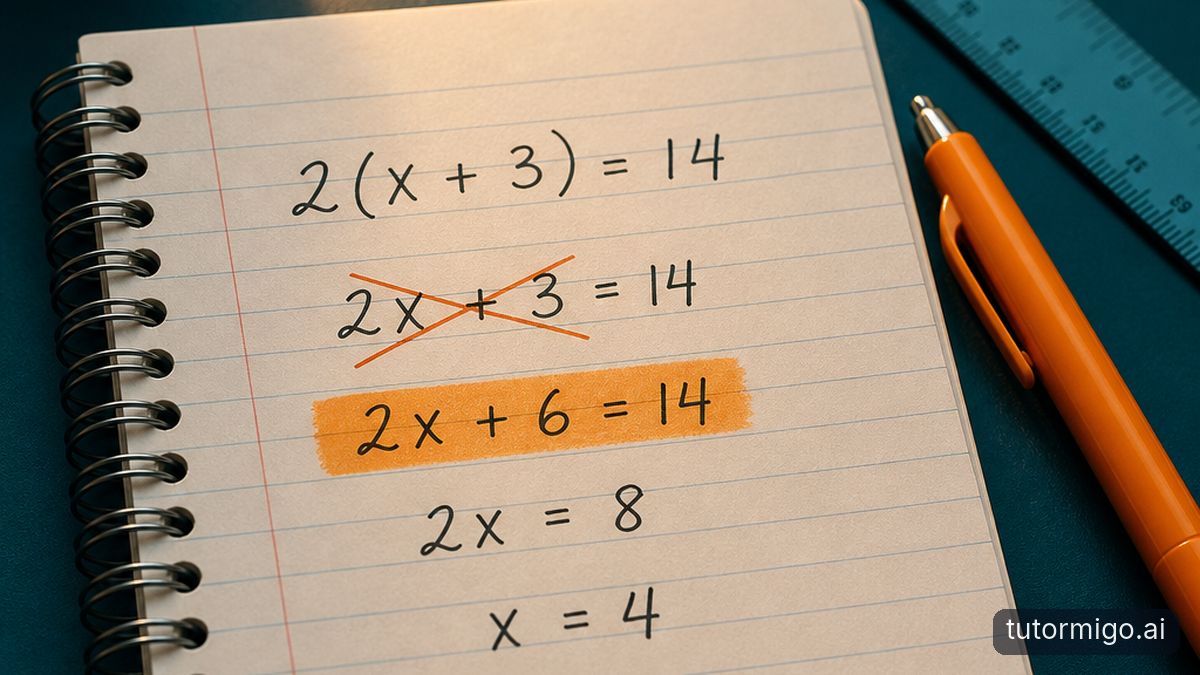
Start with the exact line where something changes. An explanation can reach a plausible answer while using an invalid operation along the way. Instead of asking only whether the final answer looks right, ask: what operation happened here, and was it applied correctly to both sides?
Suppose your problem is . An AI explanation changes it to , saying it has expanded the brackets. That step is wrong: the multiplier must apply to every term inside the brackets. The correct line is . Subtracting from both sides gives , and dividing both sides by gives .
Now test the answer in the original equation, not just the last line of the explanation. Substitution gives , which checks out. This is a useful habit, although one successful substitution does not prove that every earlier step was valid or that every possible solution was found.
Compare the method with your class notes or a worked textbook example. Look especially for dropped negative signs, incomplete distribution, and division by an expression that could equal zero. For example, requires .
Ask: “Explain the rule used between these two lines, including any restrictions.” Then check that rule against your notes. Another confident explanation is not independent confirmation.
If the step still seems unclear, take both lines to your teacher. A specific question about one operation is easier to resolve than “Is this whole answer right?”
Does this solar-system claim match a trusted source?
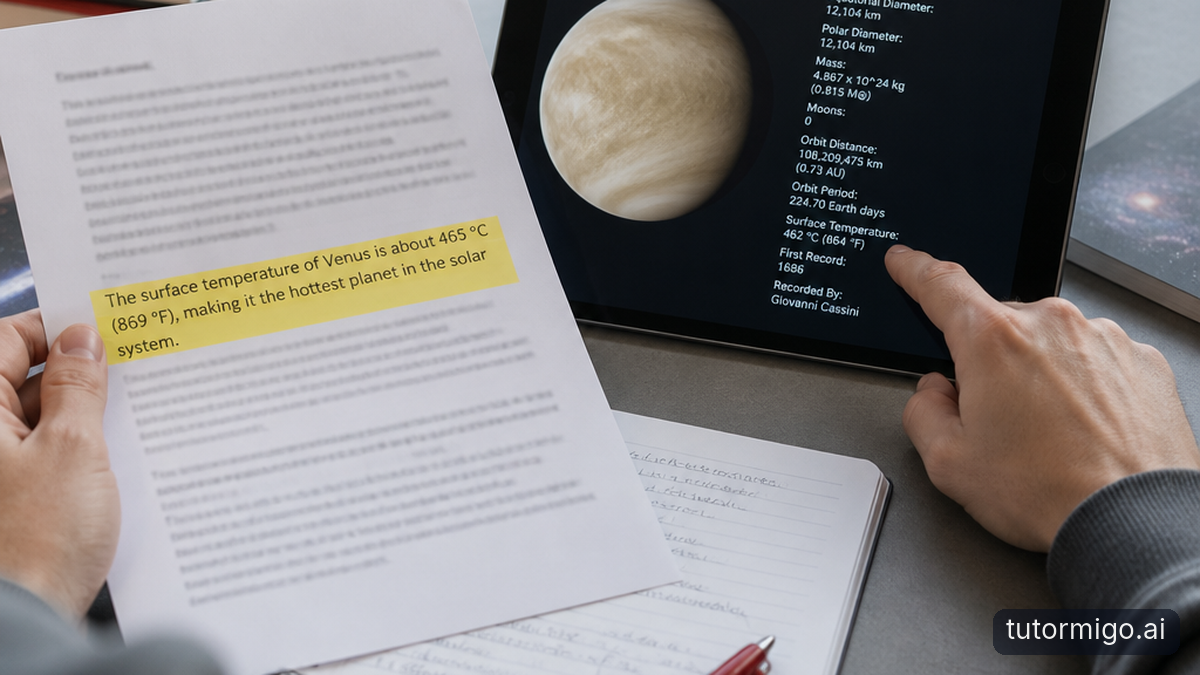
For factual explanations, separate the claim from the surrounding story. Imagine an AI answer says, “Mercury is the hottest planet because it is closest to the Sun.” The sentence sounds sensible because it connects distance with heat. But the claim about the hottest planet is incorrect: Venus has the highest average surface temperature.
Write down the part you need to check: which planet has the highest average surface temperature? Then consult a source suited to that question, such as NASA’s planetary information pages or your astronomy textbook. Look for the actual measurement or explanation rather than accepting a search-result summary.
The distinction matters. “Closest to the Sun,” “highest daytime temperature,” and “highest average surface temperature” are different claims. A reliable reference explains that Venus’s thick atmosphere produces an intense greenhouse effect. That evidence addresses why distance alone does not settle the question.
Check whether the source describes the same thing the AI described. A page about a planet’s cloud-top temperature does not directly establish its surface temperature. Likewise, an Earth-based photograph of apparent brightness would not establish which planet is physically largest. Matching the terms is part of checking the fact.
If two sources appear to disagree, compare their definitions, publication dates, and scope before choosing one. Do not resolve the conflict by counting how many AI responses repeat each version. Bring the conflicting passages to a teacher when you cannot explain the difference. The useful outcome is not just a corrected fact; it is understanding what evidence actually supports it.
Does this translation preserve meaning and context?
A translation can be grammatically smooth and still change what someone meant. Check more than individual words: who is speaking, who is listening, how formal the situation is, and whether the original sounds certain, tentative, friendly, or annoyed.
Consider the Spanish sentence “Ahora no puedo; te llamo luego.” A natural English rendering is “I can’t right now; I’ll call you later.” If an AI translates it as “I refuse; I’ll call you tomorrow,” it has introduced two changes. Temporary inability has become refusal, and an unspecified later time has become a particular day. Neither addition is justified by the sentence alone.
Compare the translation with your class notes, a reputable bilingual dictionary, or a grammar reference. Check phrases as well as isolated words. A dictionary entry may show several meanings, so choose the one that fits the surrounding conversation rather than the first option listed.
You can ask an AI Tutor to explain its word choices and identify phrases with more than one plausible interpretation. Treat that explanation as a suggestion to investigate, not proof that the translation is correct. Translating the answer back into the original language can reveal a mismatch, but it is not independent verification: similar assumptions can survive both directions.
When tone matters, include the context in your question: “This is a message to a teacher, not a close friend. Does the translation preserve that level of politeness?” If uncertainty remains, ask your language teacher or a qualified speaker familiar with the setting. Avoid sharing private messages or personal details unnecessarily when seeking help.
Compare learning tools by the checking habits they support
When comparing AI learning tools, look beyond how polished the answers sound. Ask whether the setup helps you keep your question, revisit the explanation, and work through the disputed step yourself. Those are practical learning considerations, not evidence that any generated answer is accurate.
If you are weighing TutorMigo benefits against those of other learning tools, focus on the features you will actually use. TutorMigo.ai offers personalized tutoring chat with session history in its AI Tutor Workspace. You can return to an earlier exchange to see what you asked and where your uncertainty began. That continuity can make a follow-up question more specific; it does not verify the earlier answer.
The Study Tools Hub includes a whiteboard and math step editor. These offer places to work through an algebra example rather than only rereading a paragraph about it. Keep your class notes or textbook alongside that work, and compare each operation with the method you have been taught.
Spaced-repetition flashcards can support later review once you have checked the content. For example, you might review why distributing across brackets affects every term, or what “luego” means in a particular sentence. Check an AI-assisted card before adding it to your routine so that repetition does not reinforce an error.
The comparison below distinguishes useful study features from verification. General-purpose chatbots vary by product and configuration, so assess the tool you actually use rather than assuming every chatbot has the same strengths or limits. Parents and teachers can reinforce the same standard: ask learners what they checked and which source they used, not merely whether they obtained an answer.
| Study task | TutorMigo.ai feature | General-purpose chatbot consideration | Your checking responsibility |
|---|---|---|---|
| Revisit an explanation | AI Tutor Workspace includes session history. | Check how the specific tool retains and retrieves conversations. | Identify the exact disputed claim or step. |
| Work through algebra | Study Tools Hub includes a whiteboard and math step editor. | Available working tools vary by product. | Check operations against notes and test the result. |
| Review a checked concept | Flashcards offer spaced repetition and review scheduling. | Check whether the tool includes dedicated review scheduling. | Verify card content before repeated practice. |
| Get a tailored explanation | AI Tutor Workspace provides personalized tutoring chat. | Many chatbots can adapt explanations when given context. | Judge the reasoning and evidence, not the fluent wording. |
Your next explanation: a pause-and-check checklist
Try this routine with the next AI explanation you receive, before copying it into your notes or using it in an assignment. You do not need to investigate every sentence equally. Start with the step or claim that your understanding depends on: the algebra operation, the planetary comparison, or the phrase carrying the speaker’s intention.
Make your check visible. Beside the explanation, write what you tested and what you used: “substituted into the original equation,” “compared surface temperatures in a NASA reference,” or “checked the phrase against my language notes.” This small record helps distinguish evidence from a feeling that an answer sounds right.
If something remains unresolved, keep the original question, the disputed passage, and your attempted check together. Bring those to a teacher rather than asking for a general verdict on AI. Parents supporting a learner can use the same approach; these suggestions for handling a child’s question you cannot answer offer a way to keep learning together without pretending to know.
Use this checklist as your final pause. If you cannot complete a check, mark the explanation as uncertain instead of quietly treating it as settled.
- Pinpoint: What exact step, fact, or phrase needs checking?
- Compare: What do your notes or a reliable reference say?
- Test: Can you substitute, inspect the evidence, or compare meaning in context?
- Ask: What specific question should you take to a teacher?
- Keep: Save the corrected explanation and its supporting reference for review.
Frequently asked questions
No. A second response may repeat the same mistake. Use it to clarify the claim, then check against class notes, a textbook, or another reliable reference.
Not necessarily. Check each operation and substitute the result into the original equation. Some invalid operations can lose solutions or introduce answers that do not work.
Compare definitions, context, and the exact claim being made. Keep both passages and ask a teacher if you cannot resolve the difference.
No. TutorMigo.ai is a learning resource. Its tutoring workspace and study tools can support your study routine, but you should still check important steps, facts, and translations.
Explore TutorMigo
Enjoyed this read?
Like, share, or comment below.



Comments
0Sign in required · respectful discussion · replies supported
Loading comments…