


ACT Prep: What Is Directly Visible?
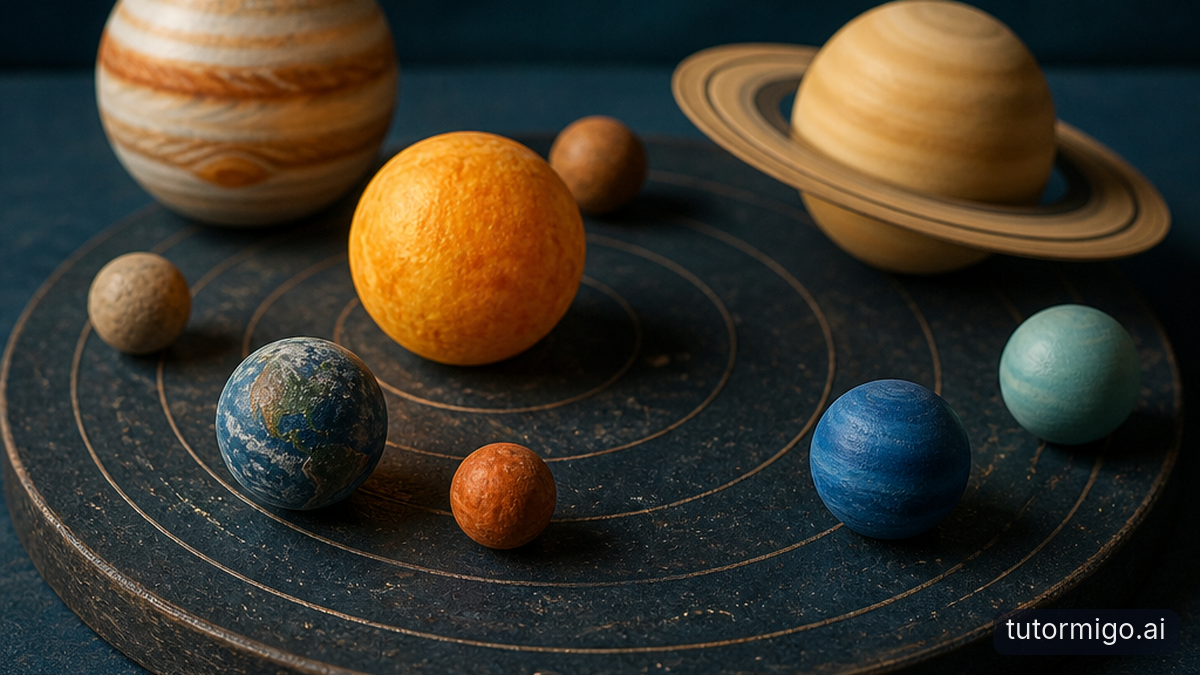
Start with a description, not an explanation. In the demo, describe the planets’ apparent sizes and positions. If you observe motion, describe what changes during the interval you watch. Say, “This planet appears larger than that one,” rather than, “The model proves their actual size ratio.” The first statement reports an appearance; the second claims a measurement the display may not support.
Keep your language tied to the view. “These two planets look close together” is different from “These planets are close together in space.” A three-dimensional scene shown on a flat screen can make objects at different depths look near one another. Likewise, a planet that appears larger may be represented differently or viewed from a different distance. You need more information before choosing an explanation.
This transfers directly to ACT Science figures. Before interpreting a graph, identify its labels, units, legend, and stated conditions. Before interpreting a diagram, check whether it is marked as drawn to scale. A supporting adult can help by asking, “What could another person point to in the same view?” If your answer includes a cause, an exact quantity, or a claim about the real solar system, you have probably moved beyond observation.
What Are You Inferring?
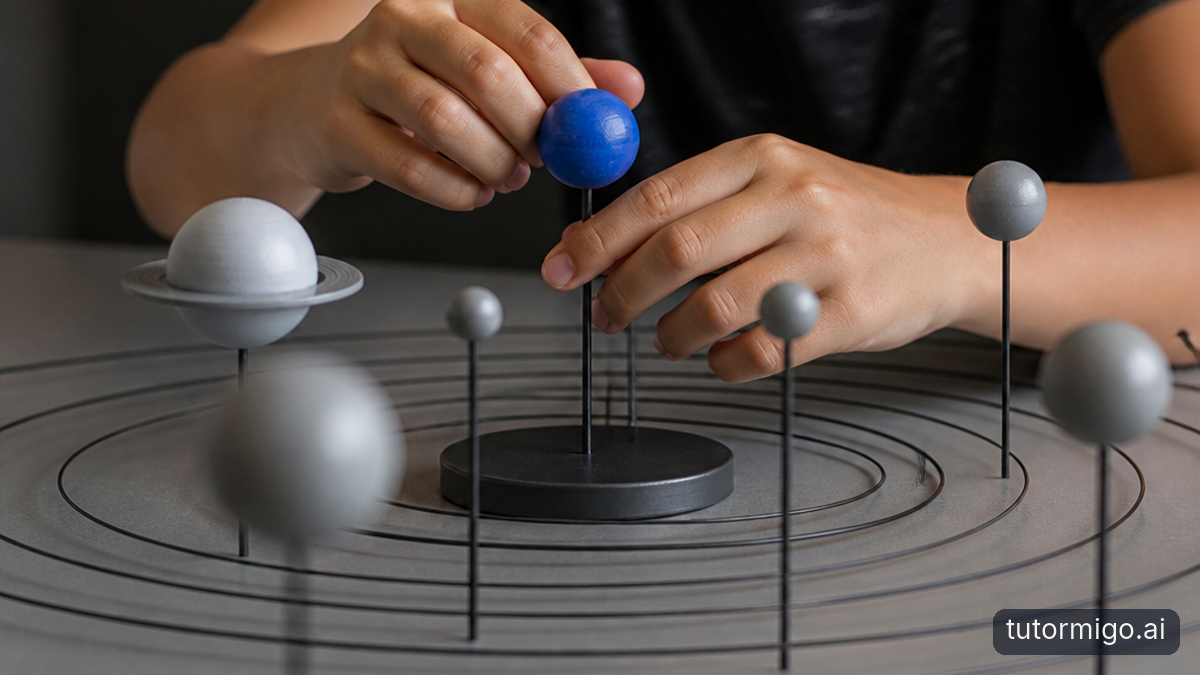
An inference connects an observation to an explanation. It is not automatically wrong, but it needs support. Suppose one planet appears to move farther across the scene than another during your observation. You might infer that it travels faster in reality. That conclusion depends on several unstated conditions: how motion is represented, whether time is treated consistently, and how perspective affects the apparent movement.
Planet size and spacing invite similar shortcuts. A large-looking planet might prompt you to assume that all sizes use one consistent scale. Wide-looking gaps might prompt you to assume that distances use that same scale, too. Neither follows from appearance alone. Treat the demo as a representation for exploring questions, not as a source of exact measurements unless documentation establishes those measurements.
For ACT prep, practice finishing this sentence: “My conclusion works only if…” Then name the missing condition. For example: “My distance comparison works only if the diagram preserves relative distances.” This makes a hidden assumption visible before it becomes an answer choice. You can ask an AI Tutor in TutorMigo.ai’s tutoring workspace to challenge your explanation with questions rather than simply confirm it. For another way to catch confident but unsupported reasoning, try spotting common ACT misconceptions.
Which Claims Need Independent Verification?
The evidence you need depends on the claim. To check actual planetary diameters, use a reliable astronomy reference with stated units. To compare orbital distances, look for clearly defined measurements, such as average distance from the Sun, rather than estimating gaps on screen. To compare orbital periods, use published period data. These sources answer different questions; one verified fact does not validate every visual detail.
You also need evidence about the representation itself. Accurate diameter data would not prove that the demo displays those diameters proportionally. That would require documentation about the model’s sizing. Similarly, knowing a planet’s real orbital period would not establish how the demo represents elapsed time. Keep “Is this astronomy claim accurate?” separate from “Does this display encode that quantity accurately?”
On the ACT, independent verification usually means checking another part of the provided material—not searching outside the test. A figure caption may establish scale, a methods paragraph may explain timing, or a table may supply values that a sketch cannot. Use any outside knowledge a question requires, but do not let remembered solar-system facts override the passage’s stated conditions. If the necessary support is absent, the careful conclusion is “not established by this evidence,” not “therefore false.” That distinction helps you reject answers that sound scientific but overreach.
Try the Three-Column Assumption Check
Use the three-column activity table to turn a quick look at the demo into a reasoning exercise. The columns separate what is visible, what you might assume, and what evidence would be needed. Treat the sample observations as sentence frames: use a row only if it matches what you actually see. In particular, do not report motion unless you observe it.
Spend about one minute describing the view without explaining it. Then choose one size comparison, one spacing comparison, and, if visible, one motion comparison. For each, write the tempting conclusion in the assumption column. Make it specific enough to test. “The model is accurate” is too broad; “The displayed planet sizes preserve actual diameter ratios” identifies a particular claim and the evidence it needs.
A supporting adult can take the role of evidence checker. Ask, “Would that source verify the real-world fact, the model’s design, or both?” Then switch roles. An AI Tutor can also help you rehearse this distinction: provide your observation and proposed conclusion, and ask which unstated conditions connect them. Verify any factual explanation against the passage or a reliable source. For more practice transferring visual exploration to test questions, see using 3D science models for ACT reasoning.
Next: Take a Timed ACT Science Practice Set
Finish with this short reasoning drill. Set a two-minute timer for all three questions. This is a practice interval, not an official ACT pacing rule. Read the scenario, choose your answers, and record your elapsed time before checking the explanations.
Scenario: A researcher presents a stylized planetary animation. Its caption states that planet sizes and orbital spacing are not to scale. A separate table lists orbital periods: Planet A takes twelve days, Planet B takes twenty-four days, and Planet C takes forty-eight days. The animation provides no stated relationship between screen time and actual elapsed time.
Question one: Planet C appears largest. Does this establish that it has the greatest actual diameter? Choose “supported” or “not established.” Question two: Which planet has the shortest orbital period according to the table? Choose Planet A, Planet B, or Planet C. Question three: Planet B appears to complete a circuit in six seconds. Can you use that observation to determine how many actual days one screen second represents? Choose “supported” or “not established.”
Check your answers after the timer stopsOne: Not established; displayed sizes are not to scale. Two: Planet A; its listed period is shortest. Three: Not established; the animation’s time relationship is unspecified. Dividing the listed period by the apparent screen duration would assume the correspondence you need to verify.
Record accuracy and total time, then label each miss: unsupported assumption, missed evidence, or rushed reading. Choose a personal ACT Science score goal and use a full, appropriately scored practice section to establish your baseline; this mini-set cannot predict a scaled score. In your next ACT prep session, complete a longer practice set using timing appropriate to your test format. Track accuracy and pacing together, aiming to reduce unsupported assumptions without exceeding your time budget.
| Observation: what you can see | Assumption: what appearance alone does not establish | Evidence needed |
|---|---|---|
| Size: One planet appears larger than another. | Displayed sizes preserve actual diameter ratios. | Model sizing documentation and reliable planetary diameter data. |
| Spacing: One displayed gap looks wider than another. | Visible gaps represent actual orbital spacing proportionally. | Model distance-scale documentation and clearly defined orbital distance data. |
| Motion, if observed: One planet appears to complete a circuit sooner. | Displayed timing preserves actual orbital-period relationships. | Documentation of the model’s time representation and reliable orbital-period data. |
Frequently asked questions
Yes. It can help you notice patterns and formulate questions. Exact size, distance, or timing claims still require appropriate evidence.
Use relevant knowledge when required, but anchor your answer in the question and supplied evidence. Familiar facts do not establish an unlabeled diagram’s scale.
Ask which evidence supports the answer and which assumption caused the error. Record that error type alongside accuracy and elapsed time.
Related reading
Enjoyed this read?
Like, share, or comment below.



Comments
0Sign in required · respectful discussion · replies supported
Loading comments…