

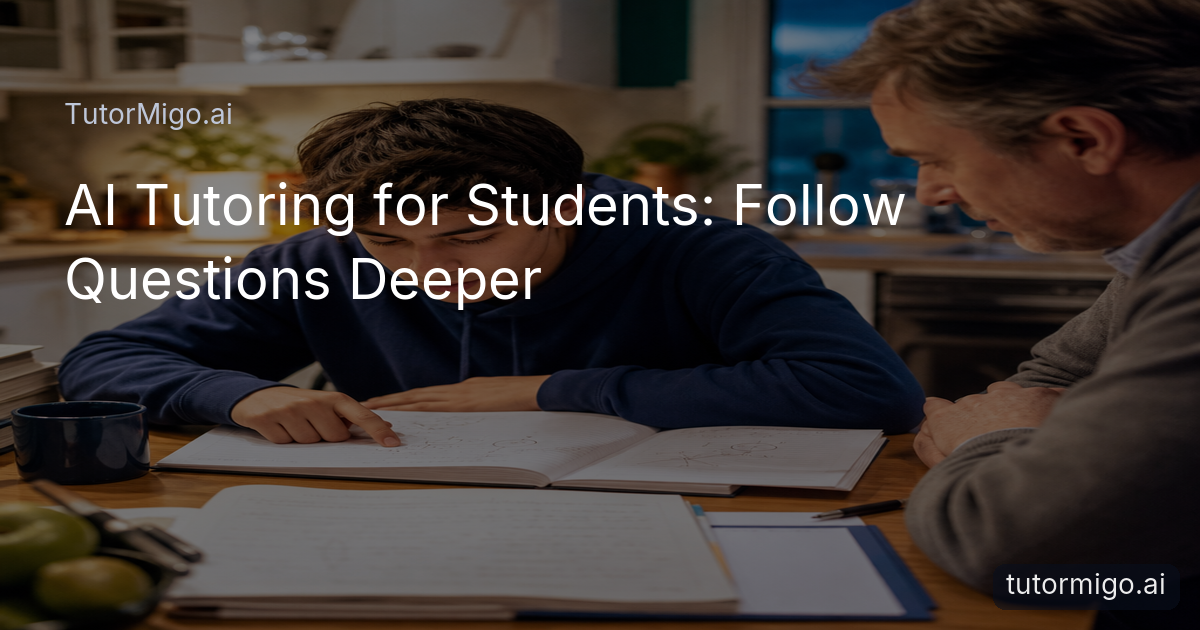
The Question Behind Student Curiosity

A student solves a homework problem, checks the answer, and then pauses: “Okay, but why does that happen?” That second question can change the purpose of the study session. Instead of collecting a correct response, the student starts looking for a cause, an example, or a different way to explain the idea.
Why is curiosity important in learning? Curiosity gives students a reason to look beyond a first answer and examine how an idea works, where it applies, and what might change it. It does not guarantee better grades or instant understanding, but it can make learning more active and personally meaningful.
That matters in ordinary situations: a formula that seems arbitrary, a historical decision with several causes, or a science result that changes when conditions change. Sometimes the most valuable part of learning is not the first answer. It is the question that comes after it.
Why Curiosity Can Disappear During Studying

Most students have practical work to finish. They may need to complete homework, memorize key information, prepare for an exam, or get through a chapter before the next class. Those goals are legitimate parts of education, and a direct answer is sometimes exactly what a student needs.
The difficulty comes when every learning task becomes a race toward completion. A student who is focused only on finding the correct response may not stop to ask what evidence supports it, whether another method works, or how the idea connects to something familiar. The pressure is not necessarily caused by one person or one system; it can simply come from limited time and many competing demands.
A useful adjustment is small: leave room for one follow-up question. After solving a math problem, ask why the method works. After reading about an event, ask which conditions made it possible. That habit keeps curiosity in learning present without turning every assignment into an open-ended research project.
How Asking Questions Turns Answers Into Understanding
Questioning helps students investigate an idea from more than one direction. In science, “Why does this happen?” can lead to “What would happen if the conditions changed?” The student is not assuming that one observation explains everything; they are identifying what could be tested or compared.
In history, asking why an event happened may lead to a question about competing causes, missing perspectives, or what might have happened if one factor had been different. In mathematics, “Why does this formula work?” can become “Can I solve the same problem another way?” Comparing methods can reveal which steps are essential and which are shortcuts.
How does asking questions help students learn? It gives them a way to identify gaps, connect examples, and check whether they can explain an idea in their own words. The result is not automatically deeper learning, but the process makes it easier to notice what remains unclear.
Try this after an answer: ask “What causes it?”, “Does it always happen?”, “Can I see an example?”, or “Can I explain it without looking?” Choose one question that fits the topic rather than forcing a fixed checklist.Answer-Seeking or Exploring an Idea?
There is a meaningful difference between using a tool to finish a question and using it to investigate one. Answer-seeking looks like this: question, answer, move on. That approach is efficient when a student needs a definition, a date, or a quick reminder before continuing.
Exploration takes a little longer: question, answer, “why?”, example, follow-up question, and then a chance to try the idea independently. A student working on a linear equation might ask for an explanation, request a similar example, compare two solution methods, and then solve a new problem without assistance. The aim is not to keep asking questions forever; it is to recognize when the first response has not yet become understanding.
Students can make this practical by naming their purpose before using an AI tool. Do they need a hint, a simpler explanation, a worked example, or a way to test their reasoning? Asking for the right kind of help reduces the temptation to copy a polished response and makes the session more useful.
For more support with turning uncertainty into a workable study task, see this guide to building better assignments from a blank page.
Where an AI Tutor Fits Into the Curiosity Loop
An AI tutor can be useful at several points in this process. A student can ask for an explanation, request another angle, explore an example, or describe an attempted solution and ask what needs checking. The value depends on how the student uses the exchange: as a prompt for thinking, not as a replacement for thinking.
Can AI tutoring encourage curiosity? It can provide a convenient place for follow-up questions and explanations, but it cannot make a student curious automatically. Students still need to decide what to ask, judge whether an explanation makes sense, verify important information, and try something independently.
TutorMigo.ai offers an AI Tutor Workspace with personalized tutoring chat and session history. That continuity can help a learner return to an earlier line of inquiry instead of starting from scratch each time. Its study tools, including a whiteboard, code sandbox, and math step editor, can also give students ways to work through an idea rather than only read a response.
This is one possible TutorMigo benefit: bringing conversation and active practice into the same learning environment. It remains different from a general-purpose chatbot mainly through the combination of tutoring context and dedicated study tools, not because every answer is automatically better.
Use AI to Give Curiosity Somewhere to Go
The most productive AI tutoring for students leaves the learner in charge. Start with a genuine question, ask for an explanation at the level you need, and then push the conversation one step further: “What is an example?”, “What would change the result?”, or “Can you show a different method?” After that, close the tool and try to explain or solve something yourself.
TutorMigo.ai’s spaced-repetition flashcards can support the review stage after exploration. A student might turn a difficult concept into a question-and-answer card, then revisit it over time rather than relying on one long study session. Interactive tools can similarly support working, revising, and checking ideas in subjects where a written explanation alone is not enough.
Can AI tutoring replace teachers? No. Teachers provide judgment, context, encouragement, classroom discussion, and understanding of a student’s broader situation. Textbooks, experiments, peers, and independent practice also matter. Digital tutoring is best treated as one resource among several, especially when students use it to challenge their first impression instead of copying the first response.
The future of digital tutoring may involve more support for exploration, but that is a possibility rather than a guaranteed direction. The central question will remain human: what does the learner want to understand next?
Before your next study session, write down one question you genuinely have. Use an AI Tutor for an explanation or example if it helps, then ask one follow-up and test your understanding without looking. Good learning does not always end with an answer; sometimes it begins with another question.
| Need | General-purpose chatbot | TutorMigo.ai |
|---|---|---|
| Ask a quick factual question | May provide a conversational response, depending on the tool and prompt | Provides access to an AI Tutor Workspace designed for tutoring chat |
| Continue a line of inquiry | Continuation depends on the tool’s available history and settings | Tutor Workspace includes session history for returning to earlier study conversations |
| Work through an idea actively | May require separate tools or a carefully structured prompt | Study Tools includes a whiteboard, code sandbox, and math step editor |
| Review a concept later | May require the student to organize review separately | Flashcards provide spaced-repetition decks with AI-assisted card creation and review scheduling |
Pros and cons
Pros
- Can provide explanations, examples, and follow-up support when a student is stuck.
- Dedicated study tools can help students work through ideas rather than only read responses.
- Session history and spaced-repetition review can support continuity beyond one question.
Cons and limitations
- AI responses still need to be checked and understood by the student.
- An AI tutor does not replace teacher judgment, classroom discussion, or hands-on learning.
- Curiosity cannot be automated; the student must choose to question, test, and reflect.
Frequently asked questions
Curiosity encourages students to look beyond a first answer and investigate causes, examples, connections, and possible alternatives. It does not guarantee higher grades, but it can make students more active participants in understanding an idea rather than simply completing a task.
Questions help students identify what they do and do not understand. Asking about causes, examples, exceptions, or alternative methods can reveal gaps and give students a chance to connect new information with prior knowledge.
Yes, an AI tutor can offer explanations, examples, and different approaches that support follow-up questions. Students should still check important information, evaluate the response, and attempt part of the work independently.
Students should use AI for hints, explanations, examples, practice, and feedback on their reasoning rather than copying complete answers. A useful routine is to ask a question, follow up once, and then explain or apply the idea without assistance.
No. AI tutoring can supplement study by providing on-demand explanations and practice, but teachers offer human judgment, context, discussion, encouragement, and insight into a learner’s needs. Students benefit from using AI alongside teachers, books, experiments, peers, and independent work.
Related reading
Enjoyed this read?
Like, share, or comment below.
Comments
0Sign in required · respectful discussion · replies supported
Loading comments…