

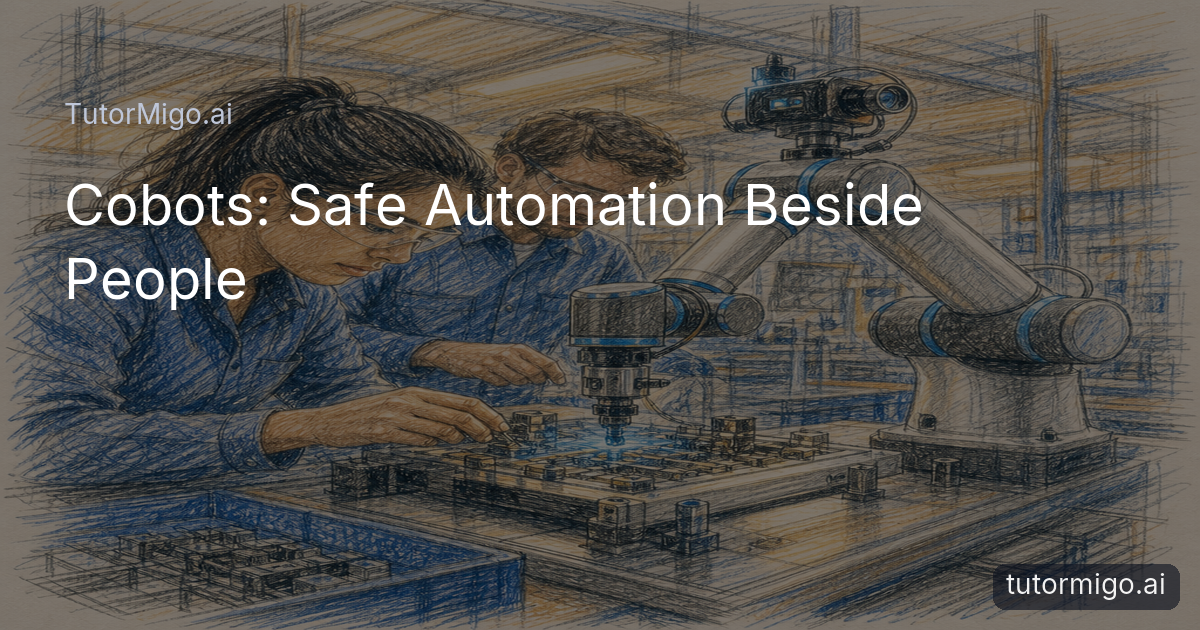
What makes a cobot different
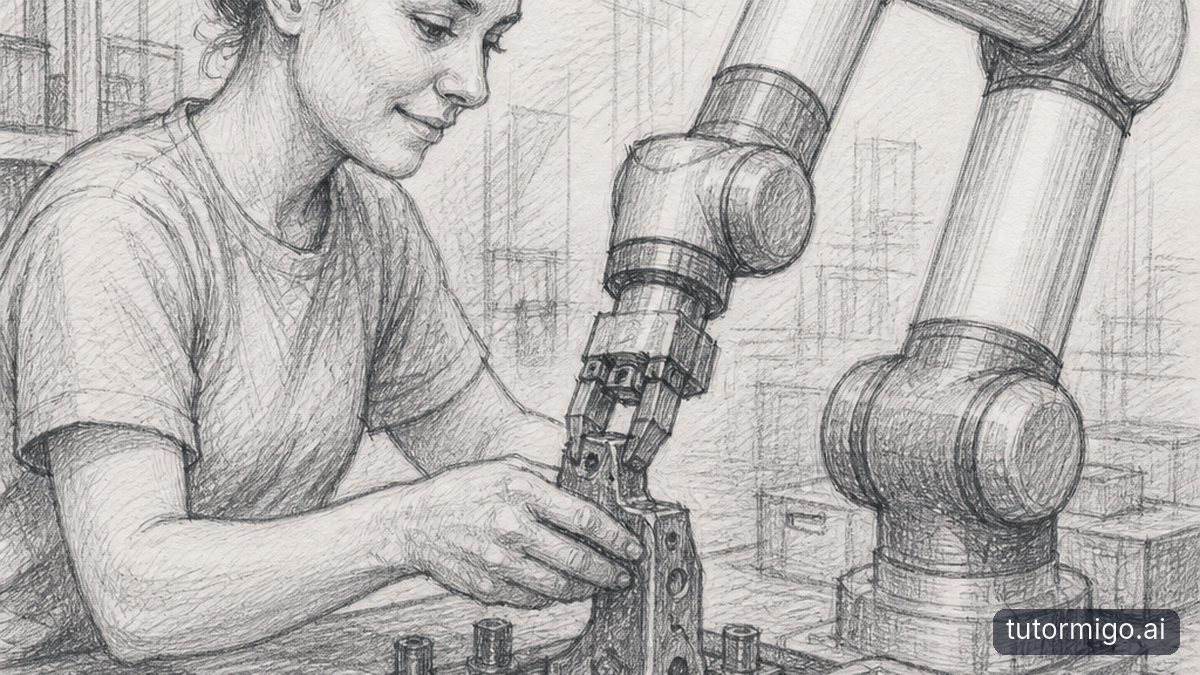
If you need to automate a repetitive factory task but do not have room for a fenced-off robot cell, a cobot may fit the problem better. Cobots, or collaborative robots, are designed for certain tasks in shared workspaces, where people and machines operate near one another under controlled conditions.
Conventional industrial robots often move quickly and handle heavy loads, so they typically operate behind fixed guarding, interlocked doors, or other protective barriers. A cobot is usually smaller and slower, and many models combine force or torque sensing with vision systems and software limits. If the robot detects unexpected contact or a change in its surroundings, it can reduce motion or stop, depending on its configuration.
That does not make every cobot automatically safe for every job. The task, end-of-arm tooling, payload, speed, sharp edges, and surrounding equipment all matter. A cobot carrying a soft gripper to move empty cartons presents a different risk from one using a cutting tool or handling hot parts. The useful distinction is not “robot versus no robot,” but whether the complete application has been designed and assessed for collaboration.
Where cobots deliver practical value
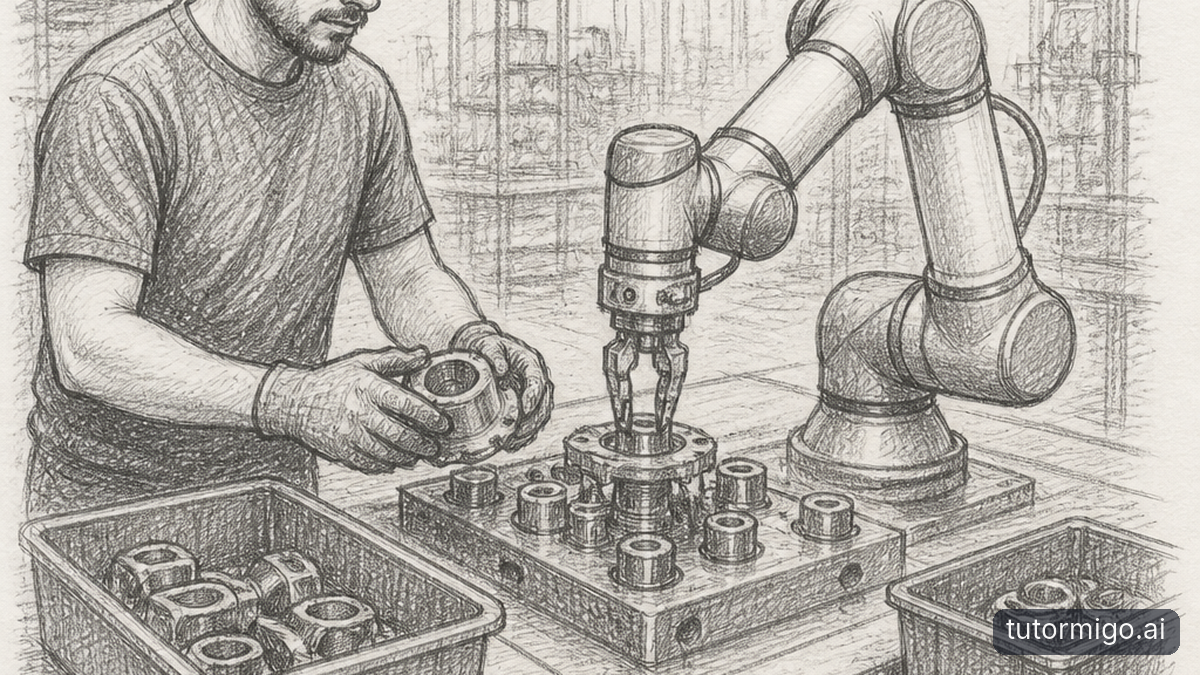
Cobots are most useful when a task is repetitive, physically tiring, or consistent enough to follow a defined sequence, while a person still adds judgment or flexibility. Light assembly is a common example. A worker can place a housing in a fixture, let the cobot insert screws or press a component into place, and then check the result before moving the part onward.
Packaging is another strong fit. A cobot can pick products from a conveyor, place them into cartons, apply a repeatable arrangement, or move completed boxes to a nearby pallet position. In quality inspection, a camera mounted near the robot can help check labels, dimensions, surface defects, or the presence of a component. The robot handles positioning while a worker investigates exceptions rather than examining every identical part.
These applications are valuable because they do not require the robot to replace every human action. A small manufacturer may use one cobot on a workstation that changes products several times a day. The same arm can be repositioned for another task instead of remaining dedicated to a single high-volume line. That flexibility is often more important than maximum speed.
How programming usually works
One reason businesses consider cobots is that programming can be more approachable than traditional industrial robot programming. Depending on the model, you may guide the arm by hand, select points on a touchscreen, or build a sequence from visual commands. You still need someone who understands the process, tooling, and safety requirements, but a specialist may not need to write every motion from scratch.
Imagine a packaging station with three actions: move to the pickup point, grip the product, and place it in the carton. An operator can define those positions, set the gripper behavior, choose a speed, and add a check for a successful pickup. If the product changes, the person may adjust a few waypoints rather than redesigning the entire cell.
Good programming also includes the conditions around the normal cycle. What should happen if the camera cannot find a part? Where should the arm stop if a carton is missing? How does a worker clear a jam and restart the sequence? Before production begins, run the cobot slowly, test unusual positions, and confirm that the end effector cannot pinch, cut, crush, or drop a part during foreseeable mistakes.
Safety requires more than built-in sensors
Force sensors and vision systems are useful safeguards, but they are not a substitute for an application-specific risk assessment. Start by mapping the robot’s full reach, including the tool and payload. Identify pinch points, collision surfaces, sharp tooling, dropped-object hazards, and any nearby machinery that could create a danger when the cobot stops or changes direction.
Then set limits that match the work rather than simply accepting the factory defaults. A lower speed may be appropriate while a person loads parts. A separate operating mode may be needed when the cobot runs without someone nearby. You may also need physical guarding, scanners, light curtains, emergency stops, or a redesigned fixture. Collaboration can reduce the need for a large cage, but it does not eliminate every protective measure.
Training should cover normal operation and recovery. Workers need to know how to pause the robot, isolate energy when required, respond to a fault, and report a change in behavior. Reassess the application whenever you change the gripper, software, product, layout, or operating speed. The relevant safety requirements depend on your location and application, so involve a qualified safety professional and consult applicable standards before deployment.
What to check before buying one
Begin with the task, not the robot catalogue. Record the part weight, dimensions, cycle time, reach, accuracy, surfaces, and required production volume. A cobot with a modest payload may be ideal for small components but unsuitable for a full carton. Likewise, a vision system may help locate randomly placed parts, while a simple fixture could provide a more reliable and less expensive solution.
Check the complete system cost. The arm is only one part of the installation. You may also need a gripper, camera, fixture, conveyor, safety devices, programming time, integration support, training, and maintenance. Ask how quickly tooling can be changed and whether the controller supports the sensors and equipment already used at the site.
Run a pilot using real parts and realistic interruptions. Measure not only the robot’s cycle time but also loading, inspection, replenishment, fault recovery, and changeover. A cobot that completes a movement in ten seconds may deliver less value if a worker must frequently reset it or wait for a camera check. The best pilot exposes those practical delays before they become part of a permanent workstation.
A sensible path to deployment
A strong first project is narrow, repeatable, and easy to measure. Choose one task such as placing finished components into trays, and document the current process before changing it. Track cycle time, rejected parts, worker reach or lifting demands, stoppages, and the time spent switching between product variants. Those measures give you a baseline for judging whether the cobot improves the whole operation.
Next, involve the people who will work beside the system. Operators often know about awkward part positions, unreliable packaging, and exceptions that never appear in a process diagram. Their input can lead to a better fixture or a simpler handoff. Build the workstation so the person can reach controls, replenish materials, and clear ordinary faults without leaning into the robot’s path.
After a controlled pilot, review the results with production, maintenance, and safety staff. Confirm that the documented procedure matches actual use, then expand only when the application remains predictable. A cobot is not a universal replacement for a conventional robot or a human worker. It is a flexible tool for sharing selected repetitive work with people when the task, system design, and safeguards all support that arrangement.
Frequently asked questions
They can be designed for shared workspaces, but safety depends on the complete application. Payload, speed, tooling, layout, contact risks, and protective devices must be assessed together.
Common examples include light assembly, screwdriving, machine tending, packaging, material handling, and camera-based inspection, especially when the task is repetitive and clearly defined.
Not always a full cage, but many applications still need guarding, scanners, emergency stops, restricted speeds, or other controls. The right measures depend on the task and risk assessment.
Many cobots support hand-guided teaching or graphical programming, which can simplify basic sequences. More complex vision, integration, and safety work may require an experienced automation professional.
Enjoyed this read?
Like, share, or comment below.



Comments
0Sign in required · respectful discussion · replies supported
Loading comments…