


Build a nine-problem interleaved practice set from your homework
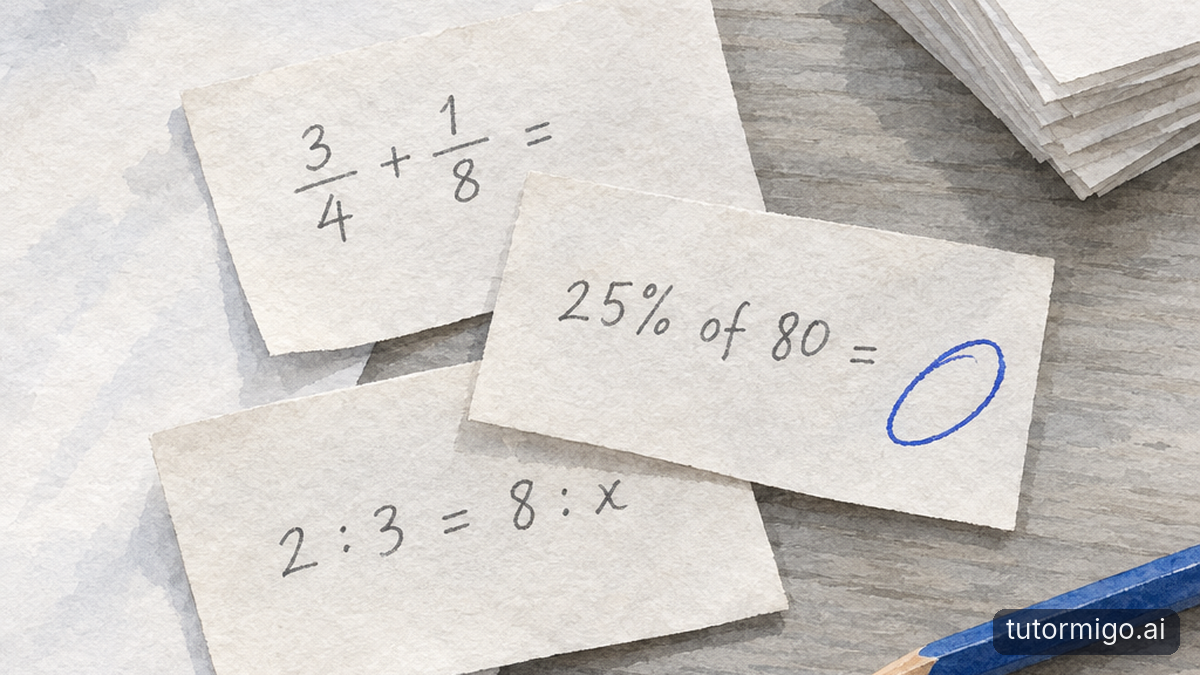
You need two or three recent homework sheets, paper, a pencil, something reliable for checking answers, and 20 minutes. Use questions you have already been assigned, preferably ones with answers you can check afterward. This routine is practice, not permission to skip required homework. If all 30 questions are due tomorrow, keep track of which ones you complete and leave time for the rest.
Pick three topics that you have studied recently. Fractions, percentages, and ratios work well because their numbers can look similar while their questions ask different things. Take three problems from each topic. Choose mostly questions you can attempt independently, with one or two that make you pause. Avoid filling your set with the hardest questions on every sheet: your aim is to practise choosing methods, not to get stuck immediately.
Copy each question onto a separate slip without its worksheet heading, then shuffle the slips. Keep a private note of the original question numbers so you can find the answers later. Spend about five minutes choosing and mixing, 12 minutes attempting, and three minutes checking. If you do not finish, keep the remaining slips for another session. For the science behind this routine, revisit why mixing problem types works.
- Pick three topics.
- Take three problems from each.
- Shuffle them.
- Before solving each one, write: “This is a ___ problem because ___.”
- Solve it.
- Check your answer and your topic choice.
Watch the reasoning: fractions, percentages, and ratios
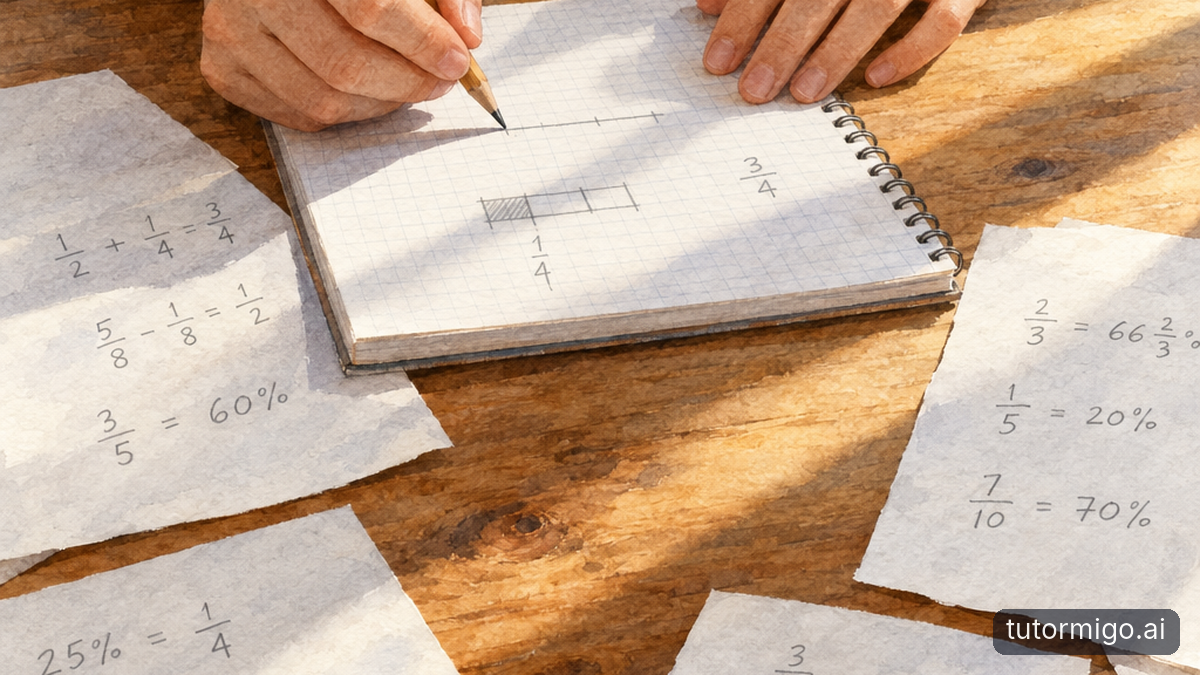
Your sentence is a decision checkpoint, not a vocabulary test. Read what the question asks before choosing a method. A fraction can appear inside a percentage question, so spotting a symbol is not enough. Look for the relationship: are you combining parts, finding an amount out of a hundred, or sharing a total in a stated relationship? Then explain that clue in ordinary words.
For the first problem below, the clue is the instruction to add two fractional amounts. For the second, it is the percentage applied to a whole quantity. For the third, it is the relationship between two groups. Notice that the ratio problem requires finding the total number of equal parts before finding either group. Naming the topic helps, but your “because” should explain why the method fits.
Read each model sentence before looking at its calculation. Then cover the sentence and explain the choice yourself. If your wording differs but identifies the same relationship, that is fine. You are building a useful habit, not memorising a script. After checking, ask whether an incorrect answer came from choosing the wrong method or making an arithmetic slip. Those need different fixes.
- Fractions: Calculate . “This is a fractions problem because I am adding two fractional amounts.” Use a common denominator: .
- Percentages: Find of . “This is a percentages problem because I need a stated percentage of a whole.” Calculate .
- Ratios: Red and blue counters are in the ratio , with counters altogether. “This is a ratios problem because the total is shared in a stated relationship.” There are parts, so each part is . Red: . Blue: .
Catch the layout trap and record your decisions
Here is a deliberate mistake: you see a shaded rectangle copied from a fractions worksheet and immediately write, “This is a fractions problem because it has shaded boxes.” But the question asks, “What percentage of the rectangle is shaded?” You recognised the page style, not the task. Even a correct calculation might hide that weak decision if you never explain your choice.
Fix it by covering the worksheet title and rereading the question. Suppose three of four equal sections are shaded. Write, “This is a percentages problem because I must express the shaded share out of a hundred.” Then calculate . Fractions still help you solve it, but the requested answer tells you what you are finding. Some questions use more than one topic, and that is completely normal.
Use the table below for your shuffled set. In “Why,” record a clue from the actual question, such as “sharing a total between two groups.” After checking, use “Correct?” for both the method and the answer. You might write “method yes, arithmetic no.” That note is more useful than a lonely cross because it tells you what to practise next. If you chose incorrectly, rewrite your explanation before trying another question.
Your turn: six mixed questions, then level up
Try this short set before returning to your own homework. Keep the answers covered and use one row of your table for each question. Write your “This is a ___ problem because ___” sentence first, even when you think the answer is obvious. The pause is the point: you are practising recognition as well as calculation. Show enough working that you can locate a mistake later.
Find 20% of 45.
Calculate 3/4 - 1/8
Pencils and pens are in the ratio 3:2. There are 20 items altogether. How many are pencils?
Calculate 2/3 + 1/6
A game costs 40 before a 15% discount. What is the sale price?
A drink uses concentrate and water in the ratio 1:4. You use 3 cups of concentrate. How many cups of water do you need?
Notice the difference between the two ratio questions. One gives a combined total; the other gives one ingredient's amount. Simply naming “ratio” does not finish the decision. Your explanation should identify what is known and what you need to find. Likewise, the discount question asks for the final price, not just the size of the discount. Underlining that request can prevent an unfinished answer.
Ready to level up? Add one familiar topic from last month, such as perimeter, using a question you can check. Start by replacing one question rather than making the session longer. If the older topic feels rusty, review one worked example, then attempt a different question without looking. Keep the challenge manageable: the goal is a better choice of method, not a bigger pile of paper.
Key takeaways and your next step
The useful result today is not just nine completed questions. It is a clearer picture of when you can choose a method independently. Keep the slips and your decision log together. Next time, revisit a question where your explanation was uncertain, even if the final answer happened to be right. A lucky answer is less useful than a method you can explain and repeat.
One of the practical TutorMigo benefits for this routine is having a place to ask for personalised help. TutorMigo.ai is an adaptive AI tutor with step-by-step guidance. You can ask its AI Tutor to explain the first decision without immediately giving you the complete solution. Share your attempted reasoning so the discussion starts with the part that confused you, rather than restarting the whole problem.
Your next step 👉 Ask TutorMigo.ai for a mixed practice set on your three topics. Try: “Mix fractions, percentages, and ratios at my current homework level. Give me one question at a time and ask me to identify the type before solving.” TutorMigo can create mixed practice sets and talk you through problems step by step when you are stuck. Use the AI Tutor as support for your thinking, not a replacement for your first attempt.
Mix: choose three topics and shuffle the questions.
Explain: identify the task before calculating.
Check: review your method and your arithmetic separately.
Which two problem types are easiest for you to mix up, and what clue helps you tell them apart?
Tomorrow: the illusion of knowing and why highlighting tricks your brain.
| Practice task | Your homework slips | TutorMigo.ai tutoring chat |
|---|---|---|
| Choose the starting material | Select questions directly from your recent homework. | State your topics and share an example of the difficulty you need. |
| Explain your choice | Write your problem type and reason in the practice log. | Share your reasoning and ask for step-by-step guidance. |
| Revisit your thinking | Keep your slips and written corrections together. | Return to earlier tutoring discussions through session history. |
Frequently asked questions
Not for this session. Choose topics you have already studied so you can practise selecting methods. Learn the basics of a new topic before adding it.
Name the main task and explain the relationship you noticed. A percentage problem can use fractions along the way. Your reasoning matters more than finding one perfect label.
Choosing a method takes time. Complete fewer questions carefully rather than rushing through the explanation. Use your log to see whether the difficulty is recognising the task or doing the calculation.
Related reading
Enjoyed this read?
Like, share, or comment below.



Comments
0Sign in required · respectful discussion · replies supported
Loading comments…