


1. Prepare a page, timer, and topic for active recall
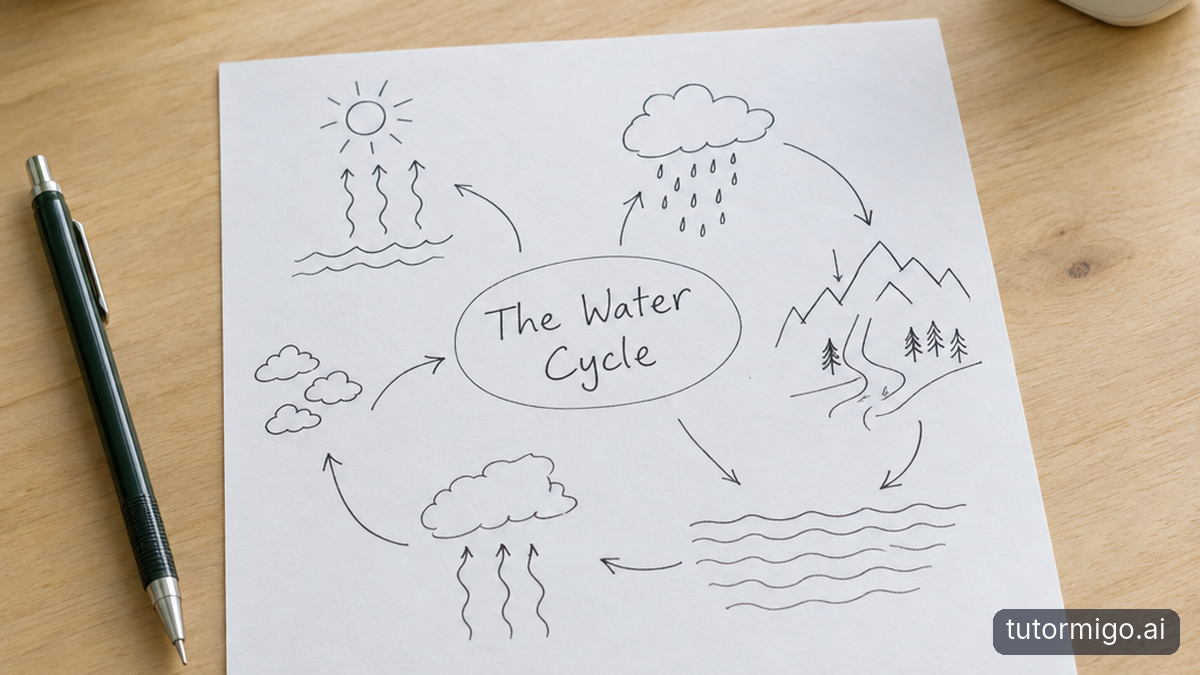
You need a blank page, something to write with, a timer, and one topic from your test. Keep your notes nearby, but closed. If you usually study on a screen, hide the lesson and turn off notifications before starting. Your job is to find out what you can remember, not how quickly you can find an answer.
Choose a topic small enough to explore in five minutes. “Science” is too big. “The water cycle” works. So does “the causes of the American Revolution,” if that is on your test. Use a heading from your class notes when you are unsure how much to include.
Write the topic in the middle of your page. Leave room around it for facts, arrows, examples, and questions. This is not a neatness challenge. A messy page with useful connections tells you more than a beautiful title surrounded by empty space.
The five minutes are for remembering. Checking your answers afterward takes a little extra time. That distinction matters: do not rush the checking just to finish everything in five minutes. You are building a useful study list, not racing toward a grade.
2. Dump what you remember, then check it

Start your timer and write everything you remember about the topic without opening your notes. Use short phrases, sketches, examples, or connected bubbles. You do not need complete sentences. If one idea sparks another, follow it. If you stall, ask yourself: What happens? Why does it happen? What example could I give?
Stay with the page until the timer ends. A quiet moment does not mean you have failed. Sometimes another idea arrives after a pause. If you are unsure about something, write your best attempt and add a question mark. Do not look it up yet.
Now open your notes and check each separate idea. Add ✓ beside a correct recalled idea. Add ✗ for an important idea in your notes that you missed completely. Add ! beside an idea you wrote incorrectly. Count ideas, not individual words, and avoid counting the same point twice.
Your ✗ and ! items are your study list. Start with wrong ideas, since those need correcting, then tackle the missing ones. This is the practical answer to the illusion of competence: instead of guessing what needs work, you have evidence on the page.
3. Try a worked example: the water cycle
Imagine your five-minute brain dump says: “The Sun warms water and it evaporates. Water vapor cools and condensation forms clouds. Precipitation falls as rain or snow. Clouds are made of water vapor.” You also draw an arrow from a lake toward a cloud. It feels like a solid start—but checking reveals something useful.
You earn three checks for recalling evaporation, condensation, and precipitation correctly. Then you mark the last sentence with !. Clouds contain tiny liquid water droplets, ice crystals, or both. Water vapor itself is invisible. You remembered a related word, but used it in the wrong way.
Next, suppose your class notes also cover transpiration, infiltration, runoff, and collection or storage. None appeared on your page, so you add four ✗ items. Transpiration releases water vapor from plants. Infiltration is water entering the ground. Runoff moves water over the land. Water collects in places such as lakes and oceans.
Your result is three correct ideas, four missing ideas, and one wrong idea. That is not a verdict on your ability. It is a map of your next study session. Use only material your class expects you to know when checking.
4. Avoid the mistake that spoils the result
Here is the tempting mistake: you forget one word, so you peek “just once.” Maybe you only check the diagram title. Maybe you glance at the first letter of a term. It feels harmless because you still plan to do most of the work yourself.
But the page is supposed to show what you can recall without help. That tiny peek gives you a cue. Seeing “infiltration” might also remind you about groundwater and runoff. Now you cannot tell which ideas you remembered independently and which arrived because the notes prompted you.
That ruins the clean result, not your whole study session. The work can still help you learn. Just label the attempt “with a hint” and avoid treating it as an unaided score. For a fresh check, close everything and try again later on a new page.
If you feel stuck during a clean attempt, draw an empty bubble or write “missing step.” Keep going elsewhere. The gap is useful information. You are not trying to make the first page look impressive; you are trying to stop surprises from appearing for the first time during your test.
5. Your turn: three topics, then a 48-hour retest
Choose three topics from your actual test material: a familiar one, a recent one, and the hardest one. The familiar topic checks whether confidence matches recall. The recent topic checks what stayed after the lesson. The hardest topic helps you find a manageable starting point instead of avoiding it.
Give each topic its own page and five-minute timer. If your test is tomorrow and time is tight, start with the hardest important topic rather than rushing through all three. Check that page, repair a few gaps, and leave time for sleep. You do not need a giant study project tonight.
If your test is next week, repeat the test 48 hours later. Use a fresh page, the same topic, and the same no-notes rule. Compare both pages against the same class material. Look for missing ideas that now appear correctly and wrong ideas you have fixed—not just a bigger total.
A gap that returns deserves another review. A correct idea recalled clearly on both attempts may need less attention. This is a simple way to space your practice; the guide to building a spaced-repetition schedule can help you plan later checks.
6. Your next step 👉 Work through the gaps
Take your ✗ list into TutorMigo.ai and work through each gap step by step. Include your ! items too. Tell the adaptive AI tutor what you missed and what your class notes say. Start with one gap rather than pasting an entire chapter.
Try: “I missed infiltration and confused clouds with water vapor. Help me understand one idea at a time, then ask me to explain it without hints.” An AI Tutor can guide your practice, but keep your class notes as the reference for what your test covers.
One of the practical TutorMigo benefits is personalized tutoring chat with session history, so you can return to the explanation you worked through. After using the AI Tutor, close the chat and explain the idea yourself. That final no-hints attempt checks whether the explanation has become something you can recall.
Key Takeaways
Recall first; check your notes afterward.
Use ✓ for correct, ✗ for missing, and ! for wrong.
Study your gaps, then retest after 48 hours when time allows.
Tomorrow: the Feynman technique — can you explain it to a 10-year-old?
How many ✗ did you get?
| Method | What you do | Best use | What to watch |
|---|---|---|---|
| Rereading notes | Review explanations with the material visible. | Check details and correct misunderstandings. | Familiarity alone does not show unaided recall. |
| Blank-page test | Recall a topic without notes, then check it. | Find missing and incorrect ideas. | Peeking makes the result a hinted attempt. |
| TutorMigo.ai tutoring chat | Bring identified gaps into personalized, step-by-step practice. | Work through confusing ideas and revisit session history. | Close the chat afterward to check independent recall. |
Frequently asked questions
That gives you a starting point. Check your notes, choose one missing idea, and learn it before trying to recall it again without help.
Yes. Sketches, arrows, labels, and short phrases all work. Check that your drawing shows the correct ideas and connections.
You do not need one. Track correct, missing, and wrong ideas separately. Compare attempts using the same topic and class notes.
Do the test now, repair the most important gaps, and try a short no-notes check later if time allows. You do not need to wait 48 hours.
Enjoyed this read?
Like, share, or comment below.

Comments
0Sign in required · respectful discussion · replies supported
Loading comments…