

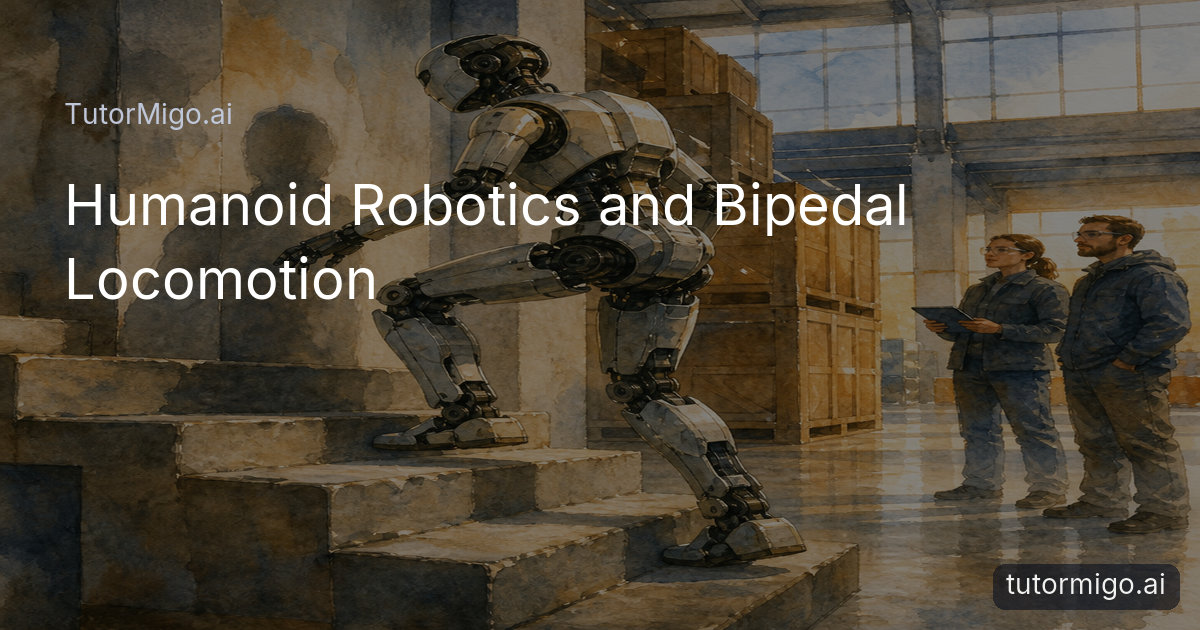
Why Walking Is Hard in Humanoid Robotics
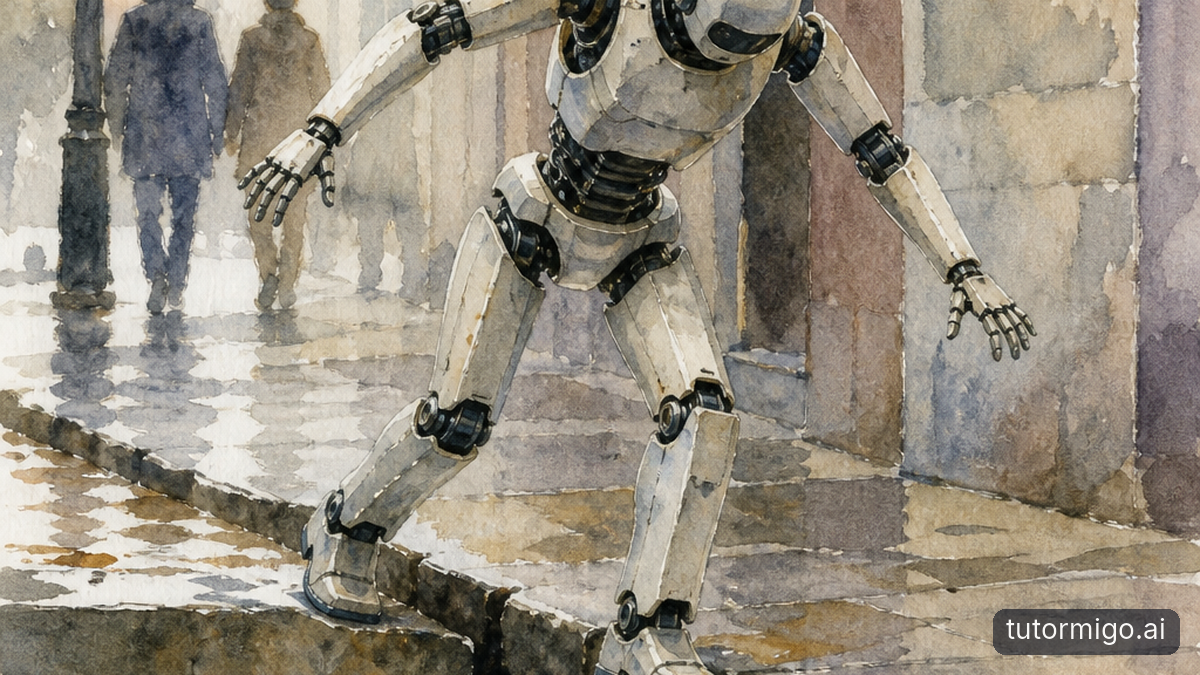
If you have ever watched a person step over a cable without thinking, you have seen a remarkably difficult control problem. A humanoid robot must keep its center of mass above a small support area while moving two legs, reacting to contact, and deciding where to place its next foot. A tiny error can become a stumble.
Bipedal locomotion is harder than rolling because walking is a sequence of controlled falls. During part of each step, one foot supports the body while the other swings forward. The robot must shift its weight, clear the ground, absorb impact, and regain stability before the next step. On a flat laboratory floor, this can be planned carefully. On a real floor, dust, slopes, loose objects, and unexpected contact change the problem.
Humanoid form adds another challenge and an important advantage. A robot with two legs, arms, hands, and a human-like height can use stairs, doors, ladders, carts, and workbenches designed for people. The goal is not simply to imitate a human silhouette. It is to combine that shape with control systems that can adjust quickly when the environment refuses to behave predictably.
Balance Control Turns Steps Into Decisions
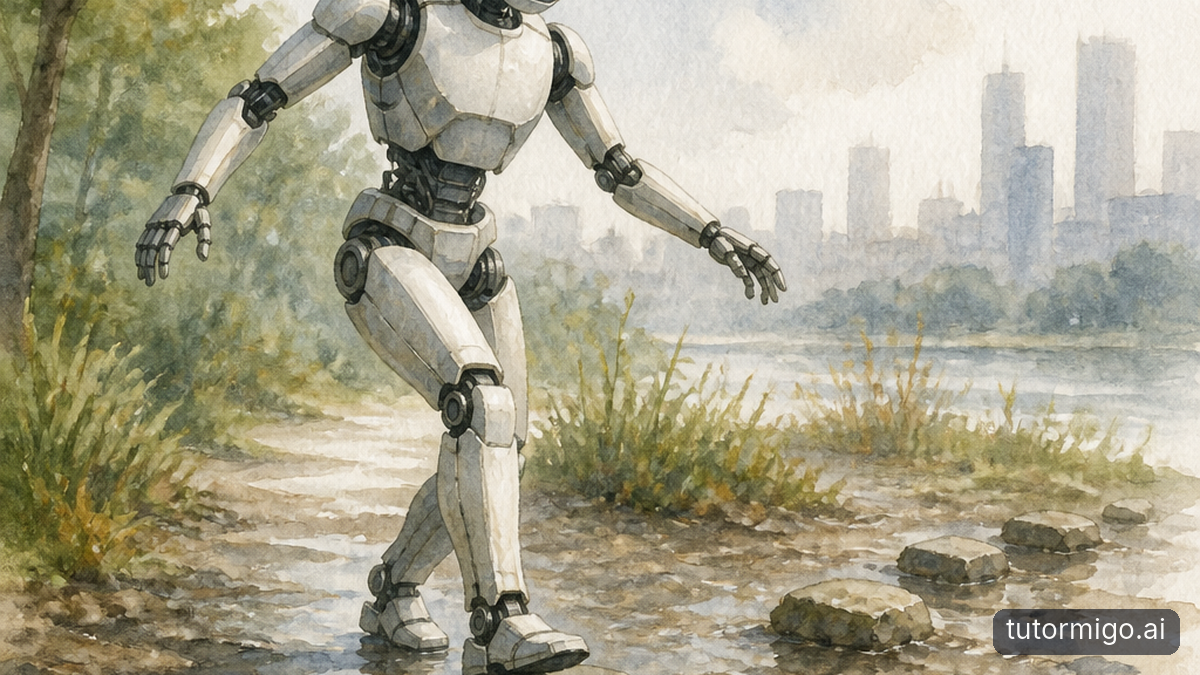
Balance control algorithms constantly estimate what the robot is doing and choose what should happen next. Sensors report joint angles, body orientation, acceleration, and foot contact. A controller then compares the current motion with a planned motion and adjusts motor commands. If the body is leaning too far forward, it may shorten the step, move an arm, bend a knee, or place the foot earlier.
One useful concept is the support polygon: the area of the floor enclosed by the foot or feet currently touching it. Keeping the estimated center of mass within that area generally improves stability, but real controllers cannot rely on a single simple rule. A robot may deliberately move its center of mass outside the support area for an instant while taking a step, then catch itself with the swinging foot.
Consider a robot approaching stairs. It needs to estimate the height and depth of each step, slow its body before contact, and coordinate ankle, knee, hip, and torso motion. A rigid sequence may work on identical stairs but fail when one riser is slightly different. Feedback makes the sequence responsive: after each foot lands, the controller updates its estimate and modifies the next movement.
Think of balance control as a continuous conversation between prediction and correction, not a prerecorded dance.
Force Sensors Help Robots Feel the Ground
Vision can show a robot where the floor appears to be, but force sensors help it discover what the floor is actually doing. Sensors in the feet, joints, or limbs can indicate how strongly the robot is pressing, whether a foot has landed, and whether contact is shifting toward an edge. That information matters when a surface is uneven, slippery, soft, or partly blocked.
Imagine a robot stepping onto a warehouse ramp covered with a thin layer of dust. Its cameras may identify the ramp correctly, yet the foot could slide during weight transfer. Force feedback can reveal the slip or unexpected load. The controller may reduce the push from the trailing leg, widen the next step, bend the knees, or pause while it finds a more secure position.
Force sensing also matters when the robot interacts with objects. If it pulls a loaded cart, a sudden increase in resistance should not be treated like a command to use maximum motor power. The system needs to distinguish a heavy cart from a snagged wheel or a person touching the handle. Gentle compliance—allowing the body and limbs to yield slightly—can protect both the robot and nearby people.
Reliable locomotion therefore combines sight with touch-like information. Cameras help answer “Where is the path?” Force sensors help answer “What happened when I used it?”
Where Machine Learning Fits Into Locomotion
Machine learning can improve bipedal movement, but it does not replace every control rule. A robot can learn patterns from demonstrations, simulation, or repeated trials: how much to bend before stepping onto a high surface, how to recover from a small shove, or how to adjust its gait on gravel. These learned policies can handle variation that would be difficult to describe with hand-written instructions.
Training often begins in simulation, where a robot can experience thousands of virtual falls without damaging hardware. Engineers vary friction, step height, body mass, lighting, and timing so the policy does not memorize one perfect environment. The difficult transition is moving from simulation to the physical world. Real motors have backlash, batteries lose power, floors behave unpredictably, and sensors contain noise.
For that reason, learning is commonly paired with safety limits and conventional feedback control. A learned system might suggest a foot placement, while a lower-level controller checks whether the movement stays within limits for joint speed, contact force, and balance. If confidence drops, the robot can slow down or stop rather than forcing an uncertain action.
When you evaluate a claim about “learning to walk,” ask what was learned, where it was trained, and how the system responds to conditions it has not seen. A polished demonstration shows possibility; dependable locomotion requires repeatable performance across many ordinary variations.
Designing Robots for Human Workspaces
Humanoid robots are attractive for environments built around human bodies. A warehouse may already have shelves at reachable heights, handles shaped for human hands, stairs between levels, and tools that would be expensive to redesign. A bipedal machine could potentially move through those spaces without requiring a complete facility rebuild.
That promise depends on more than having two legs. The robot needs enough reach and dexterity to grasp objects, stable movement near shelves, and awareness of people, pallets, cables, and moving equipment. A cluttered aisle creates a planning problem: the safest path may not be the shortest one. The robot might turn sideways, use an arm for balance, or step around a box rather than pushing through it.
Human tools introduce another layer of difficulty. A handle may require a precise grip, a power tool may create vibration, and a cart may respond differently depending on its load. The robot must coordinate locomotion with manipulation so that pulling an object does not destabilize its feet. Its torso and arms become part of the balance strategy, not separate systems.
The practical test is not whether a robot can walk across an empty stage. It is whether it can complete a useful task while sharing space with workers, handling variation, and recovering safely when the plan changes.
How to Think About Progress in Bipedal Robots
When you compare humanoid robotics projects, look beyond walking speed or a single dramatic video. Ask how often the robot succeeds, how much supervision it needs, and what happens after a small mistake. A system that walks slowly but recovers from uneven ground may be more useful than one that moves quickly only under controlled conditions.
Pay attention to the test environment. Were the stairs identical every time? Was the warehouse cleared of people and loose objects? Did the robot carry a realistic load? Did engineers reset it after every trial, or could it notice a failed foot placement and continue? These details reveal whether the work addresses locomotion as a practical operating problem.
Safety is another central measure. A capable robot should limit force near people, recognize uncertain contact, and have a reliable stop or recovery behavior. Energy use matters too: repeated heavy corrections can drain a battery even when the robot stays upright. Maintenance, sensor durability, and the time required to calibrate the system may determine whether it works outside a research demonstration.
If you are studying the field, organize your notes around four questions: how the robot senses, how it predicts, how it corrects, and how it proves reliability. This framework helps you connect balance algorithms, force feedback, machine learning, and human-centered design without treating any one component as a complete solution.
Frequently asked questions
Bipedal locomotion is movement using two legs. In robotics, it involves coordinating joints, foot placement, balance, sensing, and recovery while the robot walks across a changing surface.
Force sensors reveal how strongly the robot is contacting the floor or an object. They help it detect landing, slipping, unexpected resistance, and shifting loads that cameras alone may not identify.
Not necessarily. Machine learning may help with gait selection, foot placement, or recovery, while feedback controllers and safety limits manage precise motion, contact forces, and operating boundaries.
Two-legged, human-scale robots may navigate stairs, shelves, tools, and work areas that already exist for people. Their value depends on safe, reliable performance in those spaces rather than on appearance alone.
Related reading
Enjoyed this read?
Like, share, or comment below.



Comments
0Sign in required · respectful discussion · replies supported
Loading comments…