


The same problem with and without socratic tutoring
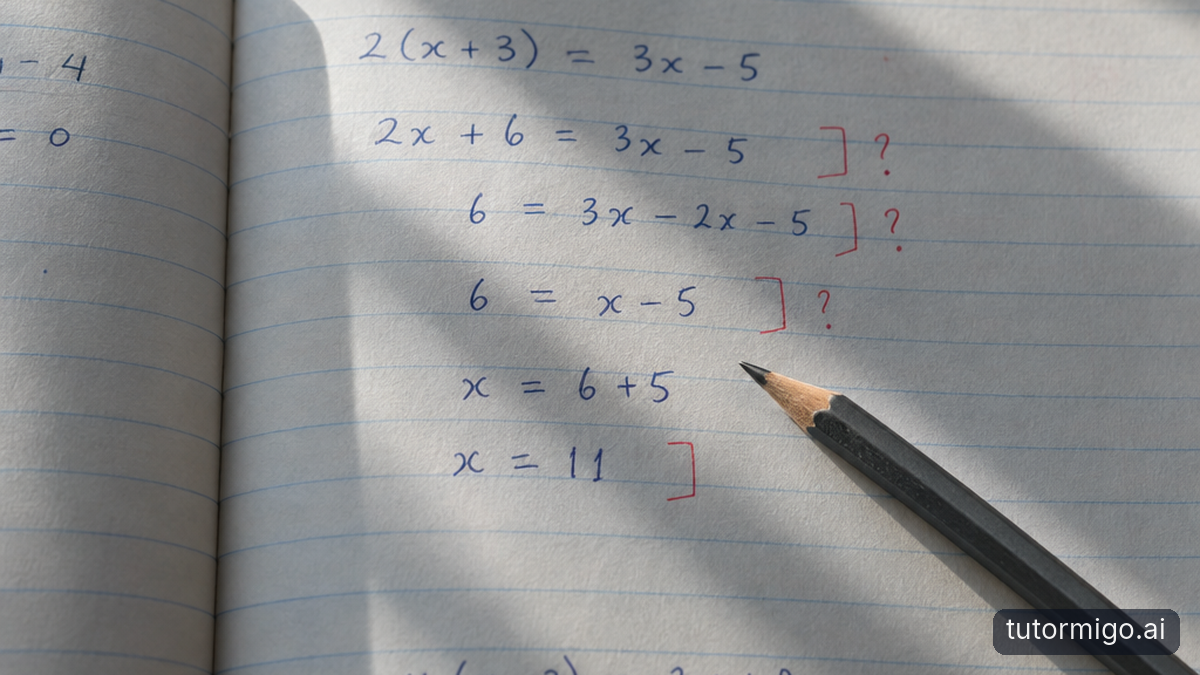
Suppose you need to solve . An answer-giving response might say: “Distribute, subtract , add , and divide by . The answer is .” That is correct. But you could read it, recognize the familiar steps, and never decide why any step works.
A purposeful questioning exchange makes your thinking visible instead:
You: “I think the left side becomes .”
Tutor: “What does the multiplier outside the parentheses apply to? Describe as repeated addition.”
You: “It means . So it should be .”
Tutor: “Right. Now you have . What could you do to both sides to collect the unknown terms together?”
You: “Subtract from both sides. That gives .”
Tutor: “Why both sides?”
You: “Changing only one side could make the two sides unequal. Then I add to both sides and divide both sides by , so .”
Tutor: “How could you check that in the original equation?”
You: “Substitution gives and . Both sides match.”
The useful difference is not that the second conversation is longer. Each question targets a decision: how multiplication works, which operation moves you forward, why equality is preserved, and how to verify the result. You supply the reasoning instead of borrowing it.
This is the practical distinction behind guided questions rather than direct answers: the conversation should leave you doing more of the thinking, not merely reading more messages.
What makes a question useful?

A useful question has a job. It should reveal what you understand, direct attention to an important relationship, or help you choose a next move. “Think harder” does none of those things. “Which terms does the outside multiplier affect?” points to the exact decision that caused trouble in the example.
Good questions also fit your current knowledge. If you understand distribution but keep making sign errors, repeating a broad explanation of parentheses wastes effort. A better question is: “What is the sign of the product involving the negative term?” It narrows your attention without completing the calculation for you.
Questions should also make assumptions testable. If you claim that multiplying outside parentheses affects only the first term, try substituting . The original expression gives , while the mistaken expression gives . That mismatch gives you a reason to revise the rule, rather than simply accept a correction.
Finally, a useful question leaves room for your answer to change the conversation. If your explanation reveals a missing concept, the next response should address it—not continue down a fixed script. Ask for one question at a time, and include your actual reasoning. A wrong explanation is valuable evidence; a bare “I understand” gives the tutor almost nothing to work with.
When hints and direct explanations are the better choice
Socratic tutoring does not mean answering every question with another question. If you have never learned distribution, asking you to discover it through repeated guesses can become frustrating. Questions work best when you have enough knowledge to make a meaningful attempt. When that knowledge is missing, a clear explanation is appropriate.
Use a small support ladder. Start with a question about the goal: “What are you trying to isolate?” If that does not help, request a more specific hint: “Which operation could remove the unknown term from the right side?” If you still cannot proceed, ask for one demonstrated step with its reason, then take over again.
For example, you might say: “I don’t know why subtracting the same amount preserves equality. Explain that directly, then give me a step to complete.” A balance-scale explanation may supply the missing idea. Afterward, you should use it, not simply confirm that it sounds sensible.
Try this boundary: “If I’m missing a prerequisite, explain it briefly. Otherwise, give the smallest hint that lets me do the next step.”
There is no prize for struggling indefinitely. If you are repeating the same guess without gaining a new idea, change the support. The goal is productive effort followed by increasingly independent work, not a conversation that withholds information for its own sake.
Check understanding without being fooled by fluency
A smooth explanation can feel like mastery because every step makes sense while you are looking at it. That feeling measures how easily you follow the explanation, not necessarily whether you can produce one. Even repeating the tutor’s wording can hide gaps if the next question changes the setup.
First, hide the conversation and reconstruct the solution on blank paper. Explain why each operation is allowed, not just what operation comes next. If you cannot start without reopening the chat, you have found a specific dependency to work on. This blank-page test for the illusion of competence is more informative than rereading until the steps look familiar.
Next, try a related problem such as . The structure is similar, but the signs and values differ. Solve it without hints, then substitute your result into the original equation. Notice whether you chose the operations yourself or mentally replayed the earlier answer.
Finally, explain an error. Why would expanding the left side as be wrong? Producing a counterexample or explaining the multiplier’s scope gives stronger evidence than saying, “You forgot to distribute.” Return later for another unaided attempt, too. Immediate success is encouraging, but it does not establish that you will remember the method after a delay.
Try this in your next study session
Choose a problem you genuinely need to understand, and begin with your own attempt—even if it is incomplete. Then set the terms of the conversation: “Help me reason through this. Ask one focused question at a time. Don’t give the final answer before I’ve tried, and explain directly if I’m missing a prerequisite.”
When you propose a step, add: “Ask me why that step is valid.” When you feel confident, use: “Challenge one assumption in my reasoning, or ask me for a counterexample.” These prompts steer attention toward your decisions rather than toward producing a polished solution as quickly as possible.
Before finishing, ask: “Give me a similar problem with a meaningful change, but don’t show its solution yet.” Work away from the conversation. Your self-check is simple: Can you start unaided, explain each important choice in your own words, check the result, and adapt when something changes? Treat a prompted success differently from an independent one.
If one check fails, return to that specific gap instead of restarting the entire explanation. If you can calculate but cannot explain, practice explaining. If you can explain but cannot transfer, try another variation. You can also teach the idea back and invite challenges before testing yourself again.
If you want a place to use this routine, TutorMigo.ai’s personal tutor workspace offers a tutoring chat with session history. Bring these prompts, then close the conversation for your independent check.
Frequently asked questions
No. Useful questions respond to your reasoning and target a specific gap or decision. Repeated vague prompts can create frustration without improving understanding.
No. A worked explanation can help when you lack essential knowledge. After reading it, hide the solution and complete a related problem independently.
Check whether you can explain your choices, solve a changed problem without hints, verify the result, and repeat the process after a delay.
Approval is not proof. Check calculations by substitution where appropriate, test claims with examples, and compare uncertain rules with your course materials.
Enjoyed this read?
Like, share, or comment below.



Comments
0Sign in required · respectful discussion · replies supported
Loading comments…