


Unsure Where to Start? Understand the IELTS Format and Band Scores
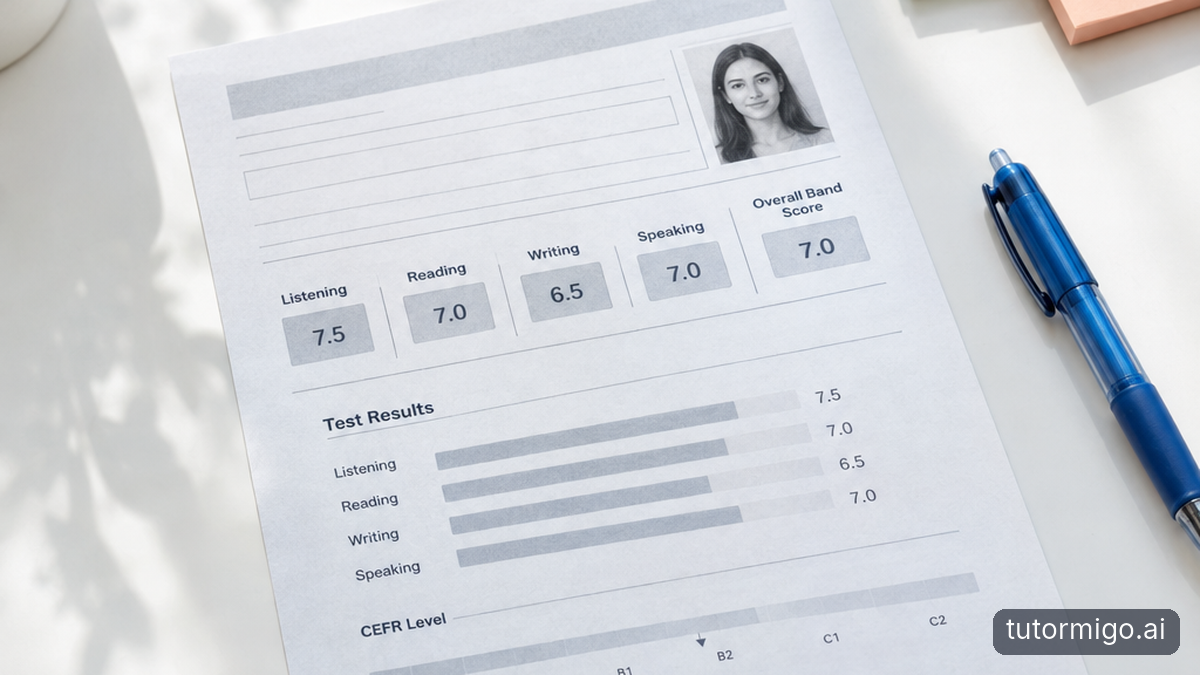
You can spend hours on IELTS preparation and still feel unsure whether you are improving. The solution is not simply more practice: it is knowing your required band, understanding each task, and reviewing mistakes systematically. Start with the test you actually need, then build your study around evidence.
Confirm whether your institution or immigration route requires Academic or General Training. Listening and Speaking are the same in both, but Reading and Writing differ. If you are uncertain, this guide to choosing Academic or General Training explains the distinction. Also confirm the accepted test delivery format before booking.
Reading and Writing each last 60 minutes. Listening takes approximately 30 minutes, with additional checking or transfer arrangements depending on delivery format. Speaking takes 11–14 minutes. Practise using the timing and interface instructions for your booked version.
IELTS reports bands from 0 to 9, including half bands. Your overall band averages the four skill scores using IELTS rounding rules. However, an overall target is not enough: a course might require band 7 overall with no skill below 6.5. Record every requirement, because one weaker skill can prevent you meeting it.
Build Your IELTS Preparation Plan Around Your Target Band

Before choosing a timetable, complete a diagnostic using reliable practice materials for your IELTS version. Time Reading and Listening, write both tasks, and record a Speaking response. Check objective answers against the key. For Writing and Speaking, use the public band descriptors and, where possible, ask an experienced teacher for feedback rather than guessing your band.
Compare your starting point with each required score. If Reading is already close to your target but Writing is consistently weaker, equal study time across all four skills is unlikely to be efficient. Keep stronger skills active while giving the biggest gap more focused attention.
A manageable week might include two Writing sessions, two combined Reading and Listening sessions, one Speaking session, and a longer review period. In a 45-minute session, spend ten minutes revisiting errors, 25 minutes on one task, and ten minutes checking your work. Adjust this around your available time rather than making promises you cannot sustain.
Set weekly goals you can observe: finish a reading passage on time, support each main argument with a relevant example, or reduce spelling errors. A parent, teacher or tutor can review these goals with you without turning every session into another test.
Practise IELTS Listening and Reading Without Falling for Common Traps
In Listening, use the preview time to predict what each gap needs: a date, a place, a number or another detail. Then follow the speaker’s meaning, not just familiar words. A speaker might say, “We originally booked Tuesday, but moved it to Thursday.” Writing Tuesday shows that you noticed a keyword but missed the correction.
Check word limits and spelling carefully. If an instruction permits no more than two words, adding an unnecessary word can lose the mark. After checking answers, replay the relevant segment with the transcript. Identify whether the problem was pronunciation, distraction, vocabulary or losing your place, then listen again without reading.
In Reading, practise locating evidence through paraphrases. A question might mention “a fall in demand” while the passage says “fewer customers wanted the service.” Skim for structure, then scan for the relevant detail rather than reading every sentence equally slowly.
For True, False and Not Given questions, distinguish contradiction from missing information. If the passage says a museum opened in June, it does not establish whether tickets were expensive. That claim is Not Given. Review why each wrong option fails, and move on when a difficult question starts consuming time needed elsewhere.
Improve Your IELTS Writing: Task Requirements, Structure and Clear Arguments
First, learn what each task requires. Academic Task 1 asks you to summarise visual information, selecting key features and making relevant comparisons. General Training Task 1 requires a letter with an appropriate purpose, tone and coverage of the bullet points. Both require at least 150 words. Task 2 requires an essay of at least 250 words.
Task 2 carries twice the weight of Task 1, so a useful starting allocation is about 20 minutes for Task 1 and 40 for Task 2. Include planning and checking within those limits. Do not spend so long polishing your first answer that your essay remains unfinished.
For an essay asking whether public transport should receive more funding, state your position clearly. Develop a paragraph through a claim, an explanation and a relevant example: more frequent buses could make commuting practical for people currently driving. Avoid listing several benefits without explaining any.
Writing assessment considers task fulfilment, organisation, vocabulary and grammar. Impressive vocabulary cannot rescue an answer that misses half the question. In Academic Task 1, include a clear overview rather than listing every figure. After feedback, rewrite one weak paragraph; this is often more useful than immediately attempting another complete answer.
Prepare for IELTS Speaking With Natural, Well-Developed Answers
Speaking has three parts: familiar questions, an individual long turn, and a more developed discussion. In Part 2, you have one minute to prepare and speak for up to two minutes. Practise making brief notes about the prompt rather than trying to write sentences you will read aloud.
For a prompt about a useful skill, your notes could cover cooking, your first attempt, help from a relative, and why the skill matters now. These details give your answer a direction. In Part 1, a direct answer followed by a reason or example is usually more natural than either a one-word reply or a memorised speech.
Record yourself and listen for patterns. Do you stop because you lack vocabulary, restart every sentence, or rush until words become unclear? Choose one issue per practice session. If you forget “colander,” explaining “the bowl with holes used to drain pasta” keeps communication moving.
Assessment covers fluency and coherence, vocabulary, grammar and pronunciation. You do not need to imitate a particular accent; aim to be understandable. For Part 3, practise explaining causes, comparing alternatives and acknowledging exceptions. A teacher or practice partner should ask follow-up questions, helping you respond to unfamiliar ideas rather than rehearse scripts.
Use Timed Mock Tests to Find Weak Spots and Fix Recurring Mistakes
A mock test is useful only if you do something with the results. Use unfamiliar, reliable materials and reproduce the conditions of your booked test as closely as possible. Complete Listening, Reading and Writing in sequence without adding unofficial breaks. Practise Speaking separately with a partner who can maintain the test structure.
Keep an error log that records the task, the mistake, the likely cause and your next action. “Reading question wrong” tells you little. “Chose False because I assumed information not stated; practise distinguishing contradiction from absence” gives you a concrete repair task.
Separate knowledge gaps from execution problems. If you know an answer during review but missed it under time pressure, work on pacing or locating evidence. If you still cannot explain the answer after checking, study the language or task requirement. Repeating timed tests alone will not reliably fix either problem.
Schedule another full mock after you have practised the identified weaknesses, not automatically the next day. Track several results rather than treating one unusually high score as proof of readiness. Use appropriate official conversion guidance for Reading and Listening, and seek informed feedback for Writing and Speaking instead of treating self-assessed bands as precise.
Your Next Steps: Turn IELTS Practice Results Into Focused Study on TutorMigo
Start your next study week with one page containing your required bands, recent results and two priority weaknesses. Make those weaknesses specific enough to practise. “Improve Writing” is too broad; “answer both parts of the essay question and explain each main point” gives your next session a clear purpose.
Choose one short repair activity for each priority. If Listening errors come from missed corrections, replay short exchanges and note the final decision. If Speaking answers lack development, record responses that include a reason and a concrete example. Return to timed practice only after working on the underlying issue.
Agree on how you will check progress. You might compare two essays against the same descriptors or review whether the same Reading error appears in a fresh passage. If someone supports your preparation, ask for feedback on these specific targets rather than a general judgement about whether you are ready. Keep a regular review point so you can change an ineffective activity before it consumes another week.
If you want help organising that work, TutorMigo.ai offers structured IELTS exam preparation with practice sets and progress tracking. Use it alongside reliable test materials and informed feedback to keep your next study session focused.
Frequently asked questions
It depends on your starting level, required bands and study time. Take a diagnostic first, then review progress before choosing a realistic test date.
No. Choose the version your institution or immigration route accepts. Their Reading and Writing tasks differ, so use matching practice materials.
Usually not. Leave time to analyse mistakes and practise weak skills between mocks; otherwise, you risk repeating the same errors.
Public descriptors help you review your work, but self-assessment is approximate. Experienced feedback can identify weaknesses you overlook.
Enjoyed this read?
Like, share, or comment below.



Comments
0Sign in required · respectful discussion · replies supported
Loading comments…