


IELTS preparation: speaking under pressure

You know the answer until an IELTS examiner asks the question. Suddenly, familiar words disappear, every pause feels enormous, and you start correcting sentences halfway through. Effective IELTS speaking practice helps you handle that pressure by combining realistic questions, spoken rehearsal, and feedback tied to the actual assessment criteria.
Your couch can be a useful starting point. It gives you somewhere comfortable to repeat difficult tasks without the pressure of an audience. But comfort alone is not preparation: you still need timed answers, unfamiliar follow-up questions, and a clear reason for each practice session.
The Speaking test lasts 11–14 minutes. Part 1 covers familiar topics, Part 2 asks you to speak at length after one minute of preparation, and Part 3 develops a more abstract discussion related to Part 2. Academic and General Training candidates take the same Speaking test, so your rehearsal should reflect this shared format.
Imagine being asked whether you enjoy cooking. A short answer such as “Yes, because it is interesting” gives you little opportunity to demonstrate your English. A more developed response explains what you cook, when you learned, and why you enjoy it. You are building a relevant answer, not delivering a memorized speech.
Use your AI Tutor to organize questions and review written versions of your responses. Then do the essential part yourself: answer aloud, listen back, and identify one change to make on your next attempt.
The flaw of standard chatbots: conversation is not assessment

A friendly conversation can keep you talking, but it does not necessarily show whether your English meets IELTS expectations. A chatbot might understand “Yesterday I go shopping and buy many thing” and continue naturally. An examiner also considers the repeated tense and noun-form errors. Being understood matters, but it is not the whole assessment.
IELTS Speaking uses four equally weighted criteria: fluency and coherence, lexical resource, grammatical range and accuracy, and pronunciation. Fluency includes developing ideas coherently, not simply speaking quickly. Lexical resource involves appropriate vocabulary and paraphrasing, rather than inserting impressive words. Grammar requires range alongside control. Pronunciation concerns intelligibility and effective use of features such as stress and intonation, not copying a particular accent.
Think of a descriptor-locked IELTS rubric as a practice principle: feedback should stay anchored to those published criteria instead of drifting into vague encouragement. Ask what evidence supports each comment. “Good vocabulary” is less useful than “You repeated ‘good’ four times; try more precise language when describing the service and atmosphere.”
Keep the evidence limits clear, too. A transcript can help you examine word choice, grammar, and organization. It cannot reliably reveal your pronunciation, pacing, or hesitation patterns. If you use a conversational English AI, pair text-based analysis with listening to your own recording or feedback from a qualified teacher.
For a closer look at this distinction, explore speaking practice that goes beyond praise. Encouragement helps you return; specific correction helps you improve.
Build confidence with spoken roleplay at home
Roleplay works best when it recreates an IELTS task rather than an imaginary conversation with no clear purpose. Start with a familiar Part 1 topic, such as your neighborhood. Have a practice partner ask three questions without showing them in advance. Answer naturally, then move on instead of restarting whenever you make a mistake.
For solo practice, use TutorMigo.ai’s AI Tutor Workspace to prepare examiner-style questions in chat. A useful request is: “Give me three IELTS Speaking Part 1 questions about where I live. Show one question at a time, then wait for my typed response before continuing.” Speak your answer aloud first, then type a faithful version for text-based review.
For Part 2, choose a cue card about a place where you relax. Allow one minute to note a location, a specific memory, and why the place matters. Then speak for up to two minutes. If you get stuck, add a concrete detail: what you noticed, who was there, or how the experience differed from your expectations.
Make Part 3 more demanding by changing perspective. After describing a park, discuss why cities need public spaces or whether governments should prioritize them. This shift trains you to move from personal experience to explanation and comparison, rather than recycling the same answer.
Keep the atmosphere low-pressure, but keep the task honest. Do not read a polished script while recording. If you are comparing a voice AI language tutor with other practice options, check whether it actually accepts spoken responses and provides audio-based feedback; a chat interface alone does not establish either capability.
Use band predictions as guidance, not guarantees
A predicted band can feel reassuring, especially when you have an application deadline. But a useful estimate needs more than a confident number. It should identify the criteria assessed, explain the evidence, and acknowledge what the sample cannot show. A single polished answer is not equivalent to a complete Speaking test.
Be especially careful with claims of accuracy within half a band. Unless a provider supplies credible validation against qualified IELTS ratings, that precision should not be treated as established. An automated prediction is not an official result, and TutorMigo.ai’s listed features do not establish validated voice scoring or a half-band accuracy guarantee.
Instead, turn feedback into an evidence log. After a mock, write one observation for each criterion. For fluency, you might note that you lost your thread while explaining a reason. For vocabulary, record repeated reliance on “nice.” For grammar, note that past-tense forms became inconsistent. For pronunciation, identify a word that was difficult to understand in your recording.
Then choose one correction you can test. Replace vague vocabulary with an accurate phrase you already understand, or retell a past experience while maintaining consistent tense. Avoid chasing advanced structures if they make your meaning less clear. A teacher or tutor can help distinguish an occasional slip from a persistent weakness.
Repeat the task with a different topic to see whether the improvement transfers. You can also read about IELTS practice scores you can actually trust before using any estimate to guide your exam plans.
Your next step: a focused couch-to-test routine
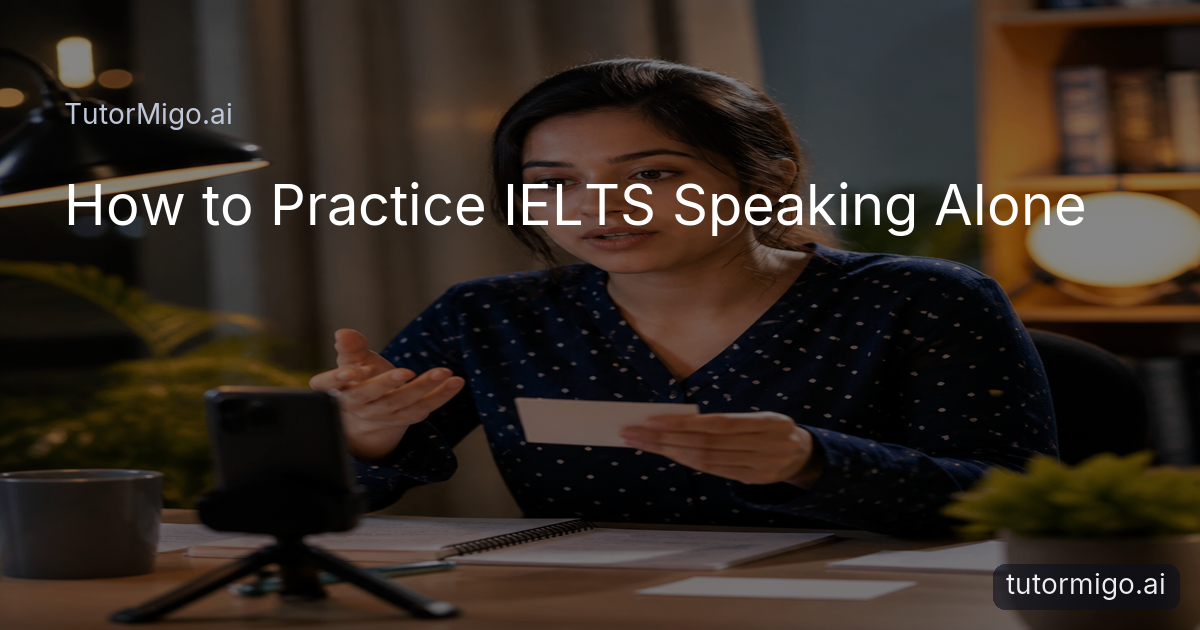
Keep your routine short enough to repeat and specific enough to measure. Start with a few familiar questions as a warm-up. Next, complete one timed Part 2 response and two related Part 3 questions. Record the session using a device you already have, then listen once for meaning and again for your chosen weakness.
On your first review, ask whether a listener can follow the answer. Did you answer the question directly? Did your example support the point? On your second review, focus narrowly: repeated vocabulary, tense control, unclear word stress, or long pauses. Trying to repair every issue at once makes the next attempt harder to manage.
Use your AI Tutor to review a faithful transcript for grammar and vocabulary, while remembering that written analysis cannot replace listening-based pronunciation feedback. TutorMigo.ai’s Exam Preparation feature also provides structured IELTS practice sets and progress tracking, giving your broader IELTS preparation a consistent home.
Every few sessions, complete a full mock without stopping to correct yourself. Ask a teacher, tutor, or willing family member to keep time and save comments until the end. Supporters do not need to interrupt every error; preserving the test conditions is valuable in itself.
Start today with one familiar topic, one recording, and one improvement target. Practice your spoken English with the official IELTS criteria beside you, and use TutorMigo.ai to structure the preparation around it. The goal is not a flawless rehearsal—it is a clearer, more flexible answer when the real examiner asks the next question.
Frequently asked questions
Yes. Use realistic questions, timed recordings, and regular full mocks. Include unfamiliar follow-up questions and get occasional feedback from a qualified teacher so comfortable practice does not hide recurring weaknesses.
No. Focus on being understandable, with clear sounds, appropriate stress, and helpful intonation. You do not need to imitate a particular national accent.
Accuracy depends on the system and its validation. Text-only feedback cannot assess pronunciation reliably, and an automated estimate is not an official IELTS result. Treat predictions as guidance, not guarantees.
Practice useful vocabulary and ways to develop ideas, but avoid memorizing complete scripts. Unfamiliar follow-up questions require flexible, relevant answers rather than rehearsed speeches.
Enjoyed this read?
Like, share, or comment below.


Comments
0Sign in required · respectful discussion · replies supported
Loading comments…