

Turn English Hesitation Into Confidence: One Bangladeshi Learner’s IELTS Preparation Story

If you pause before every English sentence, worry about choosing the wrong word, or avoid writing because your ideas feel disorganized, you are not alone. Many Bangladeshi job seekers and study-abroad aspirants know the answer but hesitate when they must speak or write quickly. A focused IELTS preparation routine can turn that hesitation into steady, measurable progress.
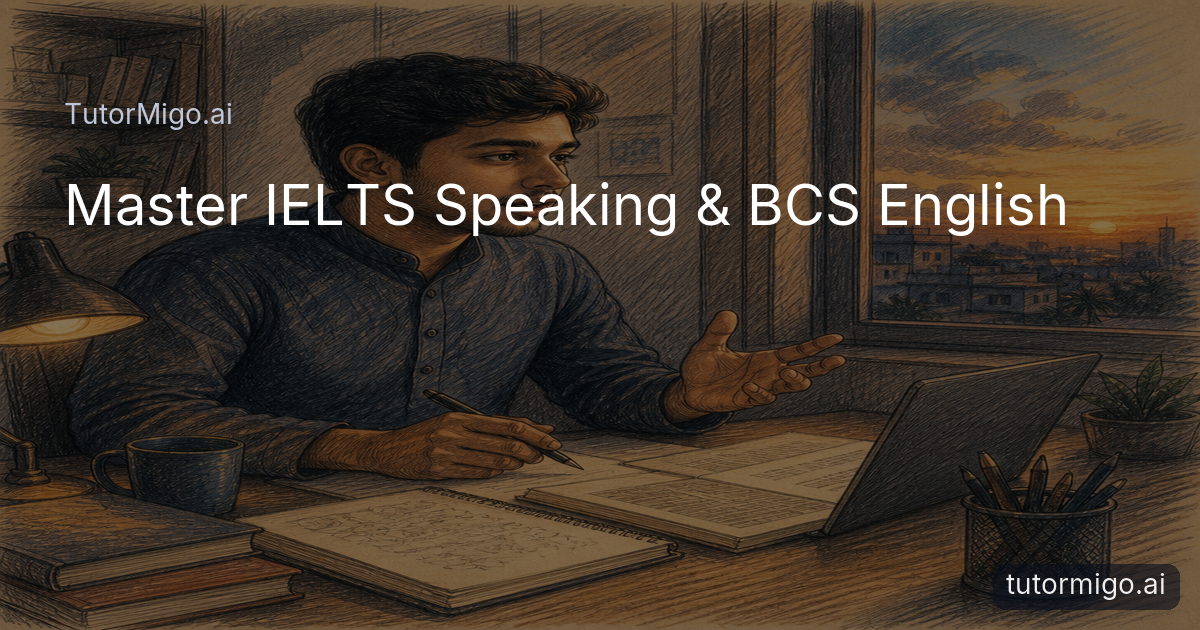
Consider Rafi, a graduate preparing for IELTS while reviewing English for the BCS Preliminary exam. In his first speaking practice, he answered a question about a useful skill with short replies: “I think communication. It is important. Everyone needs it.” His ideas were valid, but limited vocabulary and fear of mistakes stopped him from developing them.
Instead of memorizing long speeches, Rafi practiced a simple pattern: answer, reason, example, and result. He recorded or typed a one-minute response, then reviewed repeated words such as “important” and “good.” He replaced them with precise choices such as “valuable,” “practical,” and “essential” only when they matched his meaning.
He used the same confidence-building approach in writing. Rather than trying to sound impressive, he focused on a clear position, logical paragraphs, and specific examples. For additional solo speaking ideas, explore this guide to practicing IELTS speaking alone.
Understand IELTS Speaking and Writing Band Scores Alongside BCS Preliminary English Priorities

IELTS speaking and writing are assessed through band scores, so improvement means more than collecting difficult words. In Speaking, you need to communicate with fluency and coherence, use suitable vocabulary, show grammatical range and accuracy, and speak clearly enough to be understood. In Writing, examiners look at task response, organization, vocabulary, and grammar. A polished word is not useful if the sentence becomes unclear.
That gives you a practical target: make your meaning easy to follow first, then improve range and precision. For example, “Many graduates choose overseas study because it gives them better career opportunities” is stronger than a longer sentence packed with unfamiliar expressions but weak connections.
BCS Preliminary English revision overlaps with these foundations but has a different priority. You may need regular practice with grammar rules, vocabulary, sentence correction, reading comprehension, and questions that test accurate recognition under time pressure. Do not treat BCS practice as a substitute for IELTS tasks. Use BCS questions to strengthen accuracy and IELTS responses to build communication.
Choose one correction goal per session: clearer linking, fewer grammar errors, or more precise vocabulary. A narrow target is easier to notice and repeat.
Review your work against the demands of each exam. IELTS asks you to produce connected language; BCS Preliminary English often rewards quick, exact selection.
Build a Step-by-Step IELTS Preparation Plan for Listening, Reading, Writing, and Speaking
Start with a weekly plan that gives every IELTS skill a clear job. On two days, complete a Listening section and review each incorrect answer. Do not only check the key; identify whether you missed a spelling detail, lost focus, or failed to predict the answer type. On two other days, practice Reading with a time limit. Mark the sentence that proves each answer so you learn to locate evidence rather than guess.
Reserve at least two sessions for Writing. One can focus on Task 1 organization and accurate descriptions; the other can focus on Task 2 planning, paragraph development, and editing. For Speaking, practice short answers, follow-up questions, and one- to two-minute topic responses. If you study alone, type a transcript after speaking and underline repeated words, unfinished sentences, and places where your idea needed an example.
A useful four-week cycle is simple. Week one establishes your baseline with one timed set and a short speaking sample. Week two targets your two most frequent errors. Week three adds more timed practice and unfamiliar topics. Week four reduces new material and emphasizes review, calm pacing, and complete mock sections.
Keep a small error log with the question, mistake, correction, and next action. This turns vague frustration into a study decision. A structured IELTS preparation guide for all four skills can help you compare your routine with a complete skill-by-skill approach.
Improve IELTS Writing Task 2 with Clear Essay Structure and Common-Mistake Fixes
Before writing Task 2, spend a few minutes identifying the question type and your exact position. Suppose the prompt asks whether employers should prioritize practical skills over academic qualifications. Your introduction should paraphrase the issue and state a direct position. Each body paragraph should then develop one main reason with an explanation and a concrete example. A short conclusion should restate the position without adding a new argument.
Imagine your first paragraph claims that practical skills improve workplace readiness. Explain how a candidate who can manage a project or communicate with customers may contribute sooner, then give a realistic example. Avoid listing three reasons in one paragraph; the examiner should be able to see the central idea immediately.
Common mistakes are often fixable. If every sentence begins with “Moreover,” vary your linking naturally or remove the connector when the relationship is already clear. If you write “people is,” slow down during editing and check subject-verb agreement. If your examples are broad, add who, what, or why. Replace memorized phrases that do not fit the question with direct language.
Use a final editing pass for four checks: task response, paragraph logic, repeated vocabulary, and grammar errors. Clear structure usually helps your vocabulary and ideas receive proper credit instead of being buried in a difficult-to-follow essay.
Practice Spoken Vocabulary and Essay Structure with Judgment-Free TutorMigo Feedback
Hesitation becomes easier to manage when feedback arrives during practice rather than only after an exam. In a TutorMigo session, you can present a speaking answer as typed notes or a transcript and ask an AI Tutor to identify repeated vocabulary, missing development, and more natural alternatives. The point is not to label your English as “bad.” It is to show the next useful revision.
For example, type this response to a speaking question: “I want to work abroad because it is good. It will help my future and I can learn many things.” The tutor can help you expand the reason: “I want to work abroad because international experience could improve my professional skills and expose me to different workplace practices.” You can then practice saying the revised idea aloud, without memorizing a complete script.
You can use the same interaction for an essay plan. Share your introduction and two topic sentences, then ask whether the position is clear and whether each paragraph has a distinct purpose. If the feedback says both paragraphs repeat the same point, move one idea to a different example rather than adding more complicated words.
Ask for one correction, one explanation, and one replacement example. That keeps feedback actionable and reduces the fear of making mistakes.
This kind of AI Tutor practice is especially useful when you need a private first attempt before working with a teacher, tutor, or parent supporter.
Use IELTS Mock Tests and Progress Tracking to Plan Your Final BCS and IELTS Review
Mock practice is most useful when it leads to a decision. Start with a complete or sectional IELTS mock under realistic timing, then record results by skill instead of relying on one overall impression. A weak Listening result may come from spelling, concentration, or unfamiliar question types. A weak Writing result may reflect task response or organization. Your review should name the cause and the next practice task.
For the final weeks, alternate full practice with targeted repair. After a Reading mock, review every wrong answer and classify it as vocabulary, evidence location, timing, or misunderstanding. After Speaking practice, count repeated words and note whether each answer includes a reason or example. After Writing, compare your paragraph plan with the finished essay and mark where the logic became unclear.
Keep BCS Preliminary English in a separate review column. Schedule short, frequent sets for grammar, vocabulary, and comprehension, then revisit your error log. Do not spend your final IELTS week memorizing large word lists or your final BCS review writing full IELTS essays every day. Match the task to the exam and protect time for sleep and calm practice.
TutorMigo’s exam preparation workspace can support structured IELTS practice sets and progress tracking, helping you see whether your plan is working. Your final goal is not perfect English in every situation. It is controlled performance: understand the question, organize your answer, communicate clearly, and recover when a word does not come immediately.
Frequently asked questions
Yes, overlapping practice in vocabulary, grammar, reading, and accuracy can help. However, IELTS requires extended speaking and writing, while BCS Preliminary English requires focused preparation for its own question styles and time limits.
Begin privately with short typed answers or transcripts, then practice saying them aloud. Review one issue at a time, such as repeated vocabulary or missing examples, instead of judging your entire performance.
Choose a clear position, write one main reason per body paragraph, explain the reason, and add a specific example. Clear development is more useful than forcing advanced vocabulary into the essay.
Use a baseline mock early, then combine targeted practice with regular sectional or full mocks. In the final weeks, review mistakes carefully so each mock produces a specific next action.
Related reading
Enjoyed this read?
Like, share, or comment below.



Comments
0Sign in required · respectful discussion · replies supported
Loading comments…