


Why you may need to show your work for full marks
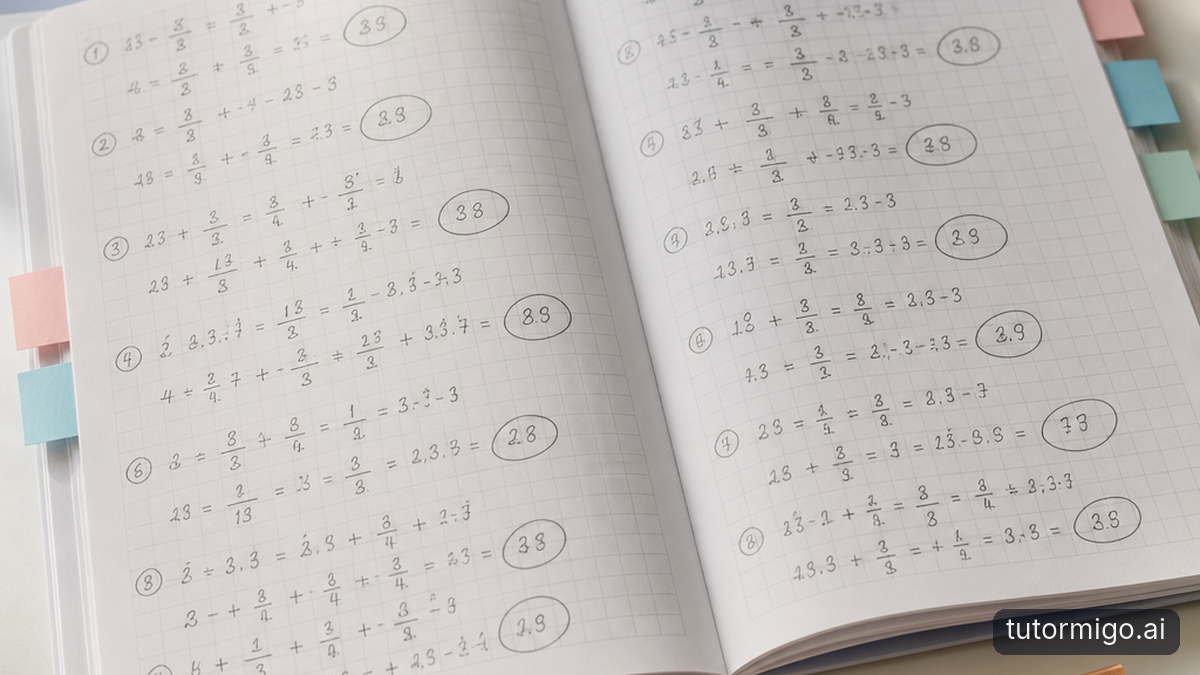
When a question asks you to show your work, the answer is only part of the evidence. Your teacher may also need to see which method you chose, whether you applied it correctly, and how your conclusion follows. Mental shortcuts can hide all three. You may understand the problem perfectly, but a marker cannot reliably award method marks for reasoning that never reaches the page.
Imagine an eight-mark question whose rubric reserves four marks for the method and four for the result. An unexplained correct answer could lose half the available marks. That is an illustration, not a universal marking rule: the actual deduction depends on the question and rubric. Before changing your habits, look at a recently marked test and identify exactly where the missing evidence cost you.
Separate comments such as “incorrect calculation” from “show method” or “justify.” They describe different problems. More calculation practice may help the first; clearer documentation addresses the others. Ask your teacher to show you one response that earns full method marks. Notice its essential lines rather than its length. The goal is to make your reasoning assessable, not to turn every short calculation into an essay. That distinction keeps your practice focused and manageable.
Use a simple structure that makes reasoning visible
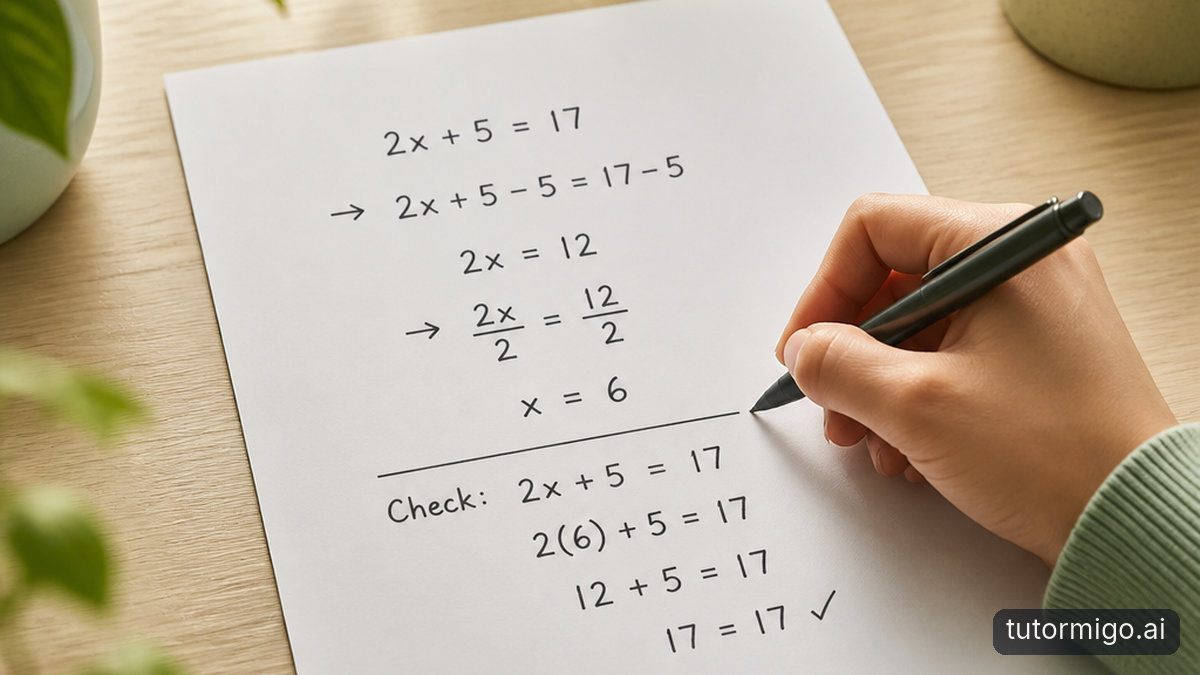
A useful solution has four parts: state the starting relationship, name the operation or principle, show the important intermediate result, and check the conclusion. You do not need four lengthy paragraphs. Often, a few aligned lines and a short explanation are enough. The structure gives your reader a path to follow without asking them to reconstruct your mental arithmetic.
Suppose the question is to solve . Start with that equation, then explain that you subtract five from both sides to preserve equality. Show . Next, divide both sides by three and write . Finally, substitute the answer into the original equation: . Each line has a purpose, and the check returns to the question you were actually asked.
Compare that with writing only . Both responses give the same answer, but only the first supplies evidence of a valid method. You can compress familiar arithmetic when your rubric allows it; do not remove the step that explains why the transformation is legitimate. For a word problem, add what the quantity represents and include the requested units in your conclusion.
Before moving on, ask: could someone follow this solution without asking me what happened between these two lines?
Use tutoring feedback to practise the process
One of the practical TutorMigo benefits to explore is using personalized tutoring for the parts of a solution you usually leave unwritten. In the AI Tutor Workspace, submit your attempt before asking for an explanation. Request feedback on missing transitions, unclear justifications, and whether your check actually tests the original condition. This makes the conversation about your reasoning rather than simply collecting an answer.
Try this prompt: “I will submit my solution one step at a time. Ask me to justify each transformation before we continue. If I skip a necessary line, ask a question instead of completing it for me.” You are setting up a show-your-thinking practice routine, not relying on a verified product mode with that name. Likewise, conversational feedback is not the same as official grading against your teacher’s mark scheme.
An AI Tutor can support the rehearsal, but you should still compare suggestions with your course methods and rubric. If feedback says a line is missing, ask which mathematical claim needs supporting. That question is more useful than requesting a longer solution. You want the smallest clear explanation that demonstrates understanding, not extra wording that merely looks thorough.
Make your working easy to inspect and revisit
Clear reasoning also needs a readable layout. Keep equivalent equations on separate lines, place explanations beside the relevant transformation, and avoid scattering calculations around the page. If you make an error, cross it out clearly and continue from the last valid step. A marker should not have to guess which of several answers you intend to submit or where your corrected method begins.
For digital practice, the Study Tools Hub includes a whiteboard and math step editor. These offer places to practise laying out a solution. Use them deliberately: write the starting equation, separate the transformations, and keep your final check visible. The benefit comes from the way you organize the work, not from assuming the tools automatically certify every line or award method marks.
You can also use session history in the tutoring workspace to revisit a previous explanation. Bring an earlier attempt into your next practice conversation and ask whether the same documentation gap appears again. Perhaps you routinely omit substitution, or perhaps you jump straight from a diagram to a result. For a broader explanation of this approach, read about building understanding through step-by-step tutoring. Revisit one recurring gap at a time rather than trying to change everything at once.
Check the method without turning feedback into copying
After receiving feedback, close the worked explanation and solve a similar problem independently. Otherwise, a beautifully documented response may only show that you can copy a model. Change a value or choose another question using the same principle. Then check whether you can select the method, explain the crucial transformation, and verify the result without borrowing the previous wording.
For example, after practising , try . The arithmetic changes, but the reasoning pattern remains: preserve equality while isolating the unknown, then substitute to check. Explain those decisions in your own words. If you cannot explain why the same operation must affect both sides, return to that concept rather than memorizing a sequence of lines.
A general-purpose chatbot can also discuss working when prompted; the practical comparison is how well your chosen tool supports the routine you will maintain. With an AI Tutor, test the experience using your own incomplete solution, not just a request for a polished answer. Parents and teachers can use the same approach in conversation: ask “Why does that step follow?” before offering a correction. Independent explanation is stronger evidence of progress than a neat answer produced with continuous help.
What to do next: repair one missing step
Start with one marked question where you reached the correct answer but lost method marks. Keep the original response unchanged, and write a second version beside it. Add only the missing evidence: perhaps the formula you selected, the substitution you performed, or the reason a transformation is valid. Use the teacher’s comments or available rubric to judge whether the revision addresses the actual deduction.
Then practise a small set of similar questions without looking at the repaired example. After each one, review three things: whether the method is identifiable, whether every important transition is supported, and whether the final result answers the question. Record the kind of gap you found, such as “missing justification,” rather than simply labelling the attempt good or bad. This makes your next practice session more targeted.
Once the structure feels natural, repeat the exercise under realistic time limits. You are building a concise habit, not adding unlimited writing to every test. If you use TutorMigo.ai, bring your attempt and the relevant marking guidance into the conversation and request process-focused feedback. Your next goal is straightforward: make the reasoning you already do visible enough that someone else can assess it fairly.
Frequently asked questions
No. Deductions depend on the question and marking scheme. Half the marks is a possible example, not a general rule. Check your teacher’s expectations.
Show the starting relationship, important transformations, necessary justification, and a suitable check. Use the rubric to decide how much intermediate detail is required.
The supported feature list does not establish a dedicated mode with that name or automatic process grading. You can request step-by-step reasoning feedback in tutoring chat.
Practise recording the key decisions anyway. You do not need to document every mental calculation, but your written response must demonstrate the method being assessed.
Related reading
Enjoyed this read?
Like, share, or comment below.



Comments
0Sign in required · respectful discussion · replies supported
Loading comments…