


Spark a science fair question with a story
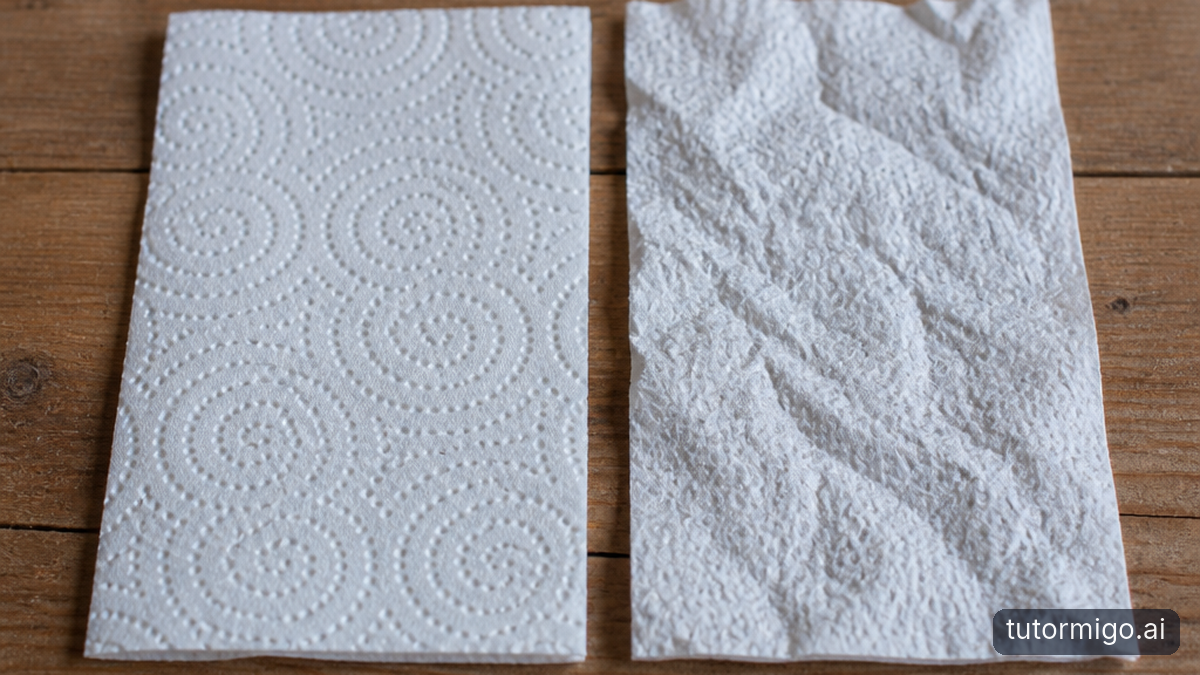
A useful science story creates a puzzle without supplying its solution. Imagine Zera describing a picnic where someone spills water. Two paper towels look similar, but one seems to soak up the puddle faster. Why might that happen? You now have a situation worth investigating, rather than an instruction to prove that a particular towel is best.
Zera’s role as a curious science buddy is to keep the possibilities open: “What if the sheets were different sizes?” “What if one towel touched the water longer?” “What if the result changed when you tried again?” Each question exposes something the story leaves uncertain. That uncertainty is the starting point for your experiment, not a flaw to hide.
Keep the storytelling brief, then separate observation from imagination. The spill is an imagined setting; claims about towel performance still need evidence. Ask yourself what you could actually observe with available materials. A useful transition is: “In this story, I wonder whether…” Finish that sentence yourself before asking for another prompt. You should leave the story with several possible questions and ownership of the one you choose, not a script to follow.
Turn “what if” into a testable hypothesis
“Which towel is best?” sounds practical, but “best” could mean strongest, cheapest, fastest, or most absorbent. Zera’s what-if approach becomes useful when it nudges you to choose one meaning: “What if we judged the towels only by how far water travels through them in one minute?” Now you have a measurable outcome instead of a vague preference.
For this example, your question could be: “How does paper towel brand affect the height water rises through equal-sized strips after one minute?” Your hypothesis might be: “I predict water will rise farther through Brand Cedar than Brand Maple because its visible texture may create different pathways for water.” The names are placeholders, and the proposed explanation is tentative. You will need evidence to judge it.
Notice that this investigates water rise under specified conditions, not total absorbency. Naming the measurement accurately prevents a narrow result from turning into an oversized claim. A good hypothesis does not have to be correct; it has to make a prediction your procedure can challenge.
Ask Zera for a question that checks your hypothesis, not a replacement hypothesis: “What part of my prediction is still too vague to test?”
Build a fair test before collecting results
Once you have a prediction, design the comparison. Your independent variable is the factor you deliberately change: paper towel brand. Your dependent variable is what you measure: water-rise height after one minute. Controls are the conditions you keep consistent so differences are less likely to come from something else. These terms matter because each describes a decision you must defend.
Cut strips to the same width and length, keeping each towel’s original layers intact. Use the same water source, container, starting depth, and timing method. Hold each strip vertically with its bottom edge immersed to the same depth. Measure from the water surface to the wet front using the same rule each time. If the front is uneven, decide in advance whether you will record its midpoint.
Zera can introduce a complication through a what-if prompt: “What if the last strip sits deeper in the water?” Your response should be a procedural safeguard, such as marking the immersion depth. This turns storytelling into experimental discipline rather than extra decoration.
Plan several fresh strips per brand and alternate the testing order. Use strips from different sheets where practical. Repeated trials reveal variation, although samples from one roll still limit how broadly you can generalize. Check the fair’s rules and ask an adult about unfamiliar materials; this project needs no heat, cleaning chemicals, or tasting.
Plan the evidence, including awkward results
Before wetting the first strip, draw a results table with spaces for brand, trial, water-rise height, and observations. Include units in the measurement heading. Record each result immediately, rather than remembering which strip “looked better.” Notes such as “strip touched container wall” can explain an unusual reading without quietly erasing it.
Choose how you will summarize repeated measurements before seeing which brand appears ahead. An average can help describe the typical result, but show the individual readings too. If the brands’ results overlap substantially, a small difference between averages may not support a confident claim. A simple graph can make both the pattern and the variation easier to see.
This is another useful moment for Zera’s scenarios: “What if the result goes against your prediction?” The scientific response is not to change the hypothesis after the fact. Report what happened, consider limitations, and suggest a follow-up investigation. If an actual procedural mistake occurs, document it and explain whether you repeated that trial.
Keep the conclusion tied to the question. You might conclude that one brand showed greater water rise under your test conditions. You cannot automatically conclude that it cleans spills better, holds more water overall, or performs the same way with every liquid.
Make Zera’s support smaller as your reasoning grows
Scaffolding should gradually disappear. Early on, Zera’s story might offer several possible directions. Later, a single question should be enough to help you spot a missing decision. Once your plan is workable, try explaining it without prompts. The purpose is to strengthen your reasoning, not make every stage dependent on another conversation.
Use a simple progression: first request a hint, then explain your choice, then check it independently. For example, instead of asking, “Write my experimental method,” try, “Ask me one question that could reveal an unfair comparison.” After answering, revise your own method and explain why the change improves the test. You retain responsibility for the decision and its wording.
A parent or teacher can use the same approach. Ask, “What evidence would change your mind?” or “Could someone repeat this using only your notes?” Avoid rescuing the project with a polished explanation the student cannot defend. A modest experiment understood deeply is more valuable than an elaborate one understood superficially.
Keep a decision log with your original question, rejected alternatives, and reasons for revisions. Those notes show how your investigation developed. For a broader view of this process, explore project-based learning for a science fair investigation. Tutormigo.ai
Your next step: run a small pilot
Before committing to the full experiment, run a small pilot to check whether the procedure is usable. Can you see the wet front clearly? Can you start the timer consistently? Does the strip stay upright without touching the container? The pilot is for finding practical problems, not selecting whichever setup makes your preferred brand win.
Write down any changes, then settle the procedure before collecting the main results. Keep pilot measurements separate if the method changes. Prepare enough fresh samples, make your blank results table, and rehearse how you will record observations. This preparation turns an interesting question into a manageable investigation while leaving room for genuine surprise.
Finally, explain your project aloud in four parts: what you are asking, what you predict, how you will test it, and what your evidence could reasonably show. If you get stuck, return to one focused what-if question rather than asking for a complete solution. You are ready when you can explain both your choices and their limits.
If you want a place to practice that questioning process, TutorMigo.ai offers a personal tutor workspace where you can discuss your plan and revisit the conversation while keeping the experimental decisions your own.
Frequently asked questions
A short story gives you a concrete puzzle to investigate. Zera’s what-if questions then help separate possible explanations and identify something measurable. The story sparks the question; the experiment supplies the evidence.
It predicts an observable outcome when you change a specific factor under defined conditions. Your method must allow evidence to challenge the prediction, not simply illustrate an assumption.
Report them honestly. Explain what the measurements show, discuss procedural limitations, and propose a follow-up question. An unsupported prediction can still lead to a rigorous, worthwhile project.
Try explaining your question, controls, measurements, and conclusion without prompts. If you cannot justify a choice, ask for one checking question and work through the decision yourself.
Related reading
Enjoyed this read?
Like, share, or comment below.



Comments
0Sign in required · respectful discussion · replies supported
Loading comments…