


Test Preparation for Tomorrow: Start Calm
Your test is tomorrow, you know what is covered, and you have barely revised. That sinking feeling is understandable; you do not need a lecture. Tonight, aim to make useful progress, not master everything: choose worthwhile topics, test your memory, correct mistakes, and stop in time to sleep.
First, take a couple of minutes to settle your workspace. Put your phone out of reach, get some water, and gather the study guide, class notes and practice questions you already have. You are not looking for the perfect revision resource. Opening ten new tabs creates more decisions when you need fewer.
Make the goal small enough to act on: “I will practice the main question types and fix the mistakes I can fix tonight.” That is more useful than “I must learn the whole course.” You may still feel worried while working; feeling completely calm is not a requirement for getting started.
Decide your stopping time before you begin. Work backwards from when you must wake up, leave room for your usual sleep needs, and protect a short wind-down period. If that leaves only an hour, use an hour well. Do not quietly turn it into an all-night session because the study guide looks long.
First 15 Minutes: Rank Your Study Guide Topics and Set a Realistic Evening Schedule
Use your study guide as the boundary for tonight. Beside each topic, mark whether you can explain it, partly remember it, or cannot yet answer a basic question about it. Check those judgments with a quick prompt where possible: explain a term aloud or sketch the first steps of a problem without looking.
Next, consider importance. Give priority to topics your teacher explicitly emphasized, skills repeated in assigned practice, and ideas needed for several question types. Do not pretend you can predict the paper. You are using the evidence you have, not guessing which obscure detail might appear.
Your best first target is often an important topic you partly understand. For example, if the guide includes vocabulary, interpreting graphs and explaining an unfamiliar process, you might secure shaky graph-reading skills before tackling that process. Keep already-solid vocabulary for a brief check rather than spending half the evening proving you know it.
For an evening starting at 7:00, use 7:00–7:15 to rank topics, 7:15–7:55 for closed-note practice, and 7:55–8:05 for a break. Use 8:05–8:45 to correct and retry, then 8:45–8:55 for a final review. Pack afterwards and wind down before a planned 9:30 bedtime. Adjust those times to your routine; preserve the sequence, not the clock. Choose two or three priorities, with the rest clearly parked.
Your First Study Block: Answer Questions Without Notes Instead of Rereading Everything
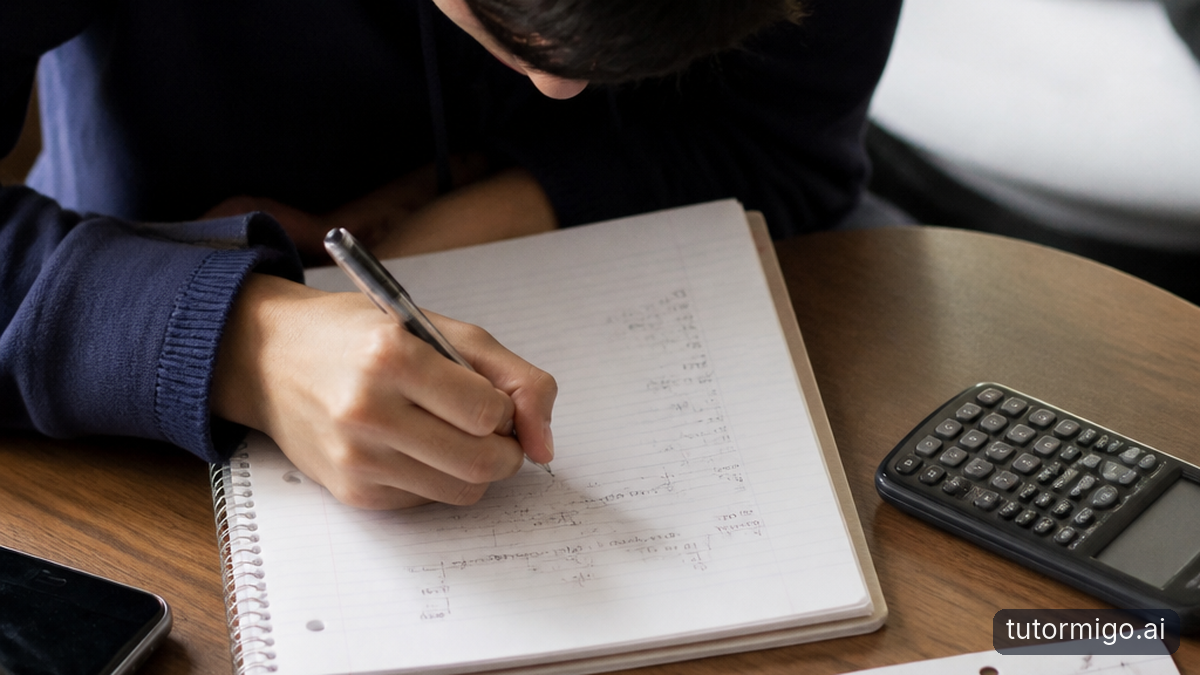
Start with a small set of questions from your priority topics. Use assigned practice, questions at the end of a chapter, or prompts from the study guide. Close your notes and attempt the answers. If you cannot finish, write what you do remember and identify exactly where you get stuck.
Match the practice to what the test asks you to do. If you need to explain, write a short explanation. If you need to solve problems, work through them on paper. For a graph question, identify the pattern and support your answer with evidence from the graph rather than simply recalling a definition.
Try a manageable batch, such as four questions, before checking. Mark each answer as correct, partly correct or incorrect, and note any correct answer that was a guess. This gives you a useful picture of what is available from memory, rather than what looks familiar on a page.
Rereading everything can feel reassuring because the material is in front of you. But recognizing a sentence is not the same as producing an answer tomorrow. Tonight, use reading to resolve a specific gap revealed by practice. If you blank on a question, make a brief attempt, flag it and move on; one difficult prompt should not consume the entire block.
Your Next Study Block: Correct Mistakes and Try Again—Skip Elaborate Notes
After your break, check your answers against reliable class materials, worked examples or an answer key. Look beyond the final result. Did you misunderstand the question, forget a fact, choose the wrong method, or make a careless slip? Different mistakes need different repairs, so “revise this topic” is usually too vague.
For each important error, write one short correction and then do something with it. If you misread a graph’s scale, note “check the scale before reading values,” then answer another graph question. If your explanation missed a cause, read that part of your notes, close them, and explain the cause again in your own words.
A useful mistake record can be just three brief lines: what went wrong, the correct idea, and the question to retry. Avoid copying whole pages or designing colour-coded summaries. Elaborate notes take time to produce, and you may finish with attractive pages but little evidence that you can answer independently.
Return to the original question after working on something else, or attempt a similar one if you have it. Getting an answer right immediately after reading it is a start, not proof it will stick. If a topic remains confusing after a focused attempt, record the gap and move to another worthwhile target. Tonight requires choices, not endless wrestling with one problem.
Your Final 10 Minutes: Review Key Gaps and Stop at Your Planned Bedtime
Use the final ten minutes to consolidate, not expand. Put away the full study guide and look at your short mistake record. Choose a few prompts that capture the evening’s most important corrections. Answer them without notes, then check only what you need to check.
For example, explain the distinction you kept mixing up, describe the steps of a method, and retry one question you previously missed. A useful final review might reveal that two corrections now make sense while one still needs a reminder. That is clearer information than another hurried sweep through every chapter.
Make a tiny morning recall sheet with three to five prompts, not a dense summary. “Explain why this process happens” is more useful than several copied paragraphs. Keep any answers separate so you can genuinely test yourself in the morning. Put unresolved, lower-priority material aside rather than adding it to an impossible morning agenda.
Then stop at your planned study cutoff, leaving time to wind down before bed. Tiredness can make another hour look productive when you are mostly rereading the same lines. Sleep supports memory and attention; it is part of preparation, not a reward for finishing everything. You do not need to feel fully ready before closing the book.
Before Tomorrow’s Test: A Short Checklist for Sleep, Packing and Morning Recall
Once studying ends, remove a few avoidable pressures from tomorrow. Check the test’s start time and location, set your alarm, and pack the materials you are allowed to bring. Put essentials together now rather than relying on a rushed search in the morning. Check whether any equipment needs charging or fresh batteries.
Give yourself a quiet transition to bed instead of checking classmates’ messages about everything they have revised. Their lists can restart the panic without changing your priorities. If a worry keeps circling, write down the practical action attached to it, such as checking your bag, then leave the revision materials closed.
In the morning, spend about five minutes answering the prompts you prepared. Check a missed answer briefly, then move on with your normal routine. This is a warm-up, not another study marathon. Discovering one remaining gap does not cancel the useful work you did last night or mean you should reopen every topic.
If you want help keeping these short recall prompts for later review, TutorMigo.ai offers flashcard decks with review scheduling. That can wait until after the test; tonight’s next step is to finish and rest.
Protect your planned sleep and set an alarm.
Pack pens, permitted equipment and any required identification.
Do a brief morning recall check, then put the notes away.
Frequently asked questions
Spend a few minutes choosing one or two important, partly understood topics. Use most of the hour to answer questions, check mistakes and retry. Reserve the last few minutes for a short recall check, then stop.
Not automatically. Prioritise importance and what you can realistically improve tonight. An important topic you partly understand may be a better use of time than a difficult, isolated topic you would need to learn from scratch.
Yes, when it answers a specific question exposed by practice. Read the relevant passage, close it and try again. Avoid rereading the entire course instead of checking what you can recall.
No. Feeling ready is an unreliable stopping rule when you are anxious. Set a cutoff that protects sleep and wind-down time, and stop even if some material remains unfinished.
Related reading
Enjoyed this read?
Like, share, or comment below.



Comments
0Sign in required · respectful discussion · replies supported
Loading comments…