


Use Mind Mapping to Connect Ideas

You reread three pages, recognise every term, and still cannot explain how the ideas fit together. A mind map can turn that tangle into a structure: one central question, a few main branches, and labelled connections. The goal is not a prettier page, but an explanation you can reconstruct.
Dense notes often preserve the order in which information appeared, not the relationships you need to understand. A paragraph introduces sunlight, another describes chloroplasts, and a later section discusses sugar production. You may remember those details separately while missing the process that connects them. Mapping asks you to decide what belongs together and why.
That is the practical power of visual learning: making relationships visible so you can inspect them. It does not mean you have a fixed visual learning style, or that diagrams always beat words. A useful map combines short verbal explanations with spatial organisation. You still need accurate reading, checking and practice explaining the material.
Think of mind mapping for students and adult learners as a way to reorganise existing notes, rather than another set to maintain. If you can follow each branch and explain each connection aloud, the map is doing useful work. If you only recognise its colours and shapes, it needs a stronger recall task.
Choose a Central Topic or Question, Then Branch Into the Main Ideas
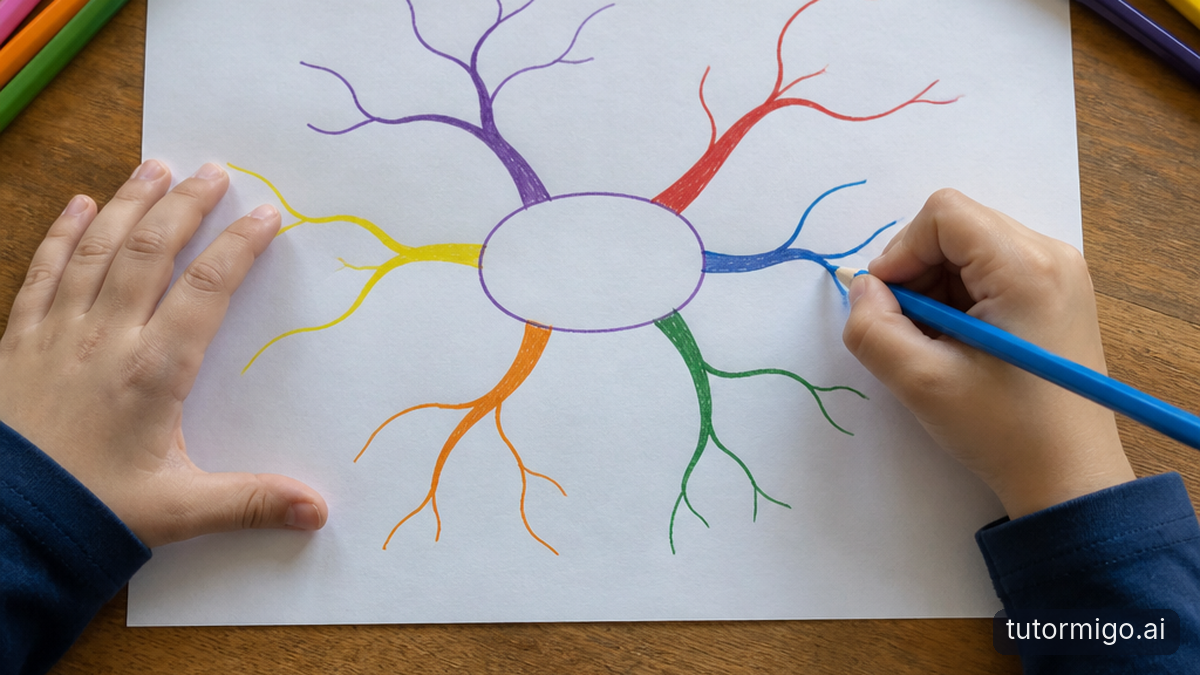
Put the idea that controls the passage at the centre. A topic such as “Photosynthesis” works when you need an overview. A question such as “How does a plant use light to build sugars?” is better when you need to explain a process. The centre should set a clear boundary: what will this map help you understand?
Avoid centres that are too broad, such as “Biology”, because almost anything could become a branch. Equally, “Chlorophyll absorbs light” is too narrow for a map of the whole process. Check your choice by finishing this sentence: “After studying this map, I should be able to explain…” If your answer keeps expanding, narrow the question.
Next, skim your notes for a few main categories. For photosynthesis, useful branches are inputs, location, stages and outputs. These are organising choices, not a required template. If your passage focuses on how environmental conditions affect photosynthesis, its main branches might instead be light, carbon dioxide availability and temperature.
Add smaller branches only where they answer a useful question about the parent branch. Under location, place chloroplasts, then distinguish thylakoid membranes from the surrounding stroma. Keep related details together. If a branch becomes crowded, ask whether it contains two different ideas or whether some details belong on a separate, more focused map.
Use Keywords, Colours and Labelled Cross-Links to Make Relationships Clear
Use short phrases that preserve meaning, not isolated words chosen only to save space. “Water” is less informative than “Water supplies electrons”. “Light reactions” may be enough once you understand them, but “Light reactions capture light energy” gives you a better explanation cue while learning. Keep definitions or exceptions in a small nearby note when shortening them would distort the idea.
Give colour a consistent job. You might use blue for inputs, green for stages and orange for outputs. Alternatively, give each main branch its own colour so you can follow its details easily. Pick one system rather than switching halfway through. Colour should help you navigate; it should not carry essential meaning that disappears in a black-and-white copy.
Cross-links connect ideas on different branches. Draw an arrow and label the relationship with a verb or short phrase: “provides energy for”, “takes place in” or “produces”. An unlabelled line says that two things are connected, but leaves you guessing how. Check the arrow direction by reading the linked ideas as a sentence.
Keep only cross-links that clarify something important. A web of arrows can become harder to read than your original notes. For anyone interested in helping visual learners study, the useful question is not “Is this colourful enough?” but “Does this representation make the relationship easier to explain?”
Photosynthesis in Practice: Map the Inputs, Stages and Outputs, Then Explain the Connections
Start with “How does photosynthesis use light to build sugars?” at the centre. On the inputs branch, add light, water and carbon dioxide. Label light as an energy source rather than a material ingredient. On the location branch, add chloroplasts, with thylakoid membranes and stroma beneath it. These locations will connect to the two main stages.
On the stages branch, add light-dependent reactions and the Calvin cycle. The light-dependent reactions occur in the thylakoid membranes. They capture light energy, split water and produce energy-carrying molecules; oxygen is released. The Calvin cycle occurs in the stroma and uses carbon dioxide and those energy-carrying molecules to build small sugar molecules.
On the outputs branch, add oxygen and sugars. Note that the small sugar molecules can be used to make glucose and other carbohydrates. Avoid drawing a shortcut that suggests sunlight directly turns into sugar, or that the released oxygen comes from carbon dioxide. The oxygen released during photosynthesis comes from water.
Now add the cross-links that make the map explanatory. Connect water to the light-dependent reactions with “is split during”. Connect those reactions to the Calvin cycle with “supply energy-carrying molecules to”. Connect carbon dioxide to the Calvin cycle with “provides carbon for sugars”. Finally, trace a spoken explanation from inputs through stages to outputs. If you cannot explain a link, return to that specific part of your source.
When a Mind Map Helps—and When a Linear Outline Is Clearer
A mind map is useful when the main challenge is seeing relationships across a topic. You might need to connect causes with effects, compare related concepts, or bring together details scattered across several pages. Photosynthesis suits a map because its materials, locations and stages belong to different categories but must work together in one process.
A linear outline is often clearer when order is the main point. If you are preparing a step-by-step explanation of an experiment, a numbered sequence keeps the procedure explicit. An argument may also benefit from an outline that separates the main claim, supporting evidence and limitations. Branches can obscure which point must come first.
You can combine the formats without duplicating everything. Map photosynthesis to understand the relationships, then write a short outline for answering “Describe the main stages of photosynthesis”. The map helps you select relevant connections; the outline gives your explanation a readable order. Neither format needs to contain every sentence from the source.
Use a simple test before choosing: are you struggling with connections, sequence or missing knowledge? Map connections, outline sequence, and return to the source for missing knowledge. A diagram cannot repair a misunderstanding by looking organised. For broader review habits, these practical study tips can help you place mapping within a manageable routine.
Try It Now: Map One Difficult Passage, Then Explain It Without Looking
Choose one difficult passage, not an entire chapter. Read it once for the main point, then identify the question it answers. Put that question at the centre of a blank page. Add a few main branches from memory before checking the text. This first attempt reveals what you understood rather than what you can copy.
Reopen the passage and correct your structure. Add short phrases, give colour one consistent purpose, and draw a few labelled cross-links. For a photosynthesis passage, check that your map distinguishes energy from materials and connects each stage to its location. Stop when the important relationships are clear, not when the page looks finished.
Cover both the passage and your map. Explain the topic aloud, or rebuild a rough version on fresh paper. Ask yourself: where does the released oxygen come from? What connects the light-dependent reactions to the Calvin cycle? Why is light an input but not a material ingredient? Check your answers and correct the exact gaps you find.
Try again the next day without looking first. Use any missed connection as a short retrieval question rather than repeatedly rereading the whole map. If you want support scheduling those follow-up checks, TutorMigo.ai offers spaced-repetition flashcards. Your next step is small: choose one passage, map its relationships, then put the page away and explain what you know.
Frequently asked questions
Include enough detail to explain the central question accurately. Use short phrases for the main ideas and add definitions or exceptions only where needed. If a branch becomes difficult to scan, move its finer details to a separate map.
No. You do not need a fixed visual learning style to use a mind map. Its usefulness depends on whether it clarifies the material and helps you practise explaining relationships, not on a learner label.
Hide it and explain the topic or recreate its main structure from memory. Then check both the facts and the relationships against your source. Recognising a finished map is easier than recalling and explaining it independently.
No. Keep linear notes or outlines when sequence, detailed evidence or precise wording matters. Use a mind map selectively when your main difficulty is connecting ideas across the material.
Enjoyed this read?
Like, share, or comment below.



Comments
0Sign in required · respectful discussion · replies supported
Loading comments…