


Start with the home learning problem, not the answer

Your child is stuck on homework, you are short on time, and explaining it again is making everyone frustrated. AI-powered educational platforms can offer personalized help, focused practice, and a clearer view of progress. TutorMigo.ai can be a learning companion while you stay involved without taking over every task.
The most useful starting point is a specific obstacle. Is your child unsure what the question means, missing an earlier concept, or struggling to explain an answer? Those problems need different kinds of help. Before opening any tool, ask your child to show where their understanding stops. That small conversation makes the next request much more useful.
For example, if your child can read a passage but cannot explain the main idea, ask for a guiding question rather than a finished summary. A Tutor can offer another explanation or help break the task into smaller parts. Your child should still do the thinking: identify the important details, propose an answer, and explain why it fits.
Set one household rule: help should make the next attempt easier, not replace it. After receiving an explanation, have your child close the response and try a similar task. If they still cannot begin, return to the confusing step. This gives you a practical way to judge whether support is helping.
Use personalized help and session history together
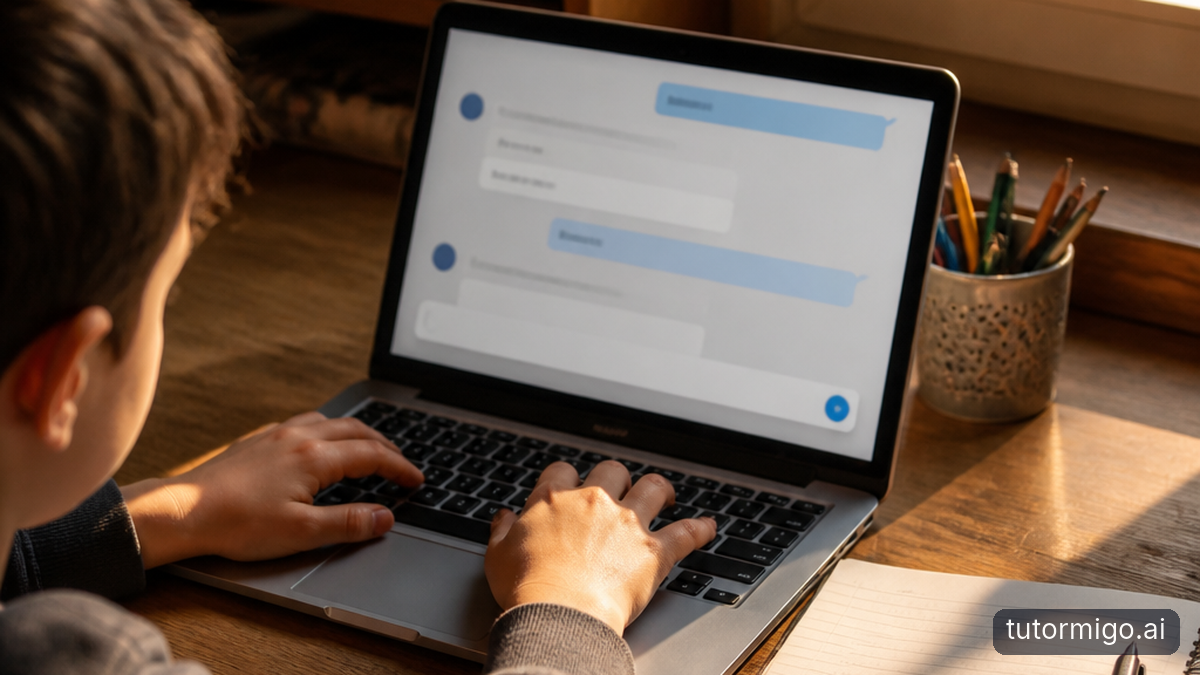
Personalized assistance works best when your child shares useful context. In TutorMigo.ai’s AI Tutor Workspace, they can explain what they are studying, describe what they have already tried, and ask for a different approach. The workspace offers personalized tutoring chat, expert personas, and session history. Start with the learning need rather than spending time choosing a persona.
A useful request might be: “I understand the example, but I cannot start the next question. Ask me one question at a time, and let me try before explaining.” Another might be: “Explain this using an everyday example, then ask me to explain it back.” These requests make the exchange more active than simply asking for the answer.
Session history also gives your child something concrete to revisit. Before beginning a new study session, they can reopen an earlier conversation, review the explanation that helped, and identify what remains unclear. Do not assume that a saved conversation proves understanding or that every previous detail will automatically guide a new response.
One of the practical TutorMigo.ai benefits is having a dedicated place for these tutoring conversations. You can encourage your child to end each session with a brief note in their own words: what clicked, what still feels difficult, and what to attempt next. That reflection helps turn access to help into a repeatable learning habit.
Match practice activities to what needs work
Different learning problems call for different practice. Remembering a definition is not the same as explaining a process or solving an unfamiliar problem. TutorMigo.ai offers spaced-repetition flashcards alongside interactive tools, so you can choose an activity that fits the difficulty rather than adding more screen time without a clear purpose.
Flashcards are useful when your child needs to retrieve information from memory. TutorMigo.ai supports flashcard decks with AI-assisted card creation and review scheduling. Your child could create cards for vocabulary or key concepts, check them against class materials, and attempt each answer before revealing it. Keep cards focused: one clear question is usually more useful than a whole paragraph to memorize.
For work that needs visible reasoning, the Study Tools Hub includes a whiteboard, code sandbox, and math step editor. Choose only what fits the task. A child studying mathematics might use the math step editor to work through a method, then explain why each step makes sense. If coding is part of their schoolwork, the code sandbox provides a place to work with code.
Keep practice manageable. Begin with a short review, spend most of the session on the difficult skill, and finish with an attempt without assistance. Ask, “Could you do this again tomorrow?” rather than “Did you finish?” The goal is a skill your child can use independently, not merely a completed activity.
Turn progress tracking into supportive conversations
Progress information is most helpful when it changes what you do next. TutorMigo.ai’s Parent Dashboard provides visibility into your child’s progress, learning controls, and co-learning features. Use that visibility as a starting point for a conversation, not as a reason to monitor every moment or turn each study session into a performance review.
Suppose your child says a topic is getting easier. Ask them to show you a fresh example and explain their approach. Compare that demonstration with the progress information available to you. Time spent studying and tasks completed can be useful context, but neither alone proves that your child understands. Look for stronger explanations, fewer prompts, and the ability to handle a slightly different question.
If your child is preparing for an exam supported by the platform, TutorMigo.ai’s Exam Preparation offers structured practice sets and progress tracking. Use practice to identify a priority, work on that area, and check again later. Keep the plan aligned with the exam your child actually needs rather than adding unrelated preparation.
Teachers have a separate dashboard with student monitoring and reporting. If your child’s teacher uses TutorMigo.ai, ask how those insights could inform home practice; do not assume every home activity is automatically shared. For more ideas, explore how parents can track learning progress with AI. Keep the conversation focused on the next useful step.
Compare learning support, not just chatbot answers
A general-purpose generative chatbot can explain concepts, suggest questions, and help a child think through a problem. Some also offer saved conversations or other study-related features. The practical comparison is not whether one tool can answer a homework question. It is whether the available tools make a useful learning routine easier for your family to maintain.
With TutorMigo.ai, you can consider the combination of a personal tutoring workspace, session history, scheduled flashcard review, interactive study tools, structured exam preparation, and parent visibility. You may not need every feature. A family struggling with forgotten vocabulary might value review scheduling most, while another might prioritize tutoring conversations and a clearer view of progress.
Try the same realistic task when comparing tools. Ask for a hint, request a simpler explanation, then have your child attempt another example without support. Notice whether your child can navigate the experience and whether you can understand what to do next. Convenience matters, but so does whether the interaction leaves your child doing meaningful work.
An AI Tutor can still produce an incorrect or confusing explanation. Check uncertain answers against class materials, and involve the teacher when a method conflicts with classroom expectations. Follow school rules about AI assistance, and avoid sharing unnecessary personal information. These habits matter whichever platform you choose; a dedicated learning setting does not remove the need for judgment.
Start small and hand over responsibility gradually
You do not need to redesign your evenings to try AI-supported learning. Choose one recurring difficulty, such as getting started on homework or remembering key terms. Agree on a small goal with your child: begin independently, ask for a hint when stuck, and explain one thing learned at the end. Keep the first routine simple enough to repeat.
During the first few sessions, sit nearby and model useful questions. Instead of typing the request yourself, ask, “What have you tried?” and “What kind of help would let you continue?” Then let your child make the request. Gradually step back while keeping a brief check-in. Independence means knowing how to seek help thoughtfully, not having to manage every difficulty alone.
After a week, review the routine together. Is your child starting more readily? Can they explain an idea without reading the response? Are study sessions calmer? If not, adjust the task or the amount of support rather than simply adding more practice. This guide to moving from homework battles to progress coaching offers a related approach. Start with one relevant TutorMigo.ai feature, keep your child’s reasoning at the center, and build from what genuinely helps.
Frequently asked questions
Think of it as a learning companion, not a replacement for you or your child’s teacher. You can set expectations, check understanding, and help your child decide when to seek more support.
Ask your child to explain an idea or attempt a similar question without viewing the tutoring response. Look for clearer reasoning and less reliance on prompts over time.
Choose the feature that matches one immediate need: the tutoring workspace for explanations, flashcards for recall practice, or the Parent Dashboard for visibility into progress.
Explore TutorMigo
Enjoyed this read?
Like, share, or comment below.



Comments
0Sign in required · respectful discussion · replies supported
Loading comments…