

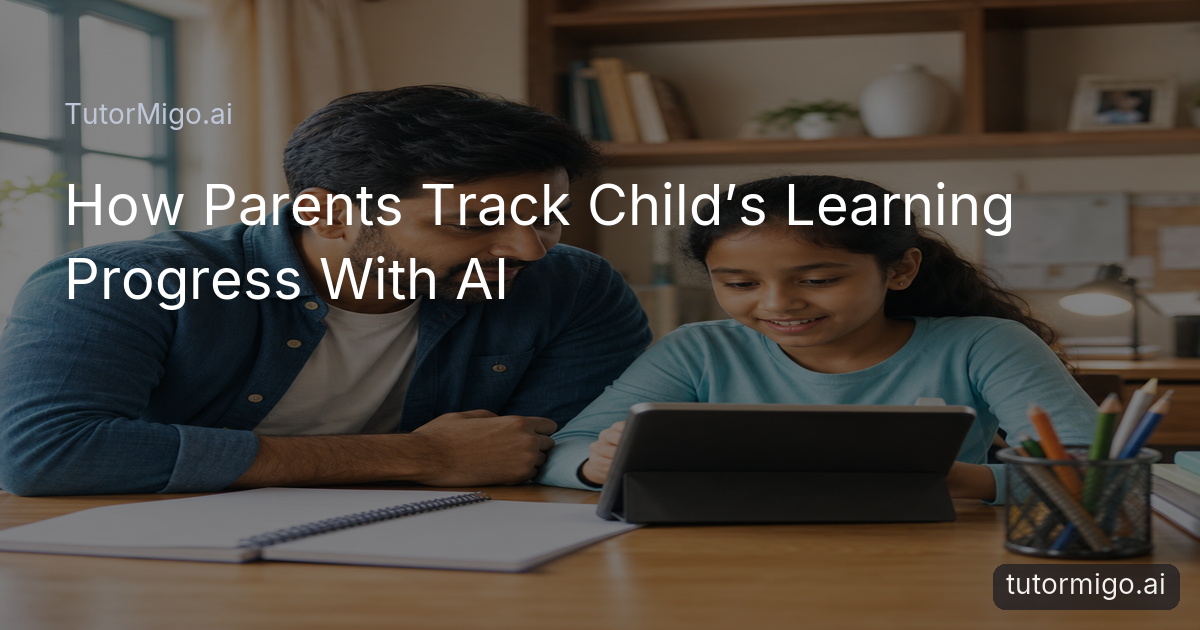
Studying More Doesn’t Always Mean Improving More

“How was studying today?” a parent asks. “Good,” the child replies. An hour has passed, homework is open, and a learning app has been used—but the parent still cannot tell what the child actually learned. This is why it helps to track child’s learning progress, not simply count minutes. Studying is the activity; progress is the change that happens through it.
Study time is still useful information. A regular routine can create space for practice, reflection, and questions. But time alone cannot show whether a child understood a new concept, remembered it later, or can use it without help. A child might spend thirty focused minutes mastering a difficult idea, while another session lasting two hours may involve repeated confusion.
A fuller view considers three connected details: what the child studied, how they responded to the work, and whether their performance or confidence changed over time. For example, completing several algebra exercises matters, but noticing that the child now explains the steps independently gives the activity more meaning. The same principle applies to reading, languages, science, and exam preparation.
Parents do not need to turn learning into a scoreboard. The goal is to combine activity with context so that student learning progress becomes easier to understand.
What Parents Should Look For in Their Child’s Learning Progress

Useful learning progress tracking starts with patterns rather than one impressive or difficult session. Look for areas where your child is becoming more independent, topics they return to repeatedly, and changes in the kind of help they need. A child who once needed every step explained but now asks one specific question may be making meaningful progress, even if the work is not perfect.
Notice what is being practiced. Are study sessions focused on vocabulary, geometry, writing, coding, or a particular exam skill? Then consider how the child handles that work. Can they explain an idea in their own words? Do they correct an error after feedback? Can they transfer a skill to a slightly different problem? These observations help you understand child’s learning without hovering over every task.
Consistency also matters. A single strong result may reflect an easy topic, while a single weak session may follow fatigue or distraction. Across several sessions, recurring difficulties are more useful signals. If a child repeatedly avoids one topic or needs the same explanation, that area may need a new approach or additional practice.
For parents asking how to track student progress, a simple conversation can add important context: “What feels easier now?” “Where did you get stuck?” and “What would you like to practice next?”
Learning science strategies for checking real understanding can also help families look beyond completion and recognition.
Why Learning Progress Can Be Difficult for Parents to See
Parents often see the visible parts of learning: a book is open, an assignment is submitted, a screen is active, or a child has spent time at a desk. What remains hidden is often more important. Did the child understand the explanation? Which concept caused the delay? Did they guess, memorize, or reason through the answer? Has a previously difficult skill become more manageable?
This gap grows when children work independently or move among several resources. One platform may hold assignments, another may offer videos, and a notebook may contain the child’s actual thinking. The parent receives fragments rather than a connected picture. Even a completed task can hide uncertainty if the child copied a method without understanding why it works.
That does not mean independent study is a problem. It means parents need a practical way to discuss the journey. Digital tutoring can make some learning activity easier to revisit, while the child’s own explanation remains essential. An AI tutor may provide a useful response, but the parent should still ask the child to describe what they learned and what remains unclear.
Teachers face a similar challenge when they support many learners at once. Visibility can help adults decide whether a student needs encouragement, another explanation, or time to practice. It should support professional judgment—not pretend to measure every part of understanding.
For a broader look at personalized learning, families can explore how AI tutors support more individualized study.
Track Child’s Learning Progress With Better Visibility
A digital learning platform can give families a more organized view of learning activity than scattered notes or memory alone. It may show which tools or subjects a child has used, what they have chosen to practice, and how learning connects across sessions. This can make parent learning support more specific: instead of saying “study more,” you can ask whether a particular concept needs another explanation or a different kind of practice.
TutorMigo.ai brings several learning experiences into one platform. The AI Tutor Workspace supports personalized tutoring conversations and session history. Flashcards provide spaced-repetition review, while Study Tools include interactive options such as a whiteboard, code sandbox, and math step editor. Exam Preparation offers structured preparation for SAT, ACT, AP, and IELTS, with practice sets and progress tracking.
These tools should not be treated as a perfect measurement of understanding. Activity can suggest what a learner has worked on, but it cannot replace conversation, teacher observation, or the child’s ability to explain an idea. The useful question is not “What number proves success?” but “What does this information help us investigate next?”
In that role, AI tutoring for children can support a calmer, more informed routine. Parents can use available learning information to notice patterns, then check those patterns through a short conversation. That balances educational technology with human context.
How TutorMigoAI’s Progress Feature Helps Parents Respond
TutorMigo.ai’s Parent Dashboard is designed to provide parent visibility into a child’s progress, learning controls, and co-learning features. Used thoughtfully, that visibility can help you understand what your child has been working on and begin a more informed conversation about the learning journey. You might notice that a child is spending time with a difficult subject, revisiting study materials, or using a particular learning tool consistently.
Because product labels and displays can change, confirm the current scope of any Progress feature before publishing or relying on a specific interpretation. Do not assume that it includes automated alerts, detailed graphs, grades, predictive analytics, or AI-written parent reports unless TutorMigo.ai explicitly documents those capabilities. The safest benefit to describe is clearer visibility into available learning activity and progress information through the parent experience.
That visibility becomes useful when paired with a child’s perspective. If the platform suggests repeated work in one area, ask, “Was this practice helpful?” If a child appears to be moving through a topic, ask them to explain one idea without looking at the screen. These questions help parents monitor child’s learning without constantly monitoring the child.
The Parent Dashboard can therefore support parent learning support as a starting point: notice, ask, listen, and respond. It is not a replacement for teachers, assessment, or the child’s own reflection.
For families comparing an AI Tutor with general-purpose chat, the difference is often practical organization: TutorMigo.ai combines a tutoring workspace, study tools, structured exam preparation, and parent visibility in a learning-focused environment.
Turn Progress Information Into Better Support
Progress information matters only when it leads to a useful next step. If your child is improving, acknowledge the specific change: “You explained that process without a hint this time.” Specific encouragement builds confidence without making every session feel like an evaluation. Let the child continue practicing at a sustainable pace rather than adding pressure simply because a tool shows activity.
If one area remains difficult, ask what part feels hard. The obstacle may be vocabulary, an earlier concept, unclear instructions, or uncertainty about how to begin. Targeted support is more helpful than repeating “study more.” You might invite the child to revisit an explanation, use the math step editor, create a flashcard for a key term, or bring the question to a teacher.
If progress slows, treat that as information rather than failure. The child may need a different explanation, shorter practice, more review, or a break. An AI Tutor can offer another explanation and answer follow-up questions, but it should support—not replace—parental involvement and teacher guidance. Children still need adults who understand their goals, emotions, and broader circumstances.
A simple routine keeps this manageable: check progress periodically, notice patterns, talk with the child, offer targeted support, and look across several sessions. Avoid judging a child from one result. The purpose of student progress tracking is to make support more thoughtful, not to watch every minute.
Progress is also more than a number. Understanding a difficult concept, asking a better question, solving a problem independently, needing fewer hints, or connecting two ideas can all show growth. When families use TutorMigo.ai’s parent visibility alongside conversation and teacher input, they gain a clearer basis for deciding what to do next.
| Approach | What it can show | What it cannot show alone |
|---|---|---|
| Study time | Whether a regular learning routine is happening | Whether the child understood or can apply the material |
| Completed assignments | Which tasks were finished | How much independent thinking or confidence the work involved |
| TutorMigo.ai Parent Dashboard | Available visibility into child progress, learning controls, and co-learning features | Every part of understanding, motivation, or classroom performance |
| Conversation with the child | What feels easy, difficult, confusing, or encouraging | A complete record of all learning activity |
| Teacher feedback | Observed performance and areas needing support | Everything the child studies outside the teacher’s view |
Pros and cons
Pros
- Makes learning conversations more specific than asking only how long a child studied
- Connects available progress information with tutoring, study tools, and structured preparation
- Encourages periodic parent support rather than constant monitoring
Cons and limitations
- Progress information is not a complete measure of understanding
- Parents should verify current feature details before assuming specific reports or metrics exist
- AI tutoring should complement teachers and family conversations, not replace them
Frequently asked questions
Check progress periodically rather than watching every session. Look for topics practiced, recurring difficulties, changes in independence, and the child’s own explanation of what feels easier or harder. A parent dashboard can provide useful visibility, but a short, respectful conversation adds context that activity information alone cannot provide.
Look for changes across several sessions: fewer hints, clearer explanations, better error correction, more confident questions, or the ability to apply a skill in a new situation. Improvement does not always appear as a higher score. Greater independence and stronger understanding can be equally meaningful signs of child learning progress.
Yes, AI tutoring platforms can organize learning activity and make some progress information easier to review. TutorMigo.ai’s Parent Dashboard provides parent visibility into child progress, learning controls, and co-learning features. Parents should use that information as a conversation starter, not as a complete measure of understanding.
Study time is a useful routine indicator, but it is not a complete measure of learning. Time does not show whether a child understood a concept, remembered it, or can use it independently. Combine time with topics practiced, changes in performance, confidence, and the kind of support the child needs.
TutorMigo.ai gives families a learning-focused environment that includes an AI Tutor Workspace, study tools, structured exam preparation, and a Parent Dashboard. The dashboard can help parents review available progress information and discuss learning more specifically. Verify current feature details before assuming the platform provides particular reports, alerts, or metrics.
Related reading
Enjoyed this read?
Like, share, or comment below.


Comments
0Sign in required · respectful discussion · replies supported
Loading comments…