


After ai tutoring, can your child solve a similar problem alone?

“The homework is finished—but can my child explain it?” That worry deserves more than a screen-time rule. AI-supported homework can build understanding or simply accelerate completion. The difference becomes clearer when you ask your child to explain a choice, solve a fresh problem, and remember the method later without help.
Start with a small transfer test, not a second homework assignment. If the completed question was , offer . Put the AI conversation aside and ask, “What would you do first, and why?” Changing the numbers checks whether your child learned a method rather than copied an answer.
Listen for reasoning: subtract the constant from both sides, then divide by the coefficient. A correct result with no explanation is worth another question; a small arithmetic slip with a sound explanation may show stronger understanding than a polished copied solution. Ask your child to check the answer by substitution.
If they get stuck, offer one hint and note where it was needed. Keep the tone curious: “Let’s find the part we should practice.” An AI Tutor becomes more useful when independent work reveals the next learning need, rather than when finished homework ends the conversation.
Use TutorMigo’s personalized tutoring and session history to revisit gaps in understanding
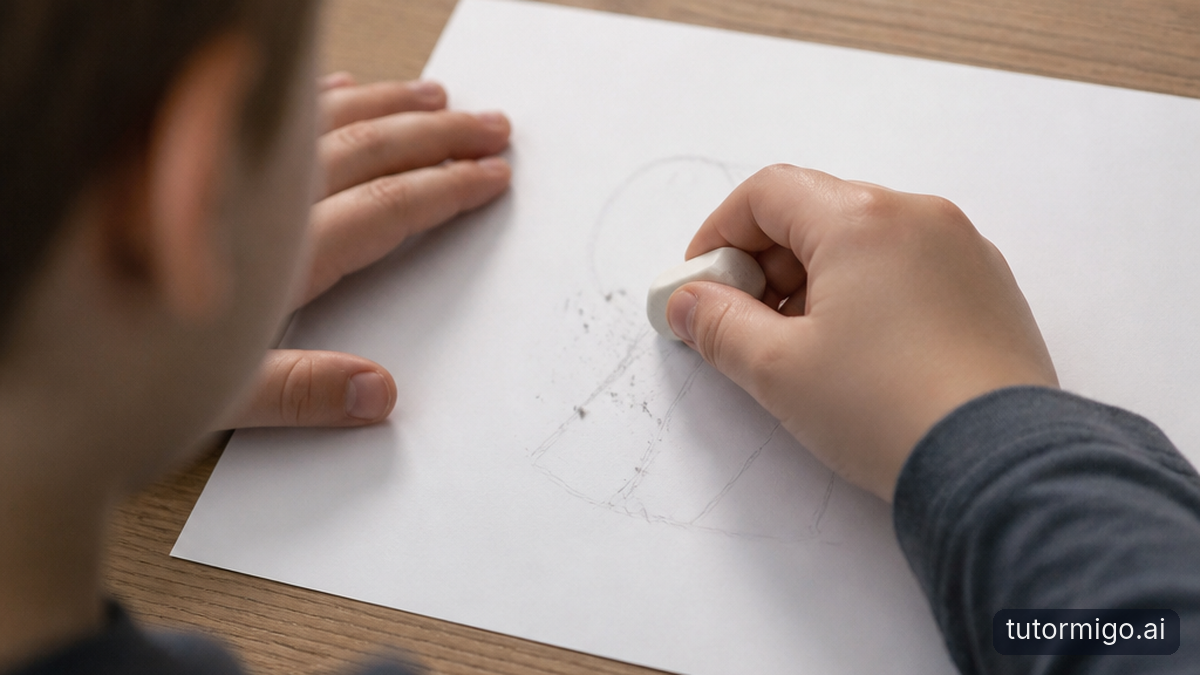
TutorMigo.ai’s personalized tutoring chat and session history give you a practical place to revisit that sticking point. Instead of starting with “Explain algebra,” your child can return to the earlier exchange and ask, “I understood subtracting from both sides, but I couldn’t explain why division came next. Give me a hint, not the answer.”
That request makes the tutoring goal specific. Personalized support is most useful when the learner identifies what they tried and where their reasoning broke down. Session history supplies context you can inspect; it should not be treated as proof that every previous explanation was understood or that the system automatically knows every gap.
Try a short follow-up routine: review one earlier mistake, ask for a different explanation, then close the chat and attempt another problem on paper. Afterward, compare the independent attempt with the discussion. If your child still needs the same hint, the gap remains a useful practice target rather than a failure.
An AI Tutor can support this back-and-forth, but your child still needs opportunities to work without it. The strongest continuity is not merely having old messages available; it is using them to choose a better next question. Keep those follow-ups brief enough that explanation and independent practice both fit into the routine.
Check retention with spaced-repetition flashcards, interactive tools, and tracked exam practice
Understanding something tonight and remembering it later are different tests. TutorMigo.ai’s spaced-repetition flashcards provide scheduled opportunities to retrieve knowledge after a delay. Use AI-assisted card creation to prepare prompts, then check that each card is accurate and asks for useful recall rather than recognition of a familiar answer.
For example, a card might ask, “Why must an equation stay balanced when you subtract?” Your child should answer before revealing the back. Pair that explanation with a fresh problem: reciting a rule does not establish that they can apply it. For more on this distinction, see why rereading alone may not build understanding.
Interactive tools offer another way to make thinking visible. Your child can use the whiteboard to sketch a diagram or the math step editor to lay out a solution, then explain each decision. When homework involves code, the code sandbox can support trying a change and predicting its effect. A working result still needs an explanation.
If your child is already preparing for an exam supported by TutorMigo.ai, structured practice sets and progress tracking can complement these checks. Revisit weaker material after a delay, then compare performance on fresh questions. Treat improving practice results as encouraging evidence—not a guarantee of independent performance on test day.
What parent and teacher dashboards reveal about progress—and why activity doesn’t prove understanding
Dashboards can help you decide where to look more closely. TutorMigo.ai’s Parent Dashboard offers visibility into child progress, learning controls, and co-learning features. The Teacher Dashboard supports class management, student monitoring, knowledge base assignment, and reporting. These features support oversight; they do not replace listening to a student reason through a task.
Suppose the available progress information looks encouraging, but your child cannot explain yesterday’s method. Neither observation should be ignored. The dashboard offers one view of learning activity and progress; the unaided explanation tests a different question. Ask your child to work through a fresh example before deciding whether to move on.
For teachers, monitoring and reports can help identify students who need a conversation or additional practice. Knowledge base assignment can focus follow-up on relevant material. But a report alone cannot establish how much help a student used, whether they could transfer a method, or what they will remember next week.
Use visibility as an invitation, not a verdict. A parent might say, “Let’s choose one thing you practiced and teach it back to me.” A teacher might follow a progress review with a brief, unaided classroom question. Combining platform information with direct evidence gives you a more balanced picture than either source alone.
TutorMigo benefits versus general-purpose chatbots: a comparison table of tutoring continuity, study tools, and progress visibility
The practical TutorMigo benefits are about how learning activities fit together, not a claim that other chatbots cannot teach. General-purpose generative chatbots can explain ideas, ask practice questions, discuss mistakes, and help plan revision. Some also provide conversation history or additional tools. Capabilities vary by product and plan, so compare the tools you would actually use.
TutorMigo.ai brings personalized tutoring with session history, scheduled flashcard review, interactive study tools, structured exam preparation, and parent or teacher visibility into a learning-focused platform. That can make a repeatable routine easier to organize. It does not remove the need to check explanations, verify generated material, or test understanding away from the screen.
The comparison table separates those concrete features from broader promises. For example, you can ask a general chatbot to produce flashcard questions; TutorMigo.ai specifically includes spaced-repetition decks and review scheduling. Likewise, asking for practice questions is not the same feature as structured exam practice sets with progress tracking, although either may support learning when used carefully.
Choose based on the friction you need to reduce. If your child already explains answers clearly and follows a reliable review routine, a general chatbot may be sufficient. If tutoring continuity, scheduled retrieval, or adult visibility would help you maintain that routine, TutorMigo.ai offers relevant structure.
| Learning need | TutorMigo.ai | General-purpose chatbots |
|---|---|---|
| Tutoring continuity | Personalized tutoring chat with session history. | Can offer explanations and follow-up; history features vary. |
| Scheduled retrieval | Spaced-repetition decks, AI-assisted card creation, and review scheduling. | Can generate recall prompts; scheduling depends on available tools. |
| Interactive work | Whiteboard, code sandbox, and math step editor. | Interactive tools vary by product and plan. |
| Exam practice | Structured practice sets with progress tracking. | Can generate practice; structure and tracking vary. |
| Adult visibility | Parent progress visibility and teacher monitoring and reporting. | Parent and educator oversight features vary. |
| Proof of understanding | Still requires independent checks. | Still requires independent checks. |
Your next-step checklist: test understanding, review mistakes, and choose a learning routine
You do not need to settle the whole AI-homework debate before making tomorrow’s study session better. Choose one recent assignment and run a short check together. Explain that the goal is to find what deserves more practice, not to catch your child using help. Then use the results to choose a manageable routine.
- Test understanding: Put AI aside and try one similar problem. Ask why the first step makes sense, not just what the answer is.
- Review one mistake: Revisit the relevant tutoring session and identify the exact point of confusion. Request a hint or alternative explanation, then retry independently.
- Check later: Use a scheduled flashcard review and a fresh application question after a delay. Separate remembering a rule from using it.
- Choose the routine: Add an interactive tool when showing the work helps. Use tracked exam practice only when it matches an existing preparation goal.
- Review visibility together: Discuss dashboard information alongside the child’s explanation and independent attempt, rather than treating activity as mastery.
Keep the first routine small enough to repeat. If your child can explain, apply, and later retrieve the idea with less help, AI support is contributing to independence. If only completion gets faster, change the routine before assuming learning has improved.
Frequently asked questions
Ask your child to explain the method, solve a similar problem without AI, and try again after a delay. Look for decreasing reliance on hints.
No. It helps you revisit explanations and mistakes, but independent work is needed to check understanding.
It can support many of them. TutorMigo.ai adds specific learning features such as scheduled flashcard review, structured exam practice, and parent and teacher dashboards.
Related reading
Enjoyed this read?
Like, share, or comment below.

Comments
0Sign in required · respectful discussion · replies supported
Loading comments…