

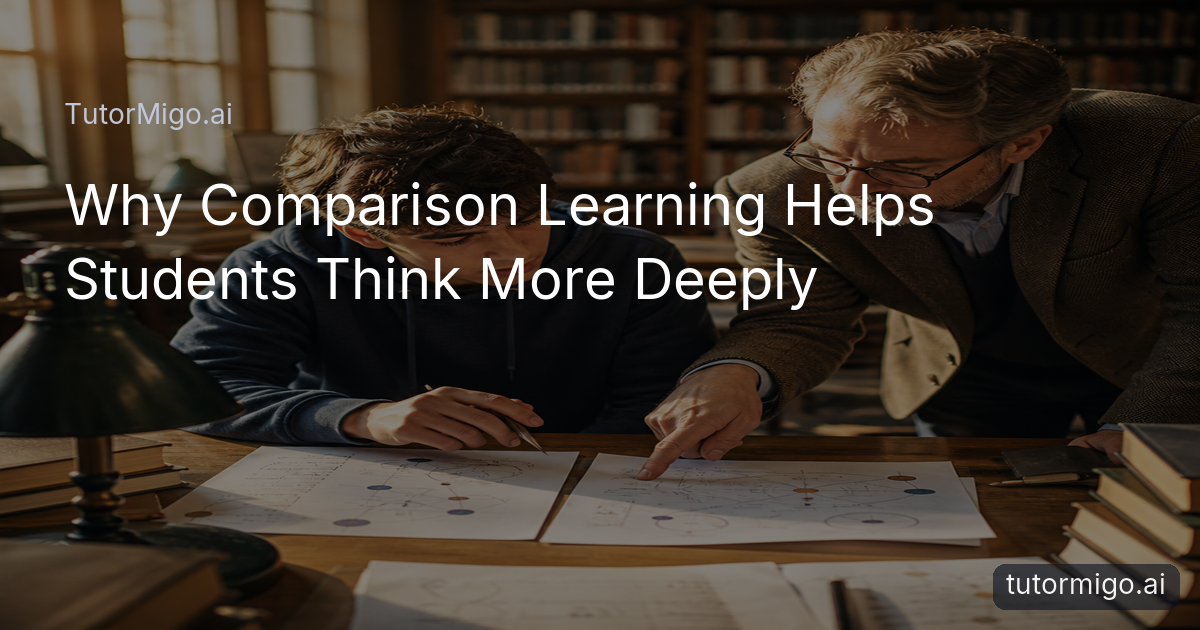
Two Ideas Meet Through Comparison Learning

You can study evaporation and boiling separately, remember a definition for each, and still hesitate when a question asks you to tell them apart. The same thing happens with historical events, mathematical methods, and scientific processes. Familiarity with two ideas does not always include an understanding of the relationship between them.
That is why comparison can be such a useful part of student learning. Placing two concepts side by side makes the boundary between them easier to see. Sometimes the difference between two ideas is where the real learning begins.
This does not mean comparison should replace learning one concept carefully. A student usually needs some basic knowledge before a comparison is meaningful. But once the foundation is there, asking how two ideas connect can move learning beyond a collection of separate facts.
Think about a student who knows that renewable energy sources can be replenished and non-renewable sources cannot. A comparison adds a further layer: how availability affects planning, why each source creates different practical trade-offs, and when a distinction matters. The goal is not to force every topic into a pair. It is to notice when a relationship explains more than either idea does alone.
Why Studying One Concept at a Time Has Limits

Studying one concept at a time has a clear purpose. It reduces cognitive load, gives students room to learn vocabulary, and lets them work through a process without immediately adding another set of details. A student learning a new formula may need to understand what each variable means before comparing it with another method.
The limitation appears when separate study leaves relationships invisible. A learner may memorize dates without noticing that two events had similar causes. They may know two definitions but miss the condition that makes one definition more precise. They may solve practice problems correctly by habit without recognizing why one mathematical method is more efficient in a particular situation.
Comparison learning addresses that gap, but only when it follows enough independent study. If both ideas are still unclear, putting them together can produce more confusion, not less. A useful sequence might be: learn each idea, explain each in your own words, then examine what they share and where they part company.
For teachers, parents, and learners, this distinction matters. The question is not whether independent study or comparison is universally superior. It is whether the learner is ready for a relationship-focused question.
What Comparison Makes Students Notice
Good concept comparison is more than a two-column list of differences. It can bring several kinds of relationships into view. Students may notice a shared purpose, a different starting condition, a pattern that repeats, or an exception that challenges an easy rule.
Consider evaporation and boiling. Studying them independently gives students information about each process. Comparing them reveals that both involve a liquid becoming a gas, while the location and conditions of the change differ. Evaporation can occur at the surface across a range of temperatures; boiling involves bubbles forming throughout the liquid at a particular boiling point under given conditions. The comparison explains both the similarity and the boundary.
Useful questions can include: What do these ideas have in common? Where do they differ? Why do they differ? When would one apply but the other not? What does one help me understand about the other? These are prompts, not a rigid formula.
The strongest comparisons also test the edges of an idea. A student might look for a case that seems similar but does not fit, then explain why. That step can reveal whether the learner understands a principle or is matching surface features. In this way, learning through comparison supports explanation, not just recognition.
| Approach | Best use | Watch for |
|---|---|---|
| Independent study | Build the basic definition, vocabulary, or process for each concept | Comparing before either idea is clear can increase confusion |
| Side-by-side notes | Identify meaningful similarities, differences, and boundaries | A long list of traits may not explain why a difference matters |
| AI Tutor Workspace | Generate examples, counterexamples, follow-up questions, and alternative explanations | Review the response and verify important information |
| Flashcards and interactive study tools | Revisit distinctions and practice worked examples over time | Recognition alone does not prove that a student can explain the relationship |
A Practical Way to Compare Two Concepts
Start with two ideas that are related enough to invite a meaningful comparison. Write a short explanation of each without looking at your notes. If one explanation is vague, return to the source material before comparing. This prevents the exercise from becoming a contest between two half-remembered definitions.
Next, record one genuine similarity and at least two differences. Then add the most important question: why does the difference matter? For mathematical methods, that might mean asking which type of problem each method handles efficiently. For historical events, it might mean connecting a shared cause to different outcomes. For scientific processes, it could mean identifying the conditions under which each process occurs.
A worked example can make the method concrete. Suppose a student compares two ways to solve the same algebra problem. The student first checks that both methods can reach a valid solution, then examines the number of steps, the risk of an error, and the kind of problem where each method is easiest to use. The comparison turns “I can do both” into “I know when and why to choose one.”
Comparison is most useful when it ends with a decision, explanation, or prediction—not merely a list of traits.
Afterward, explain the comparison aloud or in a short paragraph. If you cannot explain why a difference matters, that is a sign to study one or both concepts again.
How AI Can Support Comparison Without Replacing Judgment
An AI Tutor can help a learner begin a comparison by asking for two concepts, organizing similarities and differences, or offering a simpler example. It can also provide a counterexample, rephrase a difficult distinction, and ask follow-up questions such as “What condition changes the outcome?” Those prompts can be useful when a student knows the material but does not know how to interrogate the relationship.
The quality of the exchange depends on the student’s participation. Instead of accepting a finished table, ask the AI tutor to explain one row, challenge an assumption, or give a new case to classify. Then check the explanation against class materials, trusted references, or a teacher. Important facts and unfamiliar claims still deserve verification.
TutorMigo.ai’s AI Tutor Workspace provides personalized tutoring chat and session history, which can help a learner return to an earlier distinction rather than restart from scratch. Its interactive Study Tools Hub includes a whiteboard, code sandbox, and math step editor; these can support comparisons that need worked steps or visible reasoning. Flashcards with spaced-repetition review can also revisit the distinctions students repeatedly confuse.
For learners preparing for a structured assessment, exam preparation includes practice sets and progress tracking. Teachers and parents can add context through the Teacher Dashboard or Parent Dashboard, where visibility into learning can support a more informed conversation about which concepts need comparison and which need independent review. These are practical TutorMigo benefits, not substitutes for judgment.
When Comparison Goes Too Far—and What to Do Next
Not everything benefits from an immediate side-by-side treatment. A beginner may need to understand photosynthesis on its own before comparing it with cellular respiration. A student may need to learn the basic steps of a proof before deciding how two proof strategies differ. Superficial comparisons can also create false similarities: two events may share a date or outcome while having very different causes.
Use comparison when it reveals a relationship that matters for explanation, choice, prediction, or transfer. If the pairing feels forced, study each concept independently first. If the comparison produces a long list with no meaningful conclusion, narrow the question. “How are these different?” is often less useful than “Which condition makes the difference important?”
A simple next step is to choose one pair from your current work and create a short comparison paragraph. State one similarity, explain two differences, and finish with when each idea applies. Then ask an AI Tutor for a counterexample or a follow-up question, and verify the response. A teacher or parent can review the reasoning rather than only the final answer.
Learning becomes more connected when separate pieces of information begin to explain one another. The useful question is not always “What is this?” It may be “What is this similar to, how is it different, and why does that difference matter?”
Pros and cons
Pros
- Makes relationships and boundaries between ideas more visible
- Encourages students to explain why differences matter
- Can support better choices between methods or concepts
- Creates useful follow-up questions for an AI tutor or teacher
Cons and limitations
- Can confuse learners who have not studied either concept independently
- May create false similarities when the pairing is superficial
- Requires judgment about which differences are meaningful
- AI-generated comparisons still need evaluation and verification
Frequently asked questions
It helps students notice similarities, differences, patterns, exceptions, and conditions that may remain hidden when concepts are studied separately.
Comparison connects separate facts to relationships, helping students explain why ideas differ and decide when a concept or method applies.
Study each concept first, then identify a similarity, meaningful differences, the reasons for those differences, and situations where each concept applies.
Yes. An AI tutor can suggest comparisons, examples, counterexamples, and follow-up questions, but students should evaluate explanations and verify important information.
Comparison learning is an approach that places related ideas side by side so students can examine their relationships, boundaries, patterns, and practical uses.
Enjoyed this read?
Like, share, or comment below.
Comments
0Sign in required · respectful discussion · replies supported
Loading comments…