


When Math Learning Moves Too Fast, Start With the Missing Step

If a math lesson leaves you staring at the page thinking, “I understood the first part, but where did that come from?” you are not behind or incapable. Math is layered: a small gap with fractions, negative numbers, or algebraic notation can make the next lesson feel impossible. The useful question is not “Why am I bad at math?” but “Which step stopped making sense?”
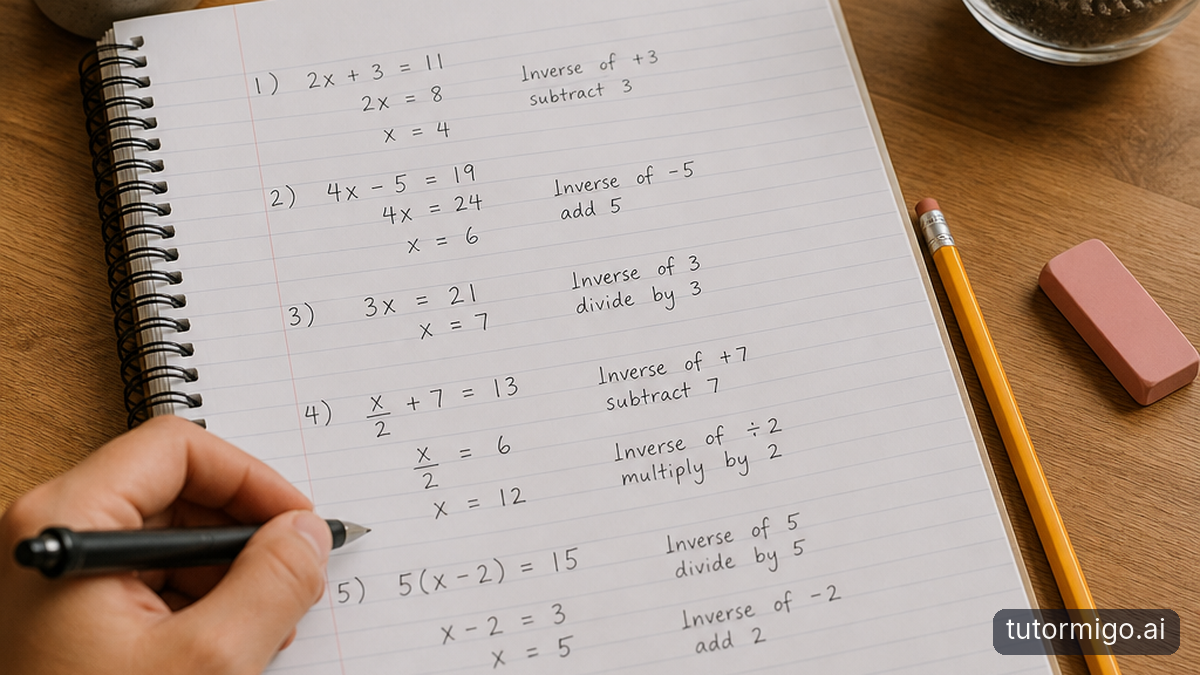
Try locating that exact point before restarting the whole chapter. For example, if solving feels confusing, check whether you understand subtracting from both sides before worrying about dividing by . Write the problem one line at a time and explain what changed between lines. If you cannot explain a step in plain language, that is the step to review.
Tutormigo can help you slow the explanation down, ask what you already understand, and revisit the same idea from another angle. Instead of copying a final answer, ask for a hint, a worked example with different numbers, or a check of your own next step. This makes confusion specific and manageable. For another practical look at getting unstuck, read how TutorMigo benefits students in stuck math moments.
Ask for Explanations That Match Your Thinking

One explanation will not work for everyone. A teacher may describe slope as a rate of change, while you need to see a table, a graph, and a real situation such as distance traveled over time. When a concept feels slippery, request a different representation rather than simply asking for more detail. You might say, “Explain this with a small example,” then follow with, “Now show me why that method works.”
Suppose you are learning fractions. Comparing $ rac{3}{4}$ and $ rac{5}{8}$ is easier when both are rewritten with a common denominator: $ rac{3}{4} = rac{6}{8}$, so $ rac{6}{8} > rac{5}{8}$. A useful explanation should connect the procedure to the meaning, not just tell you to multiply by a number. Ask what stays equivalent and why.
TutorMigo’s tutoring workspace is useful when you need that back-and-forth. You can share the point where you became unsure, ask for a simpler explanation, and continue the same learning thread rather than starting from zero. Session history can also help you return to an earlier example when homework exposes the same misunderstanding later. The goal is not to avoid effort; it is to spend effort on the idea that needs attention.
Use Interactive Tools to See Each Step
Some math ideas remain confusing when they stay only in your head or on a crowded worksheet. An interactive workspace can make the structure visible. For an equation, write each transformation on its own line. For a graph, change one value and observe what happens. For a geometry problem, sketch the known information before choosing a formula. These small actions turn “I don’t get it” into an observable question.
Imagine working with the quadratic expression . Instead of memorizing a factor pair, test whether the expression can be rewritten as , then multiply the factors back together to verify the result. If you are solving , the structure of the factored form shows why the possible solutions are and . Checking the result matters as much as finding it.
TutorMigo’s interactive study tools include a math step editor and whiteboard, which can support this kind of visible reasoning. Use them to separate steps, mark the place where your reasoning changed, and compare your approach with a guided explanation. If you make an error, preserve it long enough to understand it. A corrected mistake is often more memorable than a perfect example you only copied.

Make Review Stick With Spaced Practice
Understanding a topic once does not guarantee that you will remember it next week. Math skills fade when review happens only the night before an assignment or test. Spaced repetition gives you shorter review sessions across several days, so you retrieve a method after some forgetting has begun. That retrieval strengthens the path back to the idea.
Build cards around decisions, not just definitions. Instead of writing “What is the quadratic formula?” on one card, create a prompt such as “When factoring does not work easily, which method could solve ?” Keep a second card for the formula itself: . Add a worked example only after you can identify when the method applies. During review, explain each part aloud and mark the exact step you could not recall.
TutorMigo’s spaced-repetition flashcards can help organize decks and schedule reviews instead of leaving you to guess what to revisit. You might make one deck for fraction operations and another for algebra errors, then spend ten minutes on each across the week. This is one of the practical TutorMigo benefits: tutoring, interactive work, and deliberate review can fit into one repeatable routine rather than becoming disconnected activities.

Turn Practice Into a Trackable Learning Plan
Practice feels less overwhelming when you know what you are practicing and how progress will be judged. Start with a small target: solve five linear equations with one variable, explain the inverse operation in each, and check every answer. Afterward, record more than your score. Note whether the issue was a sign error, skipped step, weak multiplication fact, or uncertainty about which method to choose.
For structured exam preparation, divide the work into skills and revisit the weakest area first. A practice set might show that you can solve routine equations but lose time on word problems. That result suggests a different next session: underline the quantities, define a variable, write an equation, and estimate whether the answer is reasonable. Progress tracking is most useful when it changes what you do next, not when it simply produces a percentage.
TutorMigo’s exam preparation tools provide structured practice sets and progress tracking for SAT, ACT, AP, and IELTS preparation. If an exam is your goal, use those records alongside tutoring and flashcard review. A general-purpose chatbot may be helpful for generating an explanation or example, but a dedicated learning workflow can make it easier to return to previous sessions, repeat targeted practice, and see which skills still need work. Use both thoughtfully, while checking important answers against your course materials.
Keep Support Visible for Families and Teachers
Students often need independence and support at the same time. A parent may not want to hover over every problem, while a teacher needs enough information to notice a recurring misconception. Visibility can make help more timely: instead of asking only, “Did you study?” an adult can ask, “I see fractions are still taking extra practice time—what part feels hardest?”
For families, progress information can guide a short co-learning conversation. Look at the topic being reviewed, ask the student to explain one example, and agree on a realistic next session. The purpose is encouragement and planning, not surveillance. A student who can show the step that caused trouble is already developing stronger learning habits.
Teachers can use learning signals to decide whether a class needs another model, a small-group activity, or individual practice. TutorMigo’s teacher dashboard supports student monitoring, knowledge base assignment, and reporting, while the parent dashboard provides visibility into child progress, learning controls, and co-learning features. These tools do not replace a teacher’s judgment or a family conversation. They help connect what happens during independent AI tutoring with the human support that makes difficult math feel less isolating.

What to Do When Math Still Feels Difficult
Start with one confusing problem, not an entire unit. Identify the first unclear step, ask for an explanation at a slower pace, and work through a similar example without copying the answer. Then use an interactive tool to lay out your reasoning and a flashcard deck to revisit the key decision later in the week.
After two or three sessions, check the evidence. Can you explain the method in your own words? Can you solve a changed example, such as one with negative values or different coefficients? Can you spot and correct a common error? If not, narrow the target again. A smaller question often unlocks a larger topic.
The best AI learning tool is not the one that gives the fastest response. It is the one that helps you understand, practice, remember, and recognize what to do next. TutorMigo.ai can serve as a personal learning companion through that cycle, while parents and teachers add context, encouragement, and accountability. Choose one math skill today, schedule a short review, and let steady progress make the concept click.

Pros and cons
Pros
- Personalized explanations can be adjusted to your pace and starting point.
- Session continuity helps you revisit earlier examples instead of repeating the entire context.
- Spaced review and interactive tools connect understanding with practice and recall.
- Parent and teacher dashboards can make progress and support needs easier to discuss.
Cons and limitations
- An AI explanation still needs your active checking and practice.
- A tool cannot replace a teacher’s judgment, classroom context, or human encouragement.
- Progress may be gradual when foundational gaps require repeated review.
Frequently asked questions
Math concepts build on one another, so a small gap in an earlier skill can affect later lessons. Finding the first unclear step and reviewing it directly is usually more effective than restarting everything.
An AI Tutor can offer slower explanations, hints, alternate examples, and step-by-step feedback. Use it to understand your reasoning rather than simply requesting a final answer, and verify important work with your teacher or course materials.
Short sessions spread across several days are generally more useful than one long cramming session. Review cards that test when and why to use a method, then add worked examples for skills that remain difficult.
TutorMigo includes parent and teacher dashboards designed to provide visibility into progress and support planning. Adults can use that information to start a helpful conversation or adjust practice, not to replace direct instruction.
Related reading
Enjoyed this read?
Like, share, or comment below.



Comments
0Sign in required · respectful discussion · replies supported
Loading comments…