
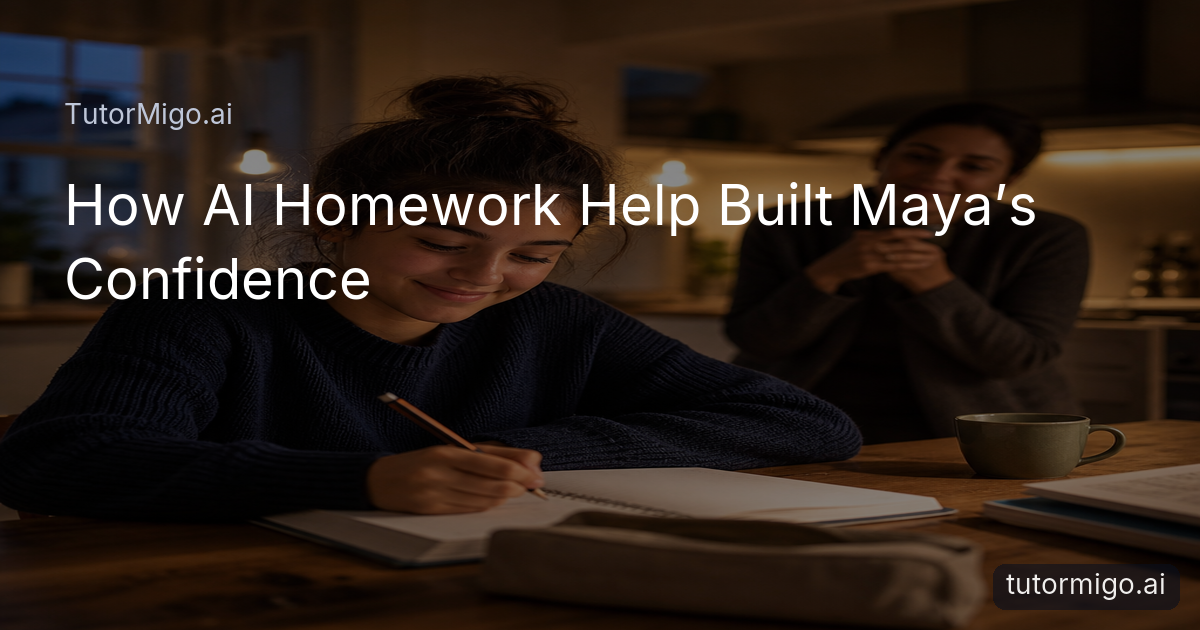
The Homework Pause That Made Maya Feel Stuck
By the time Maya opened her algebra notebook, the hardest part was often not the first problem. It was the pause before it. She would read the instructions twice, erase the same line, and glance at the clock as if the assignment were already getting away from her. On test mornings, that feeling arrived even earlier: a tight stomach, cold hands, and the certainty that one confusing question would unravel everything she had studied.
Her mother noticed a pattern. Maya understood examples when a teacher worked them out in class, but a blank page at home made the steps feel disconnected. If she asked for help, she worried that the answer would be handed to her without helping her understand it. If she searched for an explanation, she found long pages that used unfamiliar terms. The frustration was specific and physical: pencil tapping, shoulders rising, and a growing stack of unfinished work.
Maya did not need someone to tell her she was capable. She needed a calmer way into the work. That was what led her to try TutorMigo.ai, not as a shortcut around homework, but as a place to ask one small question at a time and stay with it until the next step made sense.
A Clear Explanation Replaced the Guessing
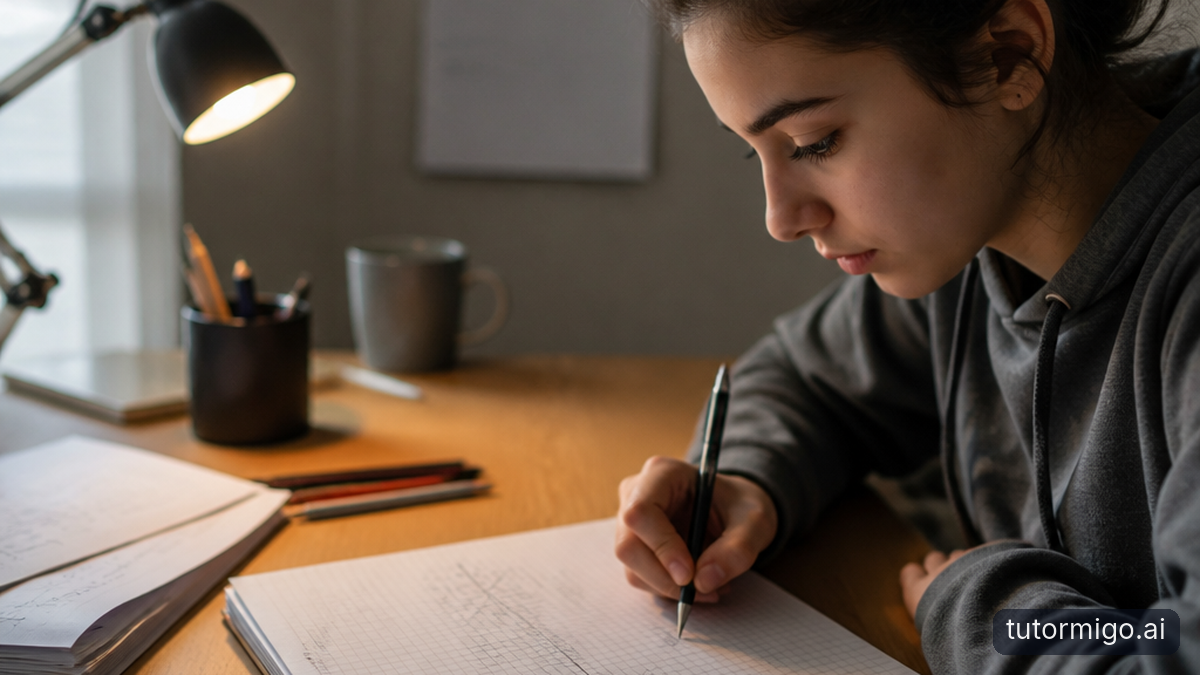
During her first session, Maya typed that she did not understand why a negative sign changed when she simplified an equation. Instead of receiving only a final result, she could ask for the step in between. The AI Tutor explained the idea in plain language, then connected it to the line she was looking at. Maya asked a follow-up question, admitted that the first explanation still felt confusing, and received another route through the same concept.
That back-and-forth mattered. She was no longer trying to sound prepared while secretly guessing. The session history also meant she could return to the same conversation instead of reconstructing the problem from memory the next evening. A small question from Monday could lead naturally into Tuesday’s practice, which made tutoring feel more like continuity than a series of emergency rescues.
Maya’s mother had been careful about AI homework help because she wanted learning, not answer collection. The experience matched the approach described in responsible AI homework help: use an explanation to build understanding, pause to think, and check whether the student can apply the idea independently. By the end of that first session, Maya had solved one problem without prompting. It was a modest result, but it changed the tone of the evening.
Practice Turned One Good Session Into a Habit
The next challenge was keeping the new confidence from disappearing when the next assignment arrived. Maya began saving the concepts that had taken the most effort into spaced-repetition flashcards. Instead of copying a definition she already knew, she made cards around the questions that had caught her: what a step meant, when to use it, and how to recognize a common mistake.
Review scheduling gave those ideas a place in her week. A few cards appeared the next day, then again after a longer interval. When Maya answered one incorrectly, she did not treat the miss as proof that she was bad at math. It became a signal that the concept needed another short look. The sessions were brief enough to fit between dinner and soccer practice, which made practice feel manageable rather than like a second assignment.
For difficult homework, Maya also used the tutormigo.ai platform’s interactive study tools to work through problems visually. She could lay out her reasoning on a whiteboard or use the math step editor to examine where a solution changed direction. This was different from reading a finished response: her own work stayed visible, including the crossed-out attempt that showed what she had already tried. When she needed a reminder about learning without handing over the work, she revisited ways AI can help without doing homework.
The First Test Became a Series of Small Checks
Three weeks later, Maya had a unit test on linear equations. Her old routine would have been to reread every page the night before and hope recognition counted as preparation. This time, she made a smaller plan. She reviewed the flashcards she had missed, worked through practice questions, and used the AI Tutor at tutormigo.ai to explain why two nearly identical problems required different steps.
She also tracked what felt steady and what still needed attention. That distinction kept the study session from turning into an anxious sweep through everything. One evening, she noticed that she was consistently making the same error when checking an answer. Rather than rushing past it, she asked for a new example, solved it on the interactive math workspace, and compared her reasoning with the explanation. The mistake became specific enough to fix.
On test morning, Maya still felt nervous. Confidence had not erased the normal uncertainty of being assessed; it had given her a response to it. She took a breath, started with the questions she recognized, and returned to the harder ones with a process in mind. Her score improved, but the more important change was that she could describe what she knew, what she did not know yet, and how she would practice next.
Her Family Could See Progress Without Taking Over
Maya’s mother wanted to support her without hovering over every worksheet. The parent dashboard gave her a clearer view of Maya’s progress and learning activity, so their conversations moved away from repeated reminders. Instead of asking, “Did you study?” she could ask, “Which topic felt easier this week?” That small shift gave Maya room to own the work while making support more informed.
The dashboard did not turn improvement into a family scoreboard. It helped connect the quiet details Maya did not always mention: a difficult concept revisited, a practice habit maintained, or a topic that needed more attention. When Maya had a strong week, her mother could notice the effort behind the result. When she struggled, they could discuss a next step before the problem became a crisis.
Her teacher saw a related benefit in the classroom. Maya began asking more precise questions, such as whether her setup was correct before she continued. Those questions gave the teacher useful information about her reasoning rather than simply showing that an answer was wrong. For parents and teachers comparing AI learning tools, this visibility is one of the practical TutorMigo benefits: encouragement at home and instruction at school can respond to the same learning pattern without treating the student as a report.
Confidence Looked Like Starting Before She Felt Ready
By the end of the term, Maya’s desk looked much the same: the same lamp, the same scratched pencil case, and plenty of assignments she did not especially want to begin. What changed was the first five minutes. She no longer interpreted confusion as a verdict. She opened the problem, identified the part she understood, and knew where to ask for a clear explanation when the next step stayed out of reach.
Her confidence showed up in small, observable ways. She began homework earlier because the task no longer felt like a wall. She reviewed flashcards before tests instead of cramming every topic at once. She was willing to show a teacher an incomplete attempt, because an incomplete attempt now felt like useful information rather than embarrassment.
That is the practical difference Maya experienced with a personalized AI Tutor: not a machine that promised perfect answers, and not a replacement for her teacher or her own thinking, but a steady learning partner with explanations, practice, continuity, and encouragement in one place. The technology did not remove every anxious moment. It helped Maya meet those moments with a plan—and that was enough to make starting feel possible.
Confidence did not arrive when Maya stopped making mistakes. It arrived when every mistake came with a next step.
Explore TutorMigo
Enjoyed this read?
Like, share, or comment below.

Comments
0Sign in required · respectful discussion · replies supported
Loading comments…