


The Algebra Problem That Wouldn’t Budge
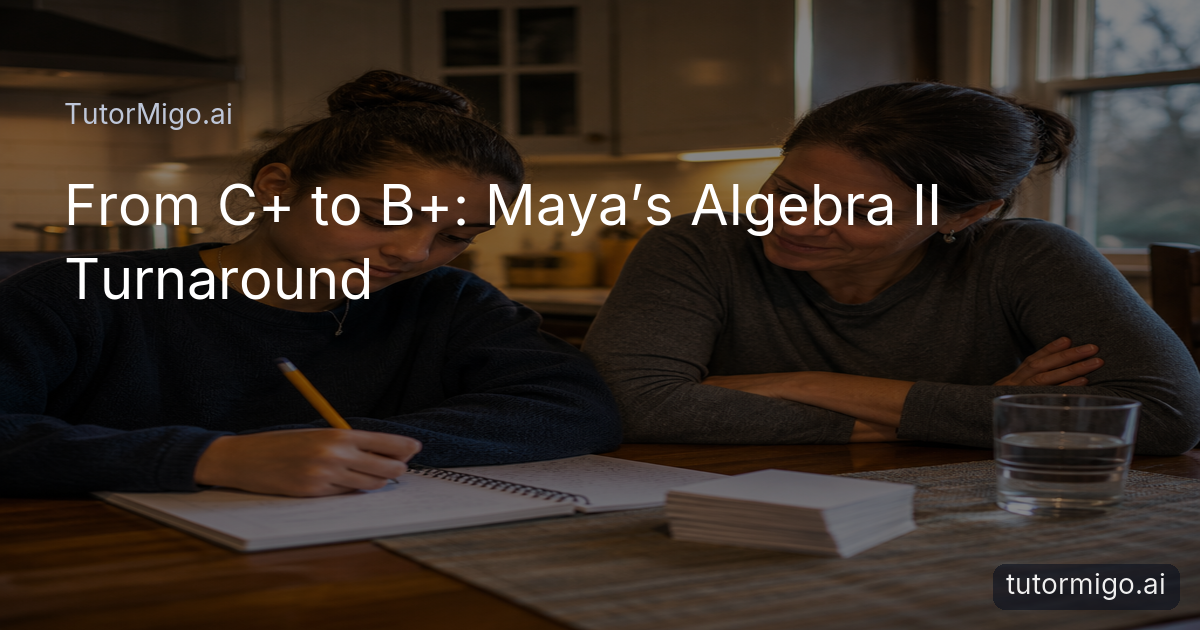
On Tuesday evening, Maya sat at the kitchen table with three unfinished Algebra problems and a quiz the next morning. She understood how to substitute numbers into a formula, but factoring quadratic equations felt like guessing. After erasing the same line twice, she asked for help—not an answer she could copy, but an explanation she could use on the next problem.
That was the moment she tried TutorMigo.ai homework help. The AI math tutor asked her to share what she had tried and then worked through the reasoning in manageable steps. In practical terms, how does TutorMigo.ai help with homework? It gives personalized, step-by-step guidance, keeps the tutoring session available through session history, and uses interactive study tools so students can practice a method rather than simply receive a final answer.
One Worked Example Changed the Pattern

Maya’s turning point came with a worked example involving . Instead of jumping to the roots, the tutor asked which two numbers multiply to and add to . Maya identified and , then watched the expression become . The final step—setting each factor equal to zero—made the answer feel earned.
She then opened the math step editor in the Study Tools Hub and rebuilt the example herself. When she entered an incorrect sign, the explanation pointed to the exact step where her reasoning changed direction. That difference mattered. A general-purpose chatbot might produce a polished solution, but Maya needed a patient sequence of prompts, a place to inspect each move, and a chance to try again. The experience was step-by-step Algebra tutoring, not answer delivery.
From Guided Practice to Independent Work
By Thursday, Maya was using the AI Tutor less as a rescuer and more as a checkpoint. She completed three new problems before asking for feedback, then made a small flashcard deck for the signs and factoring patterns she kept forgetting. Spaced-repetition review brought those ideas back the next afternoon, just before they faded.
For Maya, the clearest TutorMigo.ai benefits were continuity and independence. Her earlier session gave the next explanation useful context, while the flashcards helped her remember the method away from the homework table. She still made mistakes, but they became visible and fixable. Her quiz score moved from 6 out of 10 on the first check-in to 9 out of 10 the following week—not because the work was done for her, but because she had practiced explaining why each step worked.
A Better Conversation About Homework Help
Maya’s parent noticed the change before seeing the quiz grade. Homework took less time, but more importantly, Maya began saying things like, “I know where I went wrong.” Through the Parent Dashboard, her parent could see progress and support the routine without hovering over every equation. That made the conversation calmer: What concept needs review? Which practice worked? What should Maya try independently next?
The result was not perfect homework every night. It was a more useful habit: attempt the problem, request an explanation, test the idea in a study tool, and return to it later with flashcards. Students, parents, and teachers comparing an AI Tutor at tutormigo.ai with general-purpose chat can look for that learning loop—personalized tutoring, session continuity, interactive practice, and visible progress. Maya still owns the solution. Now she also trusts herself to find it.
For more context on building a consistent routine, read this guide to how TutorMigo benefits your study routine.
I know where I went wrong—and I know what to try next.
Finding the Right Kind of Algebra Help
Not every algebra question needs the same kind of support. A student who is confused by negative numbers may need a visual number line, while someone who understands the rules but loses track of steps may benefit from writing each operation on a separate line. Before choosing a worksheet, video, tutor, or study app, identify the exact obstacle. Broad searches for “algebra help” can produce too much information and make the problem feel larger. A focused question, such as “How do I simplify expressions with exponents?” usually leads to a more useful explanation.
Using Errors as Evidence
Wrong answers can reveal more than correct ones because they show where reasoning changed direction. Instead of erasing an incorrect solution, keep it visible and mark the first step that no longer follows the rules. Was a distributive property applied to only one term? Was the same operation performed on one side of an equation but not the other? This kind of error analysis turns confusion into specific information. Keeping a short “mistake log” can also help students notice recurring patterns, such as sign errors or skipped steps, across several assignments.
Checking an Algebra Answer
Algebra help should include a way to verify the result, not just a method for reaching it. After solving an equation, substitute the proposed value back into the original equation rather than the simplified version. If both sides match, the answer has passed an important test. For expressions, substitute a simple number for the variable before and after simplifying to see whether the two forms produce the same result. Graphs, estimation, and checking whether the answer is reasonable provide additional safeguards, especially when calculators are involved.
Building a Practical Study Routine
Short, regular practice is often more effective than a single long session. A useful routine might include reviewing one rule, completing two representative problems, checking every step, and recording one question to revisit later. Mixing familiar problems with a few new ones strengthens recall without making practice feel impossible. Students can also explain a solution aloud or write why each operation is allowed. That explanation exposes gaps in understanding and makes future algebra help more focused.
Related reading
Enjoyed this read?
Like, share, or comment below.


Comments
0Sign in required · respectful discussion · replies supported
Loading comments…