
After work, adult learning felt like a second shift

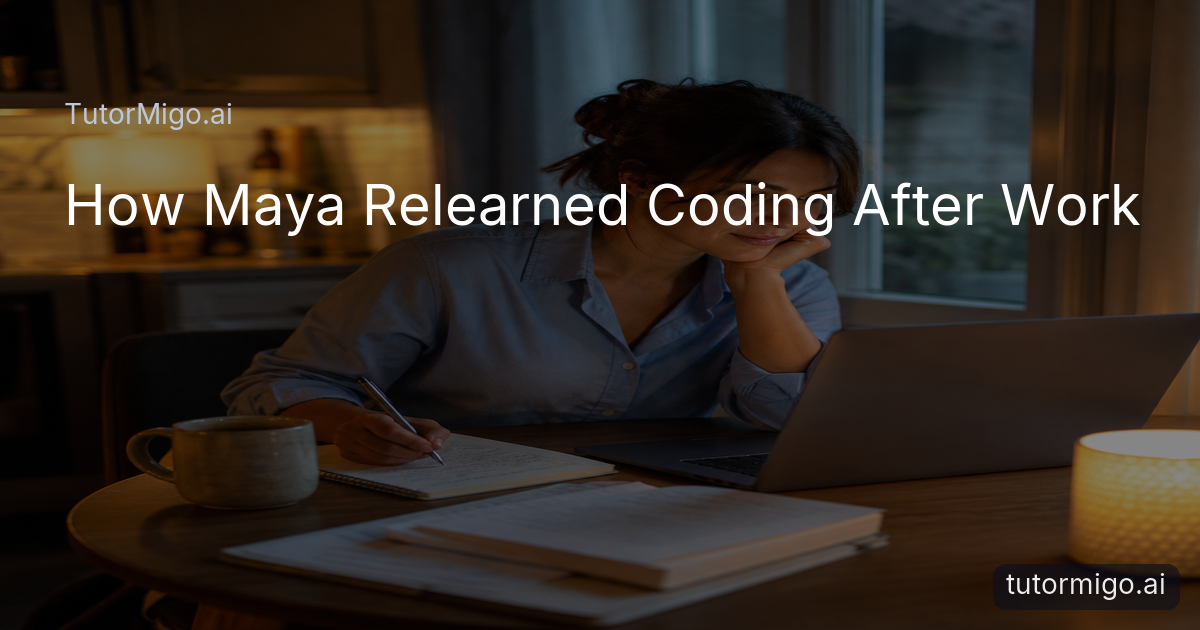
At 6:40 each evening, after finishing customer-support tickets and commuting home, Maya opened her laptop with one goal: become comfortable with coding again. She had studied a little Python years earlier, but loops, functions, and error messages no longer felt familiar. A full-time schedule left little room for long lessons, so she committed to 20-minute sessions instead of waiting for a free weekend that rarely came.
Her aim was practical. Maya wanted to change careers and complete a six-week Python fundamentals course, but she needed support that could meet her at the exact point where her confidence dropped. Searching for an AI tutor at tutormigo.ai for adults, she tried TutorMigo.ai as a more focused study environment than opening a general-purpose chatbot and starting each conversation from scratch.
That small distinction mattered. She could explain what she had tried, ask a follow-up question the next evening, and continue from the same learning thread. The experience felt less like searching for isolated answers and more like rebuilding a skill one manageable session at a time.
Twenty minutes became a dependable routine

Maya began with a simple pattern: five minutes to review the previous concept, ten minutes to work through one problem, and five minutes to explain the solution in her own words. When a nested loop confused her, the AI Tutor walked through the logic step by step rather than dropping in a finished answer. She could ask for another example, then return to the original problem while the idea was still fresh.
On especially busy nights, she used the math-like structure of the interactive study tools to make her thinking visible and test small pieces of code. On quieter nights, she practiced in the code sandbox and kept a short list of questions for the next session. The routine was not dramatic; it was repeatable.
She also created flashcards for vocabulary such as variable scope, parameters, and list methods. Spaced review helped her notice that forgetting was part of learning, not evidence that she was too far behind. Those brief reviews made the next 20-minute session easier to start.
Continuity replaced the stop-and-start cycle
Before TutorMigo.ai, Maya often used a general-purpose chatbot for coding questions. It could be useful in the moment, but she had to restate her background and the course assignment repeatedly. With the TutorMigo workspace, her session history gave her a clearer thread: last night’s explanation, today’s practice, and tomorrow’s question stayed connected.
That continuity became one of the main TutorMigo.ai benefits for her. The AI Tutor did not make the work effortless, and it did not remove the need to debug. Instead, it helped her stay with a problem long enough to understand why a solution worked. When her code returned an error, she learned to describe the expected output, isolate the failing line, and test one change at a time.
For Maya, this was an important practical difference from treating AI as an answer generator. She was using TutorMigo.ai for working professionals as a steady place to practice, revisit concepts, and ask better questions between demanding workdays.
A completed course became proof of progress
In the sixth week, Maya submitted her final Python project: a small command-line tool that organized customer-support notes by category. It was modest, but it represented skills she could explain rather than merely imitate. She had completed the course while working full-time, using 20-minute sessions most weekdays and longer practice only when her schedule allowed.
The result changed how she described herself. Instead of saying she was “trying to get back into tech,” she could point to a finished course, a working project, and a routine she knew she could sustain. She began preparing applications for entry-level technical support and junior automation roles, with clearer examples to discuss.
Maya’s experience shows how adults can learn coding online with AI without pretending that time is unlimited. The win was not a sudden transformation. It was the accumulation of small, connected efforts that turned an old interest into current evidence of ability.
I stopped waiting for a perfect evening to study. Twenty minutes was enough to keep the thread, and keeping the thread was what helped me finish.
Learning Through Deliberate Practice
Maya also changed how she approached mistakes. Instead of treating an error as evidence that she lacked technical ability, she began examining it as information. She wrote down what she expected the code to do, compared that expectation with the result, and tested one small change at a time. This process made difficult concepts less mysterious and helped her notice patterns across different problems. For adult learners, that kind of deliberate practice can be especially valuable because it connects new knowledge to the reasoning skills developed through work and daily life.
Building Confidence Through Community
Learning became less isolating when Maya started asking questions in an online coding group. Other learners offered alternative explanations, while experienced programmers showed her how to search documentation and describe a problem clearly. She did not need to know everything before participating; explaining her thinking became part of the learning itself. The conversations also reminded her that adults enter education with different backgrounds, responsibilities, and strengths. By contributing alongside others, Maya developed a more flexible sense of herself—not as someone catching up, but as an active participant in a shared learning community.
Enjoyed this read?
Like, share, or comment below.



Comments
0Sign in required · respectful discussion · replies supported
Loading comments…