

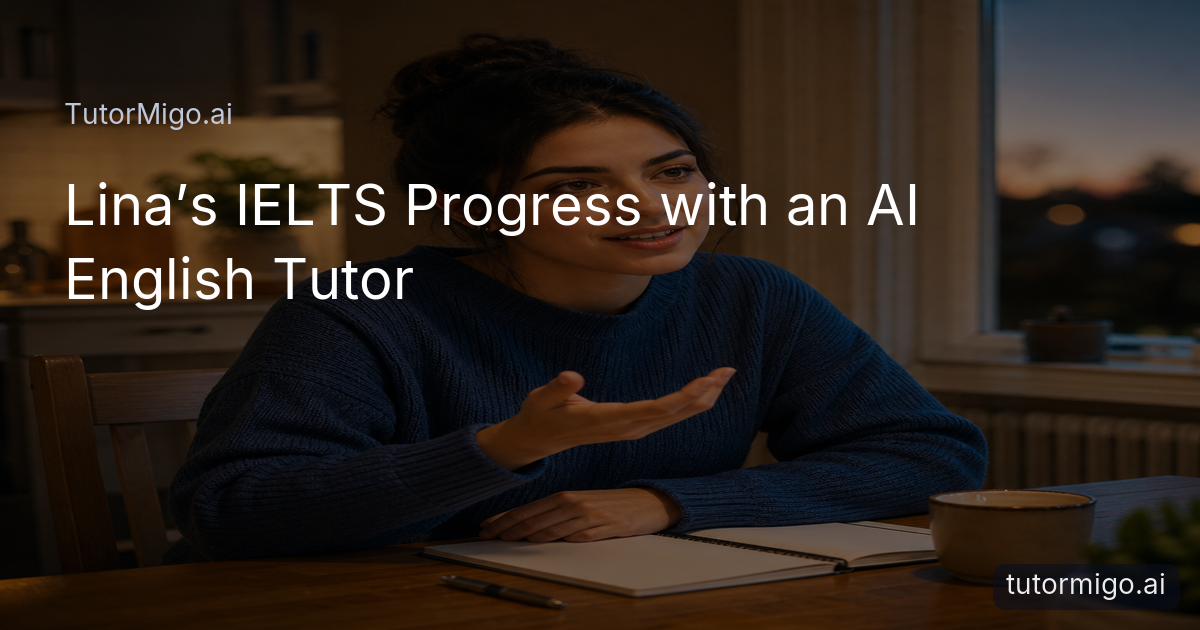
From careful answers to hesitant pauses

At the start of her IELTS preparation, Lina knew what she wanted to say but often lost her words while speaking. She would write a strong answer in her notebook, then pause when asked to explain it aloud. In writing, her ideas were clear, but repeated vocabulary and rushed sentence endings made her responses less precise.
Her goal was practical: reach the score required for an immigration application without turning every evening into a stressful test session. She began using TutorMigo.ai as an AI English tutor for short, focused practice after work. Instead of asking for random explanations, she returned to the same tutor workspace, reviewed the previous session, and continued with one manageable task. That continuity helped her notice patterns rather than judge each imperfect answer. The early TutorMigo benefits were simple but meaningful: a study routine she could repeat, feedback she could revisit, and a place where progress did not disappear after one conversation.
A method built around speaking and vocabulary

Lina divided her practice into small cycles. She first answered a speaking question aloud, then used the AI Tutor to identify places where her meaning became unclear. She did not try to memorize a perfect script. Instead, she collected useful phrases for comparing ideas, giving examples, and explaining a personal choice. The next day, spaced-repetition flashcards brought those phrases back for review before they faded.
For writing, she worked through one paragraph at a time. The interactive study tools gave her a place to outline an argument, rearrange supporting points, and examine sentence-level changes without losing the original idea. This was different from opening a general-purpose chatbot and starting a separate conversation each time: Lina could keep her practice connected to the week’s goal and return to earlier work. Her search for “how to improve IELTS speaking confidence as a non-native English speaker” became a repeatable routine rather than a source of scattered advice. For broader practice ideas, she also read this guide to AI tutoring effectiveness for IELTS preparation.
Making progress visible without making it heavy
After three weeks, Lina could hear a difference in her own recordings. She still paused, but the pauses were shorter and usually followed by a clearer explanation. Her vocabulary review showed which phrases she remembered and which needed another round. The exam preparation area helped her organize IELTS practice sets and track completed work, so she could see whether she was spending too much time on comfortable reading tasks and not enough on speaking.
Her writing also became more controlled. A paragraph that once repeated “important” several times now used more specific language because she had reviewed alternatives in context. She began each session by checking one previous goal and ended by choosing the next small action. That structure mattered when she was tired after work. She was not measuring success by how long she studied; she was measuring it by whether she could complete a speaking response, reuse new vocabulary, or revise one paragraph with a clear reason. The phrase “best online ESL tutoring for IELTS speaking and writing” now described the kind of focused support she was actively looking for.
A calmer test day and a plan beyond IELTS
By her mock test, Lina’s speaking score had risen by one band from her baseline, while her writing improved through clearer organization and fewer repeated words. The score mattered, but so did the moment before the interview: she opened her notes, took a breath, and trusted that she had practiced answering unfamiliar questions rather than memorizing fixed responses.
Her parent could review progress through the parent dashboard without taking over the study routine, and Lina’s teacher could use shared visibility to suggest where another practice set would help. That made support more specific: encouragement came with evidence, not pressure. TutorMigo.ai did not replace Lina’s effort or make the exam automatic. It gave her personalized sessions, review tools, and a visible path from one practice decision to the next. For students, parents, and teachers comparing an AI Tutor with general chat tools, her story shows the practical difference that continuity and structured progress can make. Lina finished IELTS preparation with a stronger score—and a more confident way to keep learning English afterward.
I stopped trying to sound perfect. I started practicing how to make my meaning clear, one answer at a time.
Turning Listening into an Active Skill
Lina also uses short listening exercises to train more than recognition. Before each recording, she predicts the kind of answer required, then listens for names, numbers, changes of direction, and paraphrases. Reviewing incorrect answers matters as much as completing the exercise: she notes whether the problem came from vocabulary, concentration, spelling, or a missed transition. This helps her approach unfamiliar accents with a practical strategy rather than panic.
Building a Reliable Writing Process
For IELTS writing, the tutor helps Lina separate planning, drafting, and checking. She first identifies the question’s demands and chooses two or three main ideas. After writing, she checks paragraph purpose, linking, verb tense, articles, and word limits in a fixed order. Comparing an early draft with a revised version makes improvements concrete while showing which errors continue to affect clarity.
Practising Under Real Conditions
Regular timed mini-tests introduce useful pressure without making every study session exhausting. Lina practises transferring answers, following instructions precisely, and moving on when one question becomes difficult. These routines make the exam format familiar and leave her more mental space for demonstrating what she knows.
Related reading
Enjoyed this read?
Like, share, or comment below.

Comments
0Sign in required · respectful discussion · replies supported
Loading comments…