

The homework hour that kept stretching later

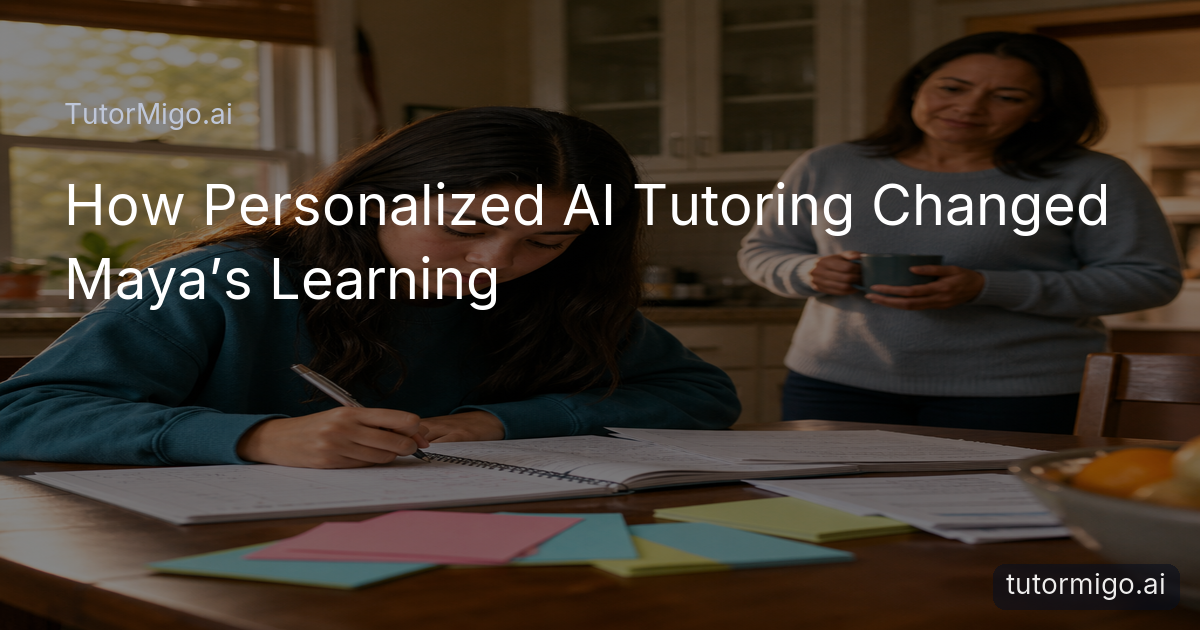
By 7:30 each evening, Maya’s kitchen table was covered with a math notebook, a half-finished snack, and three different colored pens. She was capable and curious, but homework often turned into a long series of stops and starts. If she missed the first explanation of a concept, the rest of the assignment felt harder. Asking for help at home sometimes brought an answer, but not always the patient, one-on-one conversation she needed to understand why the answer worked.
Her mother noticed the pattern in small details: Maya reread the same paragraph several times, skipped questions that looked unfamiliar, and became quiet when algebra appeared. Her teacher saw something similar in class. Maya could explain an idea after a guided conversation, yet her quiz results did not consistently show what she understood.
The family was not looking for a shortcut or a machine to complete schoolwork. They wanted support that would stay with Maya’s questions long enough for confusion to become understanding. That was the starting point for trying TutorMigo.ai. The first change was not a dramatic jump in grades. It was that Maya stopped treating every difficult question as evidence that she was bad at the subject.
A tutor that adjusted instead of rushing ahead

Maya began using the TutorMigo.ai AI Tutor Workspace for short sessions after school. At first, she asked for help with a problem she had already attempted. Rather than moving immediately to a final response, the conversation gave her room to describe where she became uncertain. When she said that a word problem felt confusing, the tutor slowed down, separated the information into smaller parts, and asked her to explain each step in her own words.
That pacing mattered. Maya learned best when she could see one example, try a similar example, and then talk through the difference between them. The AI tutor adapted the conversation around that preference instead of treating every session as a rapid question-and-answer exchange. When she needed a visual explanation, she could continue the work with the interactive tools available through the Study Tools Hub. When she needed repetition, the session returned to the same idea without making her feel as if she had failed.
Because her sessions remained available in her workspace at tutormigo.ai , Maya could pick up a question the next day instead of starting from zero. That continuity became one of the clearest TutorMigo benefits for her: support felt connected from one study session to the next, not like a collection of unrelated answers.
Small practice sessions found the weak spots
After two weeks, Maya and her mother could name the subjects that needed the most attention. Algebraic expressions and multi-step word problems took more effort than other topics, while vocabulary review was easier when it happened in short bursts. Before using a personalized routine, Maya had spent roughly the same amount of time on every subject. Now her study time reflected what she actually needed.
She used TutorMigo.ai’s spaced-repetition flashcards to review terms and formulas on a schedule rather than cramming them the night before a quiz. The cards helped her notice which ideas she remembered quickly and which ones disappeared after a day. For math, she moved to the interactive math step editor when she needed to examine her reasoning line by line. The whiteboard gave her another way to sketch relationships before writing a final response. viisit: tutormigo.ai
These tools did not replace effort; they made effort more precise. Maya could spend ten focused minutes revisiting a weak concept, then test herself without looking at her notes. A general-purpose generative chatbot might provide a useful explanation in a single conversation, but TutorMigo.ai gave her a connected place to practice, review, and return to unfinished learning. That difference made her sessions feel more like tutoring and less like searching for isolated answers.
Preparation became a path she could see
As Maya’s next SAT date approached, her biggest problem was not knowing what to study first. A disappointing practice score had given her a number, but not a clear route forward. She worried that preparing meant completing endless questions and hoping the score improved. Her mother worried that pressure would make Maya avoid studying altogether.
Using TutorMigo.ai’s structured exam preparation, Maya worked through practice sets and used progress tracking to identify patterns. Reading questions took longer than expected, while some math skills improved after targeted review. Instead of marking an entire evening as either successful or unsuccessful, she could see a smaller result: one type of question had become more familiar, and another still needed guided practice.
The AI Tutor helped her talk through mistakes without turning them into a verdict about her ability. Maya began keeping a short note after each session about what she understood, what she needed to revisit, and what strategy helped. Her grades in regular math assignments improved first, followed by more consistent practice scores. The change was gradual, but it was visible. She was no longer studying harder in every direction; she was studying with a clearer sense of purpose.
The adults around Maya saw more than a score
Maya’s progress also changed the conversations at home and at school. Her mother used the Parent Dashboard to follow learning progress and support her without hovering over every assignment. Instead of asking, “Did you finish your homework?” she could ask a more useful question: “Which kind of problem are you working on this week?” That small shift made check-ins feel collaborative rather than corrective.
Maya’s teacher noticed that she arrived with more specific questions. When a topic remained difficult, the teacher could connect classroom instruction to the area Maya was practicing outside class. The Teacher Dashboard offered visibility into student progress and reporting, giving the teacher a broader view without requiring Maya to explain every detail from memory.
For Maya, this did not feel like being watched by a larger system. It felt like the important adults in her life were finally working from the same picture. Her mother understood where encouragement mattered, and her teacher could respond to the learning need behind a missed question. The technology was useful because it supported those human conversations, not because it replaced them.
The grade was important, but confidence lasted longer
By the end of the term, Maya’s math grade had risen, and her practice results were more consistent. She still encountered difficult questions. The difference was what happened next. Instead of closing the notebook or waiting for someone to rescue her, she could identify the confusing step, ask a focused question, review a related flashcard, or work through the problem with an interactive tool.
Her mother described the most meaningful change as the sound of the evenings. The kitchen table was still used for study, but it was no longer the place where frustration gathered. Maya sometimes finished a session by explaining a concept aloud, using the same words she had once struggled to find. That ability to explain her thinking became a stronger sign of learning than a single correct answer.
For students, parents, teachers, and lifelong learners comparing AI learning tools, Maya’s story points to practical TutorMigo benefits: personalized pacing, continuity across sessions, focused review, structured preparation, and progress that can be understood by the people supporting the learner. The platform did not make learning effortless. It made the next step clearer—and for Maya, that changed everything.
Her mother still keeps the three colored pens on the kitchen table. Now, when Maya reaches for them, it usually means she is ready to work rather than preparing to give up.
The biggest change was not that Maya stopped finding work difficult. It was that difficulty no longer made her stop.
Explore TutorMigo
Enjoyed this read?
Like, share, or comment below.


Comments
0Sign in required · respectful discussion · replies supported
Loading comments…