
The 11 PM Question That Started This: A Student, a Kitchen Table, and No AI Tutor in Sight
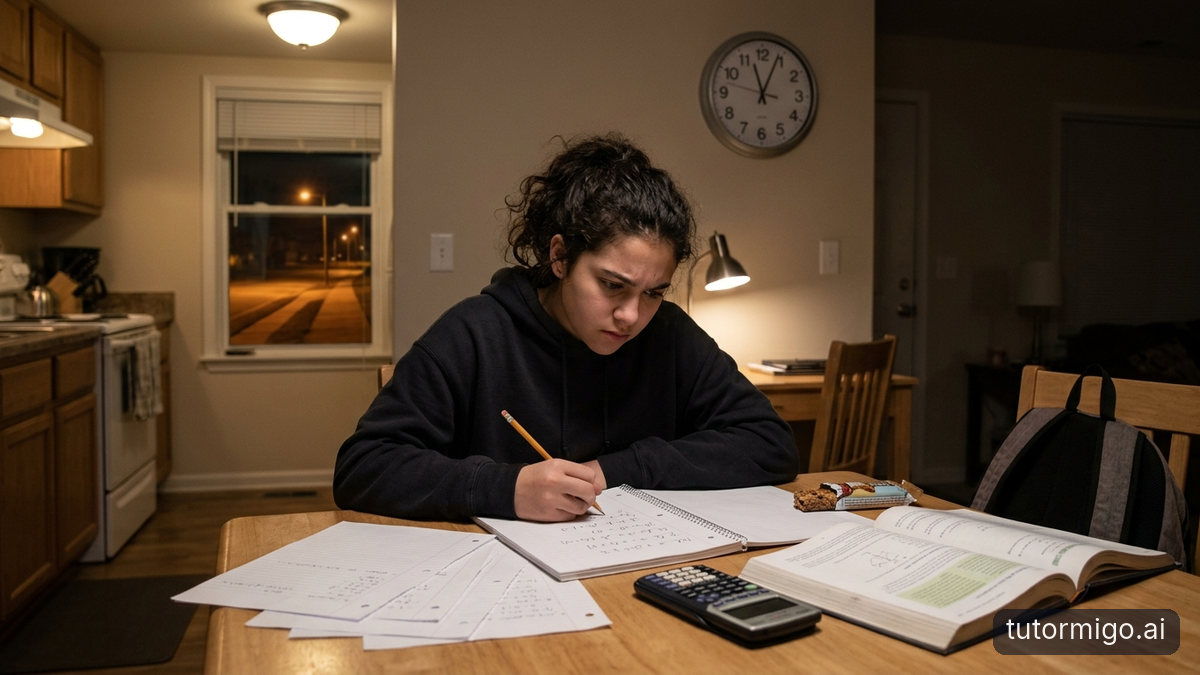
The kitchen clock in the apartment read 11:04 PM. Outside, the streetlights cast long, amber shadows across an empty suburban sidewalk, but inside, the kitchen was alive with the rustle of looseleaf paper and the quiet anxiety of an unresolved algebra problem. Maya, an eighth-grader with a penchant for letting her curiosity run right up until midnight, stared at a quadratic equation that seemed written in hieroglyphics. Her mother, exhausted from a twelve-hour nursing shift, had finally fallen asleep on the living room sofa twenty minutes earlier. There was no one left to ask. In households across the country, this late-night study crunch is a familiar, unspoken ritual. Traditional tutoring centers closed hours ago; older siblings were away at college; and parents, no matter how deeply they cared, couldn't always remember the exact mechanics of factoring polynomials after a grueling workday. This exact bottleneck has defined student struggle for generations: the moment academic support disappears right when a young learner hits a wall.
For decades, education operated on a rigid schedule of availability. If you needed help, you waited for office hours, scheduled a Tuesday afternoon session, or hoped a classmate was awake to text back a blurry photo of their homework. But learning doesn't follow a 9-to-5 timetable. Curiosity strikes at odd hours, and academic panic often arrives in the quiet hours after dinner. When Maya finally typed her math question into an AI tutor workspace designed specifically for K-12 learners, the response wasn't a cold, generic answer key that skipped straight to the solution. Instead, the interface acknowledged her confusion, broke the problem down into manageable conceptual bites, and gently asked her what she thought the first step should be. That moment at the kitchen table changed everything about how her family approached independent study, turning a solitary struggle into an interactive, guided conversation that bridged the gap between late-night frustration and genuine understanding.
When a Student Asks in Their First Language and Still Gets a Clear Answer
Language should never be a toll gate standing between a child and a foundational understanding of science, history, or literature. Yet, for millions of multilingual households navigating English-dominant school systems, homework time often involves a frustrating double translation: first translating the academic concept from English into the home language, and then translating the child's raw confusion back into formal English so a teacher or traditional tutor can understand it. Consider Mateo, a sixth-grade student whose family recently moved from Santiago. While Mateo was rapidly picking up conversational English, academic vocabulary—words like hypothesis, ecosystem, or denominator—still presented a heavy cognitive load when he sat down to tackle his science packet alone. When he felt stuck on a biology assignment about food webs, trying to phrase his question in rigid English paragraphs often tied his thoughts in knots before he even began writing.
Using a flexible learning platform changed that dynamic entirely. Mateo discovered he could type out his questions in his native Spanish, expressing his doubts and half-formed ideas naturally, just as he would speak to a family member in their living room. The system processed his thoughts instantly and replied in clear, accessible Spanish, helping him untangle the ecological concepts without losing his train of thought to translation fatigue. Crucially, it could also help him bridge the gap by introducing the relevant English terminology step by step, ensuring he understood the underlying science while simultaneously building his academic vocabulary for the classroom the next day. By removing the linguistic friction that so often stalls learning, young students gain the confidence to explore complex topics deeply, knowing their first language is welcomed as a valid tool for inquiry rather than an obstacle to overcome.
Talking Through Confusion Out Loud: Voice Support the Week Before a Final
There is a distinct kind of panic that sets in seven days before high school biology finals. The textbook is three hundred pages thick, your flashcards are scattered across the floor like autumn leaves, and the sheer volume of vocabulary—from cellular respiration to Mendelian genetics—feels insurmountable. Liam knew he understood the broad strokes of photosynthesis, but every time he tried to write down the Krebs cycle in sequence, his mind went blank. Staring at a screen typing out questions felt too slow for the pace of his anxiety. He needed to talk it out. He needed to pace around his bedroom, gesture with his hands, and argue his way through a complex biological pathway out loud to see where his logic broke down. That auditory processing is how many students actually solidify complex ideas.
Leaning on advanced voice support changed the rhythm of his exam preparation entirely. Instead of wrestling with a keyboard while his thoughts raced, Liam could simply speak to his personal AI tutor workspace as if he were sitting across a coffee shop table from a patient, infinitely knowledgeable study partner. He could ramble, pause, correct himself mid-sentence, and ask clarifying questions on the fly. When he mistakenly inverted the light-dependent and light-independent reactions, the voice assistant didn't just correct him with a flat statement; it asked a probing question: "Think about where the energy comes from in the first phase—does it need sunlight directly, or can it happen in the dark?" That conversational back-and-forth forced Liam to reason through the biochemistry himself, transforming passive memorization into active, spoken mastery just days before his exam papers were handed out in class.
From Scheduled Sessions to On-Demand Help: What Actually Changes in a Study Routine
Traditional academic support has always been defined by appointment slots. A student might see a tutor for one hour on Thursday afternoons, which leaves six days and twenty-three hours of independent study where they are entirely on their own. If a breakthrough happens on Sunday morning, or if a sudden bout of confusion hits during a Tuesday evening review session, the student must bookmark the question and wait days for their scheduled window. By the time Thursday rolls around, the urgency of the question has faded, the homework has already been turned in with errors, and the teachable moment has quietly slipped away. This scarcity model of tutoring makes academic help feel like a scarce commodity rather than an accessible, ever-present resource for growth.
When support shifts from scheduled appointments to an on-demand, responsive model, the entire psychology of studying shifts with it. Students stop saving up their confusion and start tackling roadblocks the exact moment they encounter them. If a geography project on river basins raises a sudden question about erosion rates at 8 PM on a Friday, the student doesn't have to pause their momentum or skip the question to finish later. They can spend five minutes exploring the concept right then, satisfy their curiosity, and continue building their project with an unbroken train of thought. This immediate feedback loop fosters a healthier, more active approach to learning. Students learn that getting stuck is not a signal to stop working or wait for rescue, but a natural cue to pause, investigate, and figure it out with gentle guidance.
Where the Learning Sticks: Flashcards, the Math Step Editor, and Tools That Ask Students to Do Something
One of the most persistent traps in modern educational technology is the illusion of competence. It is remarkably easy for a student to scroll through a polished video explanation, nod along because the speaker makes it sound simple, and walk away convinced they've mastered a topic—only to stare blankly at a blank test paper the following morning. True learning requires active friction; it requires the student to write out equations, test their memory, and manipulate variables with their own hands. That is why purpose-built study spaces rely on more than just conversational chat windows AI Tutoring Benefits for Smooth Lesson Understanding [Study Skills]. They integrate tactile, active tools designed to demand genuine engagement from the learner, transforming passive consumers into active problem solvers across every subject area.
Consider how different study tools work together in practice. When a student is memorizing historical dates or vocabulary for a foreign language exam, spaced-repetition flashcards surface terms precisely when the brain is on the verge of forgetting them, maximizing long-term retention without wasting hours on cards they already know by heart. Meanwhile, when tackling advanced algebra or calculus, the math step editor allows learners to break down multi-stage equations line by line, ensuring they understand the arithmetic logic of every single movement rather than guessing the final integer. Coupled with an interactive whiteboard and code sandboxes for early programming assignments, these features ensure that technology doesn't do the thinking for the student. Instead, the platform sets up the scaffolding, provides targeted hints when an error occurs, and encourages the student to carry the weight of the solution themselves.
Elena Vance: What changes everything isn't just that the answers are there when you need them. It's that the tool stops and asks what you think first, making sure the student is actually doing the thinking.
Structured Exam Prep That Shows Progress Instead of Just Assigning More Practice
Preparing for high-stakes standardized tests like the SAT, ACT, AP exams, or IELTS can easily feel like stumbling through a dense fog. Many traditional test-prep books and generic software programs operate on a blunt-force principle: assign hundreds of practice questions, grade them at the end, and hope the student figures out why they missed half of them through sheer repetition. For a busy teenager balancing sports, club meetings, and regular school coursework, grinding through endless practice sets without a clear diagnostic roadmap is exhausting and demoralizing. They don't just need more questions to answer; they need a structured pathway that identifies their specific conceptual blind spots and tracks their incremental growth over weeks of preparation.
Structured exam prep changes this by organizing preparation into targeted modules with continuous progress tracking IELTS Preparation: AI Tutoring Effectiveness | TutorMigo.ai [For Parents]. Instead of treating a practice test as a final judgment, the platform treats it as a dynamic diagnostic map. If a student consistently stumbles on geometry proportion questions within an SAT practice set, the system adjusts the focus, offering targeted mini-lessons and guided practice specifically tailored to close that skill gap before moving forward. Parents and students can see clear progress indicators that highlight improvement over time, replacing vague test anxiety with concrete evidence of readiness. This structured clarity turns an intimidating mountain of test material into a series of achievable, well-marked milestones.
What Parents and Teachers See: Visibility Without Standing Over a Shoulder
Behind every diligent student is often a parent or teacher trying to strike a delicate balance: wanting to stay closely involved in a child's academic progress without hovering uncomfortably over their shoulder every single evening. Parents often feel out of their depth with modern school curricula, worrying silently whether their child is falling behind in math or simply spinning their wheels on difficult reading assignments. Educators, on the other hand, manage classrooms of twenty-five to thirty students, making it nearly impossible to know precisely which concept each individual child wrestled with during their independent homework hours on a Tuesday night. This visibility gap leaves families and teachers guessing about where support is truly needed most.
A thoughtful approach to educational technology bridges this gap by offering dedicated dashboards for families and educators Teacher Dashboard Insights for Step-by-Step AI Tutoring [Learning Science]. Through a clean parent dashboard, families can view learning progress, track session history, and understand which topics their child is exploring, all without invading the student's private workspace or micromanaging their study habits. Similarly, teachers gain actionable insights into class-wide trends and individual student engagement, allowing them to tailor classroom instruction around actual learning bottlenecks rather than guesswork. This shared visibility creates a supportive triangle between student, parent, and teacher, ensuring everyone is aligned and informed without adding administrative burden to already overwhelmed educators.
Honest Limits: Why This Supports Teachers Rather Than Replaces Them
In any conversation about artificial intelligence in education, an essential and necessary question invariably arises: Where does human teaching fit into all of this? There is a legitimate and understandable fear among educators and families that automated tools might eventually be positioned as a substitute for human classrooms, reducing rich social learning to a sterile exchange between a child and a screen. Let us be entirely clear and unequivocal: no AI platform can ever replace a dedicated human teacher. A machine can explain the mechanics of a chemical reaction or scaffold a math equation with infinite patience, but it cannot notice when a student is blinking back tears of frustration, celebrate a quiet breakthrough with a genuine smile, or teach the invaluable social lessons of collaboration, empathy, and resilience found in a physical classroom.
AI tutoring tools are built not to replace teachers, but to act as tireless instructional assistants that shoulder the heavy burden of repetitive explanation and after-hours support. When a student spends twenty minutes working through a difficult grammar concept with an AI tutor at home, they arrive at school the next morning with clearer questions and fewer foundational gaps, allowing teachers to spend their precious classroom hours on deep discussions, creative projects, and personal mentorship. By handling the rote mechanics of practice and clarification outside of school hours, these systems free up educators to do what they do best: inspire, connect, and guide young minds through the deeply human art of learning.
What I Keep Coming Back To: Removing Barriers of Language, Time, and Location
Reflecting on the modern educational landscape, what stands out most isn't the underlying technology itself, but the profound human relief it brings to families and students. For generations, high-quality academic support has been unevenly distributed—tied tightly to geography, family income, and local tutor availability. If you lived in a rural town far from academic centers, or if your family budget could not stretch to accommodate private tutoring fees, you simply went without that extra layer of personalized guidance. You relied entirely on classroom instruction and whatever independent grit you could muster at the kitchen table when the house finally grew quiet.
By fundamentally removing the barriers of language, time, and location, tools like TutorMigo.ai are helping to reshape education into something much more equitable and accessible. Whether a student is studying algebra in a bustling city apartment at midnight, practicing vocabulary in Spanish before a morning class, or reviewing science concepts with voice support before a final exam, reliable academic help is no longer a luxury reserved for the few. It is an on-demand, supportive companion available to any K-12 learner, anywhere in the world. And in my view, that quiet democratization of learning is the most important change happening in education today.
Pros and cons
Pros
- Available 24/7 for late-night study questions and exam preparation.
- Supports multiple languages for diverse student and family needs.
- Offers personalized step-by-step guidance across any K-12 subject.
Cons and limitations
- Cannot entirely replace human mentors or classroom teachers.
- Requires basic digital device and internet connectivity.
What changes everything isn't just that the answers are there when you need them. It's that the tool stops and asks what you think first, making sure the student is actually doing the thinking.
Explore TutorMigo
Enjoyed this read?
Like, share, or comment below.


Comments
0Sign in required · respectful discussion · replies supported
Loading comments…