


How do you build an AI-powered AP exam prep schedule?
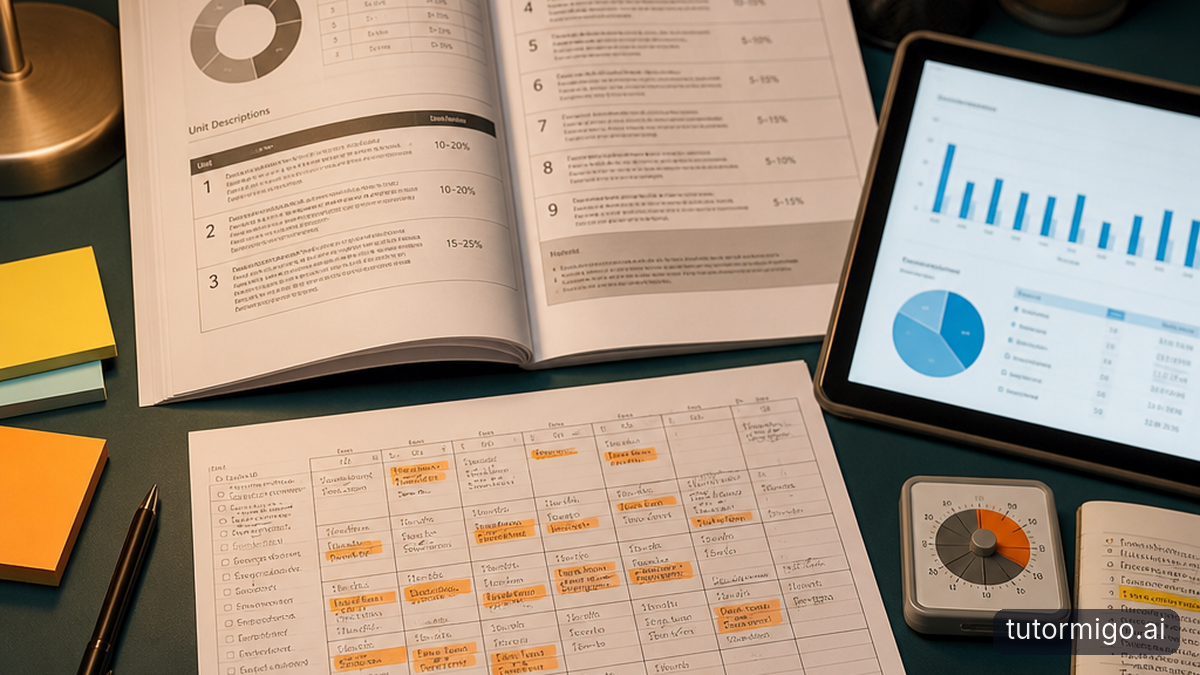
Build your eight-week AP plan by diagnosing unit weaknesses, checking official exam weighting, and scheduling targeted review before timed practice. Reassess weekly using fresh questions and rubric-based feedback. Keep spaced repetition running throughout, then finish with full-length simulations and focused correction of your remaining gaps.
Start with your course’s current College Board Course and Exam Description. Record its units, published weighting ranges, exam sections, and timing rules. These documents define the College Board curriculum you are preparing for; an AI-generated topic list is not a substitute. Use current official scoring materials whenever available.
Week one: establish evidence. Complete a representative diagnostic under realistic conditions. Your diagnostic baseline score should include unit-level accuracy, unanswered questions, timing problems, and free-response rubric points. Treat a short diagnostic as an initial sample, not a reliable prediction of your final AP score.
Weeks two and three: repair high-weight weaknesses. Schedule three focused review sessions and two shorter retrieval sessions each week. Ask your AI Tutor to explain the reasoning behind missed questions, then attempt a different problem without help. Preserve useful explanations in session history so subsequent tutoring can revisit the same misconception.
Weeks four through six: emphasize application. Mix units and increase free-response questions (FRQ), while retaining short recall sessions. For your AP exam study schedule AI workflow, update priorities from fresh attempts, not from how familiar yesterday’s explanation feels.
Weeks seven and eight: rehearse and consolidate. Complete timed sections, then a full-length rehearsal using the official format. Review errors before taking another mock. If school deadlines interrupt the plan, move the least valuable task rather than abandoning the week; a study plan that survives a normal week needs deliberate flexibility.
Prioritizing High-Yield Units Over Chronological Review
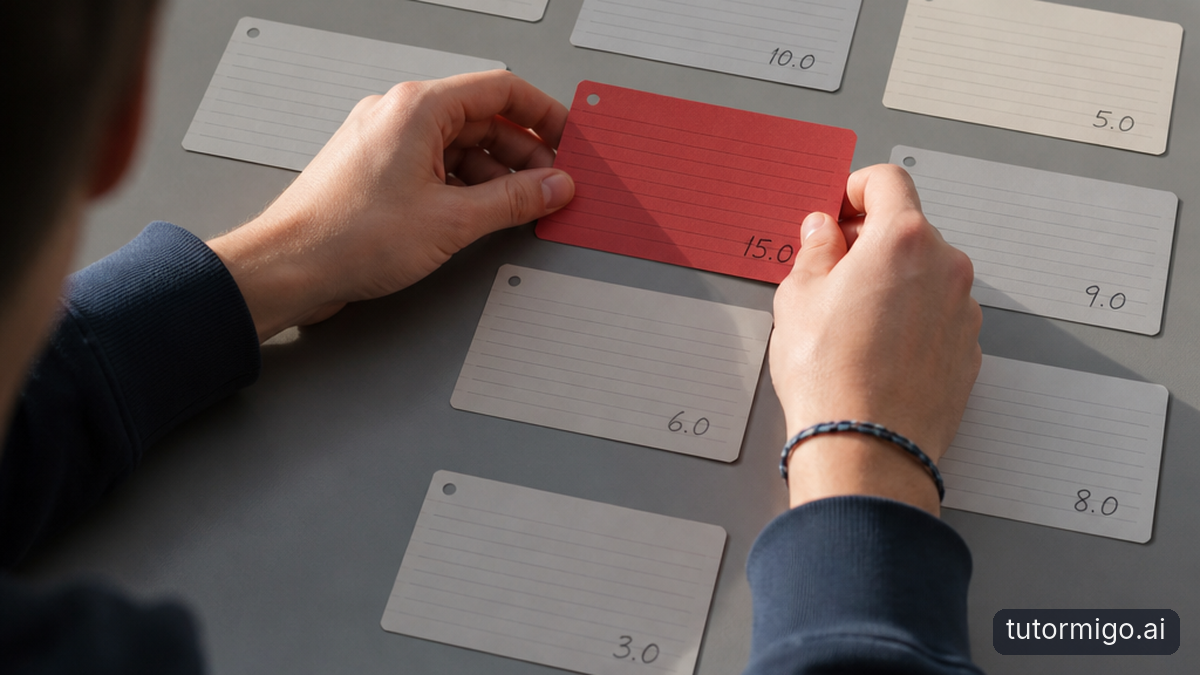
Prioritize units by combining official exam weighting with demonstrated weaknesses, not textbook order. Spend more time where missed concepts affect heavily tested material, while maintaining minimum coverage elsewhere. Recheck priorities weekly because improved accuracy, prerequisite gaps, and timing problems can change the best next task.
High-yield unit review means selecting work with a strong connection to assessed content and your current gaps. A heavily weighted unit you already understand may need maintenance, while a moderately weighted prerequisite could deserve immediate attention because it supports several other topics.
Consider a hypothetical ten-hour revision week. A chronological template might allocate four hours to familiar chapters. Replacing those four hours with targeted practice redirects 40% of that week’s time. That illustrates avoidable repetition; it does not establish that AI saves every student 40%, or that total preparation time should fall.
Create a simple priority record for each unit: official weighting range, recent independent accuracy, recurring error, and next action. Keep question difficulty reasonably comparable. Three easy correct answers should not automatically outweigh repeated failures on representative exam tasks.
Use a spaced repetition calendar alongside that record. Review a missed concept the next day, revisit it several days later, and extend the interval after successful recall. These are example intervals, not a universal prescription. TutorMigo.ai’s flashcards support spaced-repetition scheduling; you should still check that each card tests an accurate, relevant idea.
Reserve some weekly time for mixed questions across every assessed unit. Otherwise, prioritization becomes neglect, and familiar strengths can quietly decay while you concentrate on weaknesses.
Static Study Timetables vs. Generic Prep Books vs. TutorMigo AI Study Plans
A timetable, a prep book, and a tutoring platform solve different problems. The comparison below describes typical formats, not every commercial product. Some books include online diagnostics, and some calendars connect to sophisticated tools. Judge the resource you actually have rather than assuming its category determines its quality.
A static timetable is useful for protecting study time. A generic prep book can provide coherent explanations, practice questions, and worked answers. TutorMigo.ai adds personalized tutoring, session history, structured AP practice with progress tracking, and spaced-repetition flashcards. Those are practical TutorMigo benefits, not evidence of guaranteed score improvement.
Real-time weakness detection deserves particular care. Feedback on an answer is not the same as a validated diagnosis across an entire course. Use TutorMigo.ai’s practice records alongside your own unit log, and verify whether a pattern persists across multiple independent attempts before changing the schedule.
General-purpose chatbots can also explain concepts, suggest schedules, and discuss rubrics. The relevant difference is how conveniently your workflow combines tutoring continuity, practice, review scheduling, and progress records. Choose the setup you will maintain consistently, rather than assuming one product category is incapable of helping.
For FRQ work, an answer explanation is useful evidence for revision, but it is not an official examiner’s judgment.
Executing Your Exam Sprint with TutorMigo.ai
Converting Course Syllabi into Targeted Flashcard Decks
Compare your syllabus with the official course framework, then select one weak learning objective. TutorMigo.ai supports AI-assisted flashcard creation, but that should not be confused with a verified automatic syllabus importer or guaranteed curriculum mapping. Supply the relevant concepts and inspect the resulting cards before reviewing them.
For AP Biology, replace “Explain cellular respiration” with focused prompts about electron carriers, proton gradients, and evidence from an experiment. Before relying on an automated flashcard generator, learn how better flashcard questions improve recall. Include application prompts, not just definitions. Keep a unit label and learning objective in your own deck organization so you can check coverage.
Scoring Free-Response Prompts Against Official Rubrics
Attempt the response independently, then compare it with the official rubric for that specific question. Ask the AI Tutor to identify evidence for each criterion, flag missing reasoning, and distinguish an incorrect claim from an incomplete explanation. This is scoring rubric alignment as a study process, not certified automated scoring.
Verify every suggested point against the published rubric. If interpretation is uncertain, ask your teacher. Rewrite the missed reasoning and attempt a new prompt later. For AP Calculus, use the math step editor or whiteboard to examine the intermediate work that your final answer conceals. An apparent arithmetic mistake may actually reveal a conceptual gap.
Forming Peer Accountability Hubs with Study Squads
Arrange a small, student-organized accountability group with classmates; do not assume TutorMigo.ai includes a shared squad workspace. Agree on a weekly target, complete work independently, and discuss one corrected misconception each. These collaborative study squads should reinforce retrieval and honest checking rather than become answer-sharing sessions.
Use progress records to guide support. Parent Dashboard visibility can help families discuss consistency, while Teacher Dashboard monitoring and reporting can inform classroom follow-up. Keep the conversation specific: which unit improved, which error persists, and what task comes next?
What to Do Next
Open TutorMigo.ai and ask for a free eight-week revision breakdown for your AP course. Include your available hours, diagnostic results, and official unit weights; check current access terms for any features you use. Your AP exam study schedule AI plan should end each week with one decision: maintain, intensify, or replace the next practice task.
Frequently Asked Questions About AP AI Prep
Use these answers as planning defaults rather than promises. Your starting knowledge, course demands, and independent practice results matter more than a universal timetable. Keep checking current College Board materials, and ask your teacher to resolve uncertain scoring judgments before treating AI feedback as an accurate measure of exam readiness.
| Feature | Personalization Level | Real-Time Weakness Detection | FRQ Feedback Capability |
|---|---|---|---|
| Static study timetable | Manually customized dates and tasks | None inherent; requires your own tracking | None inherent |
| Generic prep book | Usually fixed content; you select relevant chapters | Self-checks may reveal gaps; varies by book | May include sample answers and scoring guidance |
| TutorMigo.ai-supported study plan | Personalized tutoring plus structured AP practice | Practice progress tracking; not a claimed automatic unit diagnostic | Tutoring discussion can support review; official-rubric scoring is not guaranteed |
Frequently asked questions
Start about eight weeks before your exam if possible, beginning with a representative diagnostic and current official course materials. Start earlier when you have substantial prerequisite gaps. If less time remains, prioritize assessed weaknesses rather than trying to compress every textbook chapter into an unrealistic calendar.
AI can suggest feedback when given the exact prompt and official rubric, but it can misinterpret criteria or award unsupported points. Treat its score as provisional. Check each criterion yourself and ask a teacher about ambiguous responses; AI feedback is not official AP scoring.
A starting example is five to seven focused hours per course weekly, adjusted for your baseline, workload, and time remaining. This is a planning suggestion, not a researched requirement. Include timed practice and error correction, and adjust when your results or school commitments change.
Alignment requires checking each card against the current course framework and relevant learning objective. AI-assisted creation does not guarantee official coverage or accuracy. Label cards by unit, verify explanations, and combine spaced repetition with application questions, since factual recall alone cannot demonstrate full exam readiness.
Enjoyed this read?
Like, share, or comment below.



Comments
0Sign in required · respectful discussion · replies supported
Loading comments…