

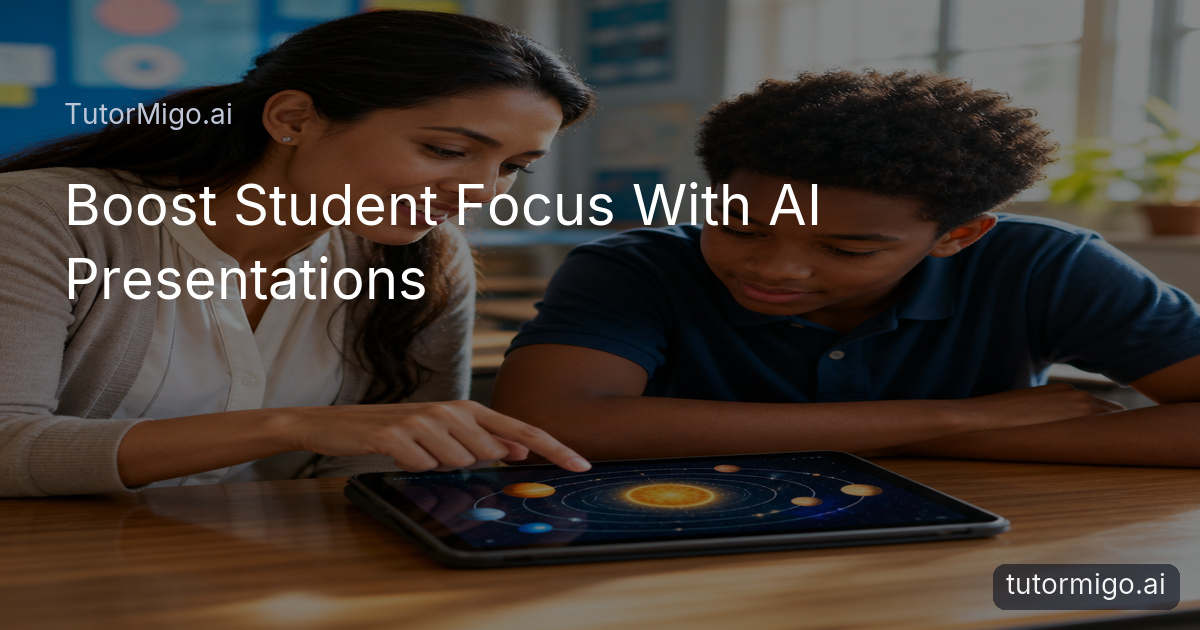
When Students Lose Focus, Use AI to Make Lessons More Engaging

We have all been there: you are halfway through a carefully prepared lecture, and you notice the glazed look in your students' eyes. Keeping learners engaged is one of the most persistent challenges in education, especially when the subject matter is dense or abstract. This is where modern technology offers a genuine lifeline. By integrating AI into your workflow, you can transform static, text-heavy lessons into dynamic, multi-sensory experiences that capture attention immediately. Instead of relying solely on traditional lecture formats, you can use AI to generate creative metaphors, real-world examples, or even interactive scenarios that relate directly to the students' lives.
For instance, if you are teaching a complex historical event, an AI tool can help you draft a narrative-driven presentation that frames the facts as a series of critical choices, turning a dry timeline into a compelling story. When students see their teacher using tools that feel modern and responsive, their own interest levels often rise. Furthermore, when you have an AI Tutor available to help you brainstorm these creative angles, the barrier to entry drops significantly. You no longer have to spend hours searching for the perfect analogy; you can collaborate with your digital assistant to find the most effective way to explain a concept. This shift from "delivering information" to "facilitating discovery" is the cornerstone of keeping students focused and excited about what comes next in the curriculum.
How You Can Use AI to Build Clear, Creative Student Presentations

Creating a presentation that is both clear and visually stimulating often feels like a balancing act. You want to include enough detail to be accurate, but not so much that you overwhelm your audience. AI can act as your co-designer here, helping you structure your thoughts logically before you ever open your slide software. Start by feeding your core learning objectives into an AI model and asking it to outline a presentation flow that builds knowledge step-by-step. This ensures that every slide serves a specific purpose, preventing the common trap of "information dumping" that causes students to tune out.
Beyond structure, AI can help you refine the tone and language of your content to better suit your specific group of learners. If you are presenting to a younger audience, you might ask the AI to simplify jargon or suggest analogies that resonate with their daily experiences. If you are working with advanced students, you can use it to generate thought-provoking questions that challenge their assumptions. By leveraging an AI to review your presentation drafts, you can ensure that the complexity level is perfectly calibrated. This collaborative approach allows you to focus on the human element of teaching—the delivery, the eye contact, and the passion—while the technology handles the heavy lifting of organization and clarity. The result is a presentation that feels cohesive, purposeful, and genuinely helpful to the students sitting in front of you.
Turn Complex Ideas Into Easy-to-Follow AI Presentation Slides
The biggest hurdle in teaching complex topics—like advanced physics, intricate literature analysis, or data-heavy social studies—is the cognitive load placed on the student. When you present too much information at once, the brain struggles to categorize it. AI allows you to break these massive topics into bite-sized, logical segments. You can use AI to summarize a long chapter into three key takeaways, or to create a sequence of slides that builds a concept from the ground up, starting with a simple definition and moving toward a nuanced application. This step-by-step help is invaluable for students who might otherwise feel intimidated by the material.
Consider a scenario where you are teaching the water cycle. Instead of one slide with a diagram and five paragraphs of text, you can use AI to create a series of slides. The first slide introduces the concept with a simple, relatable question. The second slide uses a clear, AI-generated summary to explain evaporation. The third slide introduces condensation, and so on. By pacing the information, you allow students to absorb one idea before moving to the next. This methodical approach, supported by AI-assisted drafting, ensures that even your most struggling learners can follow the thread of your argument. When the content is presented in manageable chunks, students feel more confident in their ability to understand, which in turn keeps them engaged and ready to participate in the lesson.
Keep Students Involved With Interactive AI Presentation Activities
Passive listening is the enemy of retention. To truly cement a student's understanding, you need to move them from being a spectator to being a participant. AI makes it remarkably easy to weave interactive elements into your presentations. You can use AI to generate quick, formative assessment questions that you can embed directly into your slides. For example, after explaining a core concept, you can prompt your students to vote on a potential outcome or predict what happens next in a process. These small, frequent interactions act as "knowledge checks" that keep students alert and provide you with immediate feedback on their comprehension.
Another effective strategy is to use AI to create "scenario-based" learning activities. If you are teaching ethics, you can have the AI generate three different perspectives on a dilemma, then present these to the class and ask them to discuss which one is most persuasive and why. This transforms your presentation into a launchpad for critical thinking. By using the technology to facilitate these moments of interaction, you are not just teaching a subject; you are teaching students how to think critically about the information they are consuming. This active engagement is what leads to deeper, long-term understanding, and it makes the classroom experience feel dynamic and alive. When students know they will be asked to contribute, their level of focus during the presentation naturally increases.
Help Students Understand More by Combining AI With Discussion and Practice
The most effective learning happens when you combine high-quality presentation materials with follow-up discussion and deliberate practice. AI is not a replacement for the teacher-student relationship; rather, it is a tool that frees you up to spend more time on those high-impact interactions. Once your presentation has introduced the core concepts, use the remaining time to facilitate a deep-dive discussion. You can use AI to generate a list of open-ended questions that encourage students to connect the lesson to their own lives or to other subjects they have studied. This synthesis is where true mastery begins.
After the discussion, provide students with opportunities for practice that reinforce the lesson. You might use AI to generate a set of practice problems or a quick review quiz that targets the most difficult parts of the presentation. By creating a loop—presentation, discussion, and practice—you ensure that the knowledge is reinforced multiple times in different ways. This multi-modal approach accommodates different learning styles and ensures that no student is left behind. When you use technology to handle the preparation, you have more energy to listen to your students, answer their nuanced questions, and guide them through the practice phase. This holistic approach to learning is what separates a standard lecture from a transformative educational experience.
Your Next Steps for Using AI in Student Learning
If you are ready to start using AI to improve your student presentations, the best approach is to start small. You do not need to overhaul your entire curriculum overnight. Choose one topic that you know students find particularly difficult and use AI to help you design a more engaging, structured presentation for that specific lesson. Experiment with different prompts to see how the AI can help you simplify the language, create better analogies, or generate those crucial interactive questions. The more you practice, the more intuitive the process will become, and the more you will see the positive impact on your students' focus and understanding.
As you become more comfortable, look for ways to integrate other tools that support this workflow. For instance, you might use your platform’s built-in features to track student progress or provide personalized support for those who need extra help after the presentation. Remember, the goal is to enhance the human connection in your classroom, not to replace it. By using AI to handle the organizational and creative heavy lifting, you are buying back time—time that you can spend mentoring, inspiring, and connecting with your students. Start with one lesson, observe the results, and let that success guide your next steps in building a more engaging, AI-supported classroom environment.
Pros and cons
Pros
- Significantly increases student engagement.
- Helps simplify complex academic concepts.
- Saves time on visual design and lesson structuring.
Cons and limitations
- Requires initial time to learn new AI tools.
- Can lead to over-reliance if not balanced with traditional teaching.
Frequently asked questions
AI tools can help you generate outlines, summarize complex topics, and create interactive elements, saving you time while making lessons more visually and conceptually stimulating.
Yes, AI can break down dense information into manageable, logical slides that are easier for students to follow and process during a presentation.
By using AI to create polls, quizzes, or discussion prompts within your presentation, you can shift from passive listening to active participation.
Explore TutorMigo
Enjoyed this read?
Like, share, or comment below.

Comments
0Sign in required · respectful discussion · replies supported
Loading comments…