

Why You Remember a Chapter Today but Forget It Tomorrow

You study a chapter, close the book, and feel confident. A few days later, the same questions seem strangely difficult. This happens because reading information again can create a feeling of familiarity without requiring you to retrieve the answer for yourself.
That is where flashcards for students can help. Instead of looking over the same notes, you pause and try to remember a term, fact, process, or explanation before checking the answer. This small change turns revision into an active task.
Flashcards are not a replacement for understanding a topic. They work best after you have learned the main idea and need to check whether you can still recall the important details. A student studying biology might first read about cells, then use flashcards to test key vocabulary. A language learner might use them to practise words and meanings. In both cases, the goal is not simply to see information again. It is to practise bringing it back to mind.
For students, parents, and educators comparing study tools, this makes flashcard learning useful for short, focused review. You can use a few minutes between classes, before homework, or at the end of a longer study session without reopening an entire textbook.
What Are Flashcards and How Do They Help Students?

Flashcards present a question, term, or concept on one side and the answer or explanation on the other. You look at the front, try to answer from memory, and then reveal the back to check yourself. That process is called active recall: deliberately retrieving information instead of only rereading it.
For example:
Front: What is photosynthesis?
Back: The process plants use to make food using light energy.
The useful part is the pause before you reveal the answer. If you silently read the back first, you are mainly reviewing. If you attempt an answer, even an incomplete one, you get clearer feedback about what you know and what needs more work.
Flashcards can contain definitions, dates, formulas, vocabulary, steps in a process, or short explanations. A strong card asks one manageable question. Instead of writing “Explain everything about the water cycle,” make separate cards for evaporation, condensation, precipitation, and collection.
This simple format answers the question “What are flashcards used for?” They are used to practise retrieving small pieces of knowledge so that revision becomes more active, specific, and easier to measure.
How Flashcards for Students Make Revision More Effective
Flashcards help students in several practical ways. First, they encourage active recall. You cannot know whether you can explain a concept until you try to explain it without looking. Second, they make revision faster because each card focuses on one idea rather than an entire page of notes.
Third, flashcards show you what you do not remember. If you hesitate over “What is the difference between weather and climate?” that hesitation is useful information. You can return to the lesson, improve the card, or practise the concept again instead of spending equal time on material you already know.
Fourth, cards break large topics into smaller pieces. A long history unit may feel overwhelming, but a deck of focused questions gives you a clear starting point. Finally, flashcards make short study sessions more productive. Ten careful minutes of answering questions can be more purposeful than ten minutes of highlighting familiar sentences.
Try this routine with a topic you are learning:
- Study the main explanation first.
- Create or review cards for the essential ideas.
- Answer each card before revealing the back.
- Notice which cards cause hesitation or mistakes.
- Return to those difficult concepts later.
These are useful effective study techniques for better learning, especially when combined with practice questions, problem-solving, and clear understanding.
Why Digital Flashcards Can Make Studying Easier
Physical cards can work well, but digital flashcards remove some everyday friction. You do not need to carry a box of cards, find a pen, or spend extra time sorting separate piles. Online flashcards can be available whenever you have a short review window, whether you are at home or preparing for a lesson.
Digital flashcards are also easier to organise when a subject grows. You can keep vocabulary, science terms, historical facts, or revision questions in separate decks rather than mixing everything together. This makes it simpler to focus on one topic at a time.
For students already using digital study tools, TutorMigo’s study tools can make it easier to turn learning materials into useful study formats, including flashcards.
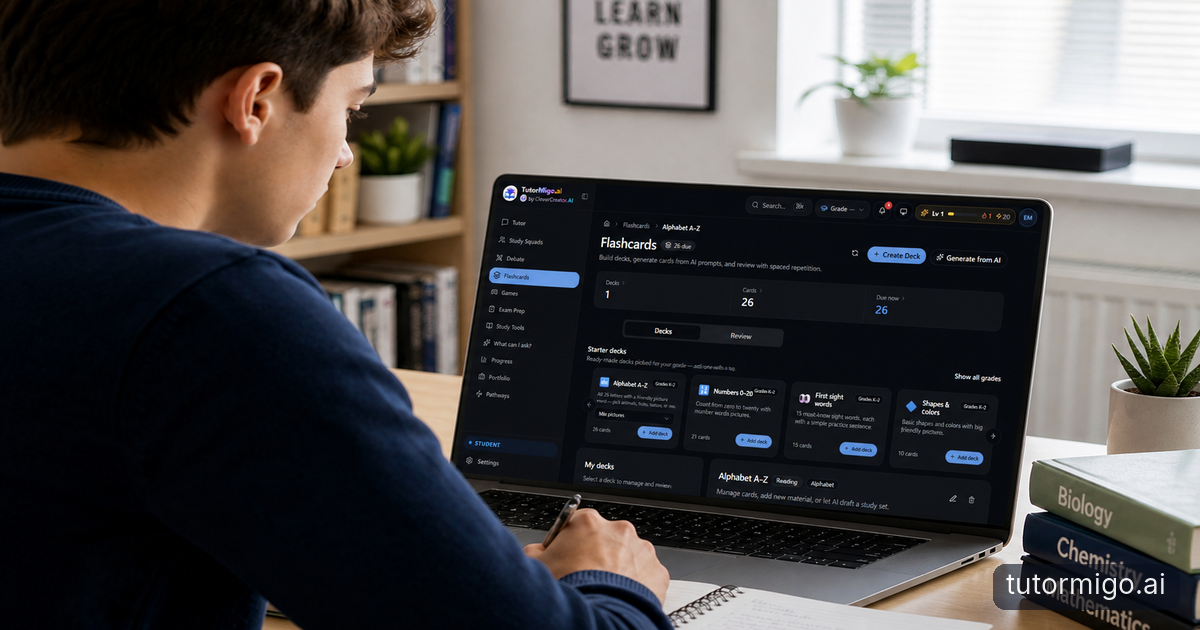
A useful digital system may also support spaced review, which means returning to cards over time rather than trying to learn everything in one long session. TutorMigo’s Flashcards feature includes spaced-repetition decks, AI-assisted card creation, and review scheduling. Those tools can make the routine more convenient while keeping the important part in your hands: attempting to answer before checking.
The TutorMigo benefits are most noticeable when the feature fits a routine you can actually maintain. A student might review ten cards after studying a lesson, then revisit the harder cards later. A parent or teacher can encourage consistency without turning every revision session into a long planning task.
How to Use TutorMigo Flashcards Effectively
TutorMigo flashcards are most useful when you treat them as a check on understanding, not as a shortcut around learning. Start by studying the topic through your usual lesson, notes, or guided tutoring session. Then create a focused deck or review an existing one. AI-assisted card creation can help you get started, but read each card carefully and adjust your approach if a question feels unclear.
Next, answer every card before revealing its explanation. Say the answer quietly, write a few words, or explain the idea in your own mind. Then mark the difficult concepts mentally and pay attention to cards that you repeatedly miss. Review scheduling can help you return to material instead of relying on one last-minute session.
If you use an AI Tutor for a topic, ask for an explanation when a flashcard exposes a gap in your understanding. The tutor can support the learning conversation, while the flashcard gives you a focused way to test recall afterward. Session history in the AI Tutor Workspace can also help you continue a study conversation rather than starting from zero each time.
For a simple routine, study one topic, review a small deck, attempt each answer, note the difficult cards, and revisit them later. You can also read this guide to master active recall with AI flashcards and study plans for another practical review approach.
Flashcard Mistakes to Avoid—and What to Do Next
Flashcards are simple, but the way you write and use them matters. Avoid putting an entire paragraph on one card. A crowded answer is difficult to remember and difficult to check. Split it into smaller questions, such as one card for a definition and another for an example.
Do not simply read the answer and move on. Give yourself a genuine chance to recall it first. Also avoid making every card unnecessarily complicated. Clear wording is usually more useful than a question designed to trick you.
- Keep one main idea per card. This makes mistakes easier to diagnose.
- Use your own words when possible. Explaining an idea simply can reveal whether you understand it.
- Review difficult cards again later. A short return visit is better than abandoning them.
- Use more than flashcards. Combine recall with reading for understanding, worked examples, practice questions, and problem-solving.
Flashcards should support your study plan, not become the entire plan. If you are unsure about a concept, pause the deck and get an explanation from a teacher, tutor, or AI Tutor. Then return to the card and see whether you can explain the idea more clearly.
Studying is not always about spending more hours with a textbook. Sometimes, changing how you review makes the time more useful. Ready to make revision more interactive? Try TutorMigo and explore how its Flashcards feature can fit into your study routine.
Frequently asked questions
Flashcards are used to practise remembering information. Each card presents a question, term, or concept, followed by an answer or explanation. They can support vocabulary learning, definitions, processes, dates, formulas, and other focused revision tasks.
Flashcards encourage active recall, which means trying to retrieve an answer before looking at it. This helps students identify gaps in their knowledge, focus on difficult concepts, and make short revision sessions more purposeful.
Digital flashcards can make studying more convenient by reducing manual organisation and making review accessible across short study sessions. They are most effective when students attempt each answer first and combine flashcard practice with understanding and problem-solving.
Students should study the topic first, review focused cards, attempt each answer before revealing it, identify difficult concepts, and revisit those cards later. Flashcards should support—not replace—explanations, practice, and deeper understanding.
Yes. TutorMigo’s Flashcards feature provides spaced-repetition decks, AI-assisted card creation, and review scheduling. Students can use it to create or review digital flashcards and build a more consistent revision routine.
Enjoyed this read?
Like, share, or comment below.



Comments
0Sign in required · respectful discussion · replies supported
Loading comments…