

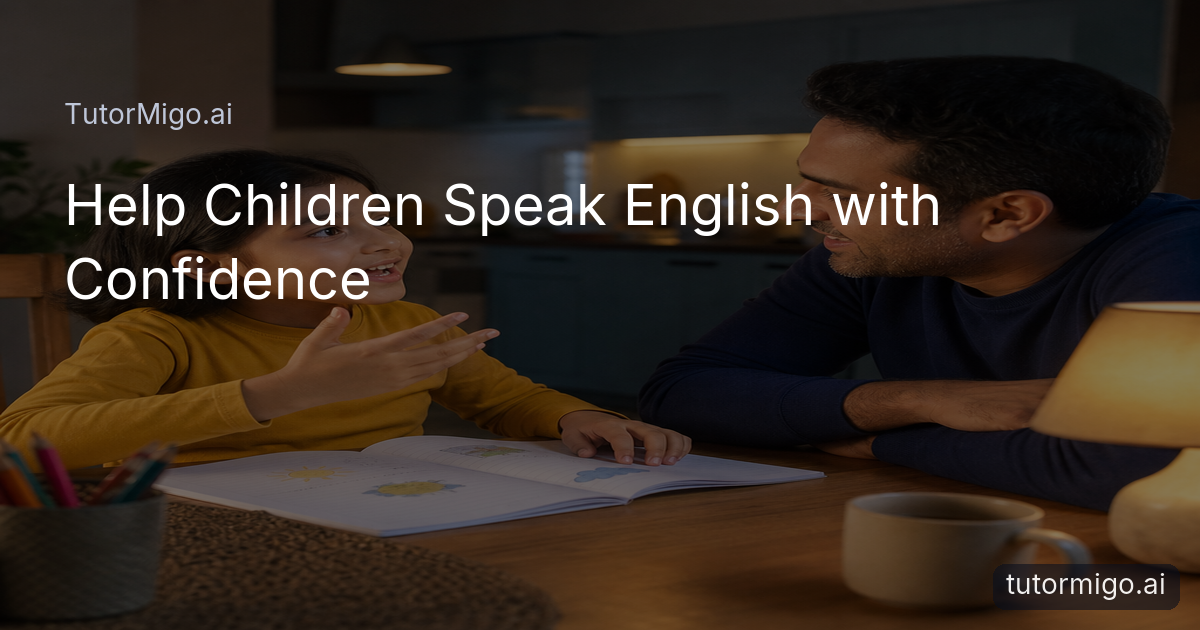
Your Child Knows the Words but Still Hesitates to Speak

Your child may recognize dozens of English words, answer vocabulary questions, and still go quiet when someone asks, “What did you do today?” This gap is common: knowing a word is not the same as retrieving it quickly, combining it with other words, and saying it aloud without fear of making a mistake.
Speaking confidence grows through repeated, low-pressure retrieval. A child needs chances to say useful phrases such as “I think…,” “Can you repeat that?” and “Yesterday I played…” rather than only matching words to definitions. Short practice is usually more effective than an occasional long lesson because it makes speaking feel familiar.
When you compare AI tools, look beyond whether they can generate a conversation. Ask whether the tool helps your child return to the same goals, remember useful vocabulary, and notice progress over time. A general-purpose chatbot may produce an interesting exchange, but it may not provide a focused workspace or a clear review routine.
Start by choosing one everyday situation, such as ordering food or describing a hobby. Keep the first goal small: your child says three complete sentences and asks one question. That gives parents and teachers something observable to support without turning every conversation into a test.
Run Short Conversation Sessions with TutorMigo’s AI Tutor Workspace

TutorMigo’s personalized AI Tutor Workspace gives learners a focused place to practise conversations repeatedly. Instead of starting from a blank chat each time, set one purpose for the session: describing a weekend, explaining a picture, or asking for directions. The AI Tutor can then help the learner work with the language needed for that situation.
A useful session can take 10 to 15 minutes. Begin with two warm-up questions the child can answer easily. Move to one stretch question that requires a reason or detail, such as “Why did you enjoy the game?” Finish by asking the child to repeat one improved sentence. The aim is not perfect grammar in every reply; it is clearer, longer, more willing speech.
Teachers can assign the same speaking situation to a small group while allowing each learner to practise at a comfortable pace. Parents can use a familiar routine, such as a daily check-in after school. Because session history is available in the workspace, adults can revisit earlier practice and select one phrase or topic for the next session.
Ask the learner to notice one success after each conversation: a new phrase used independently, a longer answer, or a question asked without prompting. This turns the AI Tutor into a practice partner within a repeatable routine, rather than a source of one-off answers.
Flashcards Study: Turn New Vocabulary into Words Your Child Can Use
Vocabulary becomes useful when a learner can retrieve it during a real sentence, not only recognize it on a list. A good flashcards study routine therefore connects each word to a speaking purpose. For example, instead of a card that only shows “delicious,” create a prompt such as “Describe a meal you enjoyed using delicious.” The answer should be spoken aloud before the card is checked.
Build small decks around the child’s current conversation topics. A “My weekend” deck might include visited, exciting, tired, and because. Include useful chunks such as “I went with…” and “The best part was…” alongside individual words. AI-assisted card creation can help turn a practice conversation into review material, but an adult should remove cards that are too difficult, repetitive, or unrelated.
Use active recall by showing the prompt first and asking the learner to produce the word, phrase, or sentence from memory. If the answer is incomplete, give a small hint rather than the full solution immediately. Then have the child say the complete phrase once more. This links remembering with speaking and makes the deck more valuable than passive rereading.
Keep the deck manageable. Ten strong cards reviewed regularly are more useful than fifty cards that never return to the schedule. Add only vocabulary the learner is likely to use in the next few conversations.
Build Spaced-Repetition Decks and Use Interactive Tools to Strengthen Retention
Spaced repetition helps vocabulary return just before it is likely to be forgotten. TutorMigo’s flashcards feature supports review scheduling, so learners can revisit a new phrase across several days instead of cramming it once. A simple pattern might be a first review the same day, another the next day, and further reviews later in the week. The exact timing matters less than returning consistently.
Organize decks by speaking goal rather than by random word lists. A deck called “Talking about routines” could contain time phrases, action verbs, and sentence starters. During review, sort cards mentally into three groups: easy, almost remembered, and needs help. Spend extra attention on the last group, then use those cards in a short spoken response.
Interactive study tools can reinforce the same language in a different way. On the whiteboard, a learner might arrange sentence parts, draw a simple story sequence, or connect a cause with an effect before explaining it aloud. This gives the child a visual structure for longer answers and helps a teacher see where the message breaks down.
Helpful habit: End every deck review with one minute of free speaking. Ask the learner to use three reviewed phrases in a mini-story, even if the story is simple.Changing the practice format while keeping the vocabulary goal the same strengthens retrieval without making review feel repetitive.
Monitor Speaking Progress with Session History and Support Practice at Home
Progress in speaking is easier to support when adults track specific behaviors rather than relying on a general impression. After a session, note whether the learner answered in complete sentences, used a target phrase independently, asked a question, or needed fewer prompts. These observations are more useful than simply counting how many words were reviewed.
TutorMigo’s session history helps parents and teachers look back at previous conversation practice. Compare an early response such as “Park good” with a later response such as “The park was good because I played with my cousin.” The improvement may involve length, detail, vocabulary, or willingness to continue. Choose one next target instead of correcting everything at once.
At home, adults can create a two-minute speaking bridge after flashcards. If the deck includes first, then, and finally, ask the child to explain how they get ready for school. Praise the use of the structure before correcting a small grammar error. A calm response makes it safer to try again.
Teachers can review recurring needs and adjust the next deck or conversation prompt. Parents can share one concrete success with the child: “You explained why you liked the book without my help.” This kind of feedback shows what improvement looks like and encourages another practice session. For more ideas on using AI to follow learning over time, see this guide to tracking a child’s learning progress with AI.
Follow This Simple Action Plan for More Confident English Speaking
Use a repeatable weekly routine rather than waiting for a large block of study time. On the first day, choose one practical speaking situation and run a short conversation in TutorMigo’s AI Tutor Workspace. Save three to five useful words or phrases from that exchange, making sure each one belongs to a sentence the learner could actually say.
On the next day, turn those items into a small flashcard deck. Ask the learner to answer each prompt aloud, give a hint when needed, and repeat the complete phrase after checking the card. Schedule later reviews so the words return across the week. At the end of each review, ask for a one-minute story or explanation using at least three cards.
During one session, use an interactive study tool to map the answer visually. For example, the learner can place events in order on the whiteboard and then describe them with “first,” “then,” and “finally.” This reinforces both meaning and sentence structure without requiring a longer lesson.
Finally, check session history once a week. Record one improvement and one next target, such as “answers now include details” or “needs practice asking follow-up questions.” Keep the next goal narrow. Consistent conversation, purposeful flashcards, spaced review, and supportive feedback will do more for confidence than adding more material.
Begin today with one familiar topic, one 10-minute conversation, and five phrases worth remembering. Repeat the routine tomorrow, then let the learner see how much more easily those phrases come back.
| Tool approach | Useful for | What to check |
|---|---|---|
| General-purpose chatbot | Occasional conversation or brainstorming | Whether practice goals, review, and progress are easy to continue |
| TutorMigo AI Tutor Workspace | Repeated, focused conversation practice | Session history and a clear next target for the learner |
| TutorMigo flashcards and study tools | Remembering phrases and applying them | Spaced review, active recall, and a chance to use language aloud |
Pros and cons
Pros
- Focused conversation practice can be repeated around practical speaking goals.
- Session history helps adults notice concrete changes over time.
- Spaced-repetition flashcards connect vocabulary review with active recall.
- Interactive study tools can give longer spoken answers a visual structure.
Cons and limitations
- Adults still need to choose suitable topics and remove vocabulary that is not useful.
- An AI practice session should complement, not replace, real communication with supportive people.
- Progress is easier to see when sessions and reviews happen consistently.
Frequently asked questions
Start with 10 to 15 minutes. Use a few easy questions, one stretch question, and a short repeat of an improved sentence. Frequent, manageable sessions are easier to sustain than occasional long lessons.
Begin with about five to ten useful words or phrases connected to one speaking goal. A small deck supports regular active recall and gives the learner enough vocabulary to use in a short conversation.
Review session history and compare observable behaviors: longer answers, more independent phrase use, clearer details, better follow-up questions, or fewer prompts. Choose one next target rather than correcting every error.
TutorMigo combines a personalized AI Tutor Workspace with session history, spaced-repetition flashcards, and interactive study tools. These features support a continuing practice and review routine instead of isolated conversations.
Related reading
Enjoyed this read?
Like, share, or comment below.



Comments
0Sign in required · respectful discussion · replies supported
Loading comments…