

How to build math intuition with AI: What does it mean?

Building math intuition means using AI to connect mathematical rules with patterns, representations, and reasons. Instead of requesting an answer, you predict an outcome, explain your thinking, and test it against examples. The goal is conceptual understanding you can apply independently when a problem changes.
Math intuition is not guessing quickly. It is recognizing structure and knowing how to check whether a result makes sense. For example, understanding that represents three copies of a whole quantity explains why it equals , not .
This is the distinction behind procedural vs conceptual knowledge. Procedural knowledge tells you which operation to perform; conceptual math understanding explains why that operation preserves a relationship. Both matter. A reliable procedure saves effort, while understanding helps you choose and repair it.
An AI Tutor can help connect abstract notation with tangible geometric reasoning. Ask it to explain distribution using equal groups, then draw those groups yourself. Compare the explanation with your sketch rather than assuming either is correct.
Use this instruction: “Ask me one question at a time. Have me predict before calculating, and check my explanation before continuing.” TutorMigo.ai’s personalized tutoring chat and session history provide a workspace for revisiting that reasoning instead of restarting without context.
Moving from Rote Formula to Conceptual Why

Conceptual learning begins when you explain what a formula means before using it. For a quadratic function, predict how changing one coefficient affects its graph, then check examples. This connects symbolic manipulation with visual evidence and makes memorized procedures easier to reconstruct when memory fails.
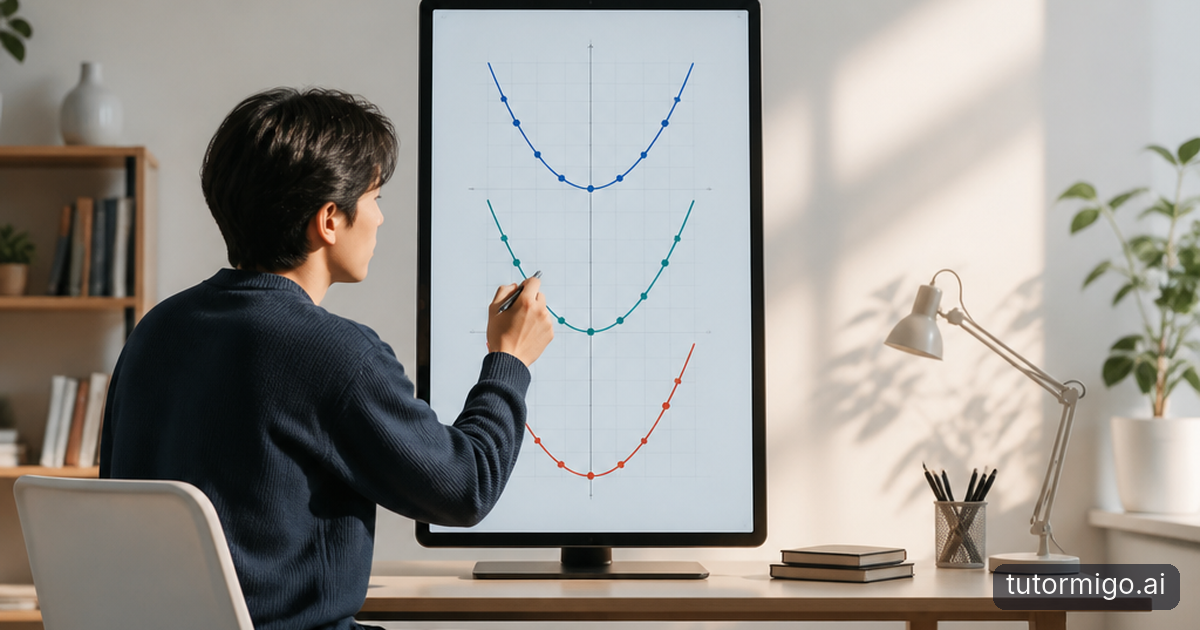
Consider . Ask: “What happens to the parabola when increases?” Before calculating, predict whether the curve moves, stretches, or changes its opening direction. Then compare , , and .
At every fixed input, the output increases by the same added amount. The parabola shifts upward without becoming narrower. Its vertex moves from to . That explanation is more useful than memorizing “the constant moves the graph.”
Now test the limits of your rule: compare with . The expressions look similar, but one changes the input and the other changes the output. Explaining that difference strengthens algebra fundamentals.
For guidance on asking productive questions, explore our Socratic step-by-step math tutor approach. Request examples and counterexamples, not just another explanation of the same rule.
Formula Memorization vs. Step-by-Step Solvers vs. TutorMigo.ai
The strongest study approach combines accurate procedures with explanations and independent checks. Formula memorization supports recall, while worked solutions can clarify unfamiliar methods. Guided AI tutoring adds opportunities to predict, justify, and revise, but its value depends on your participation and the accuracy of its feedback.
The comparison below describes study approaches, not guaranteed outcomes. An answer-solver can support learning when you study its reasoning and then solve a fresh problem without assistance. Conversely, even a conversational tutor becomes an answer dispenser if you repeatedly request finished solutions.
When comparing TutorMigo benefits, focus on the learning routine supported by its features. Personalized tutoring chat lets you ask follow-up questions; session history lets you revisit earlier attempts. The whiteboard and math step editor provide places to work through representations and transformations.
General-purpose generative chatbots can also explain mathematics and respond to Socratic prompts. The practical distinction is whether you prefer a dedicated tutoring workspace with associated study tools—not a claim that other tools cannot reason or teach.
Test any option with an unfamiliar variation. After reviewing a solution, close it and explain why each step works. If you can only reproduce the original example, you have evidence of recall, not yet transferable understanding.
Mastering Difficult Equations with TutorMigo.ai
To understand a quadratic inequality, connect its factors, graph, and solution intervals rather than copying algebraic steps. Ask the tutor to check each decision, including boundary values and signs. Then solve a changed example independently to find out whether your reasoning transfers beyond the original question.
Unpacking Reasoning Errors Instead of Just Handing Out Answers
Start with In TutorMigo.ai’s tutoring chat, request step-by-step reasoning through questions: “Do not finish the problem for me. Ask what I would try first, then check my justification.”
First, factor the expression as . Explain that the required numbers multiply to and add to . Next, identify the boundary values, and , where the expression equals zero.
Now ask which intervals those boundaries create. Test , , and . The expression is positive, negative, and positive respectively. Because the inequality accepts negative values and zero, the solution is .
If you choose the outside intervals, ask the AI Tutor to inspect your sign reasoning rather than repeat the answer. Did you confuse the roots with the full solution? Did you assume a product of two negative factors stays negative? Showing your intermediate work makes mistake pattern analysis more useful, although any suggested diagnosis still needs checking.
Visualizing Functions and Transformations Dynamically
Sketch the upward-opening parabola on the whiteboard and mark its intercepts. The curve lies below the horizontal axis between the roots, connecting the graphical meaning of the inequality with your sign tests.
Dynamic visual graphing can make transformations easier to investigate, but do not assume automatic plotting is included in every study tool. TutorMigo.ai’s listed tools include a whiteboard and math step editor; use these to sketch and annotate successive cases. If you use a separate graphing tool, compare its output with your predictions.
Finally, change the inequality to x^2 - 5x + 6 > 0. Predict how the intervals and endpoint inclusion change before asking for feedback. This predict-check-explain cycle shows how to build math intuition with AI without outsourcing the thinking.
Frequently Asked Questions About AI Math Learning
AI math learning works best when you remain responsible for predictions, explanations, and verification. Ask for manageable questions, show intermediate work, and check important results independently. Neither fluent explanations nor correct final answers prove understanding; applying the same idea to an unfamiliar example provides stronger evidence.
Before choosing a tool, try one problem you understand and one that confuses you. Notice whether the explanations reveal assumptions, whether feedback addresses your actual working, and whether you can request less help. A convincing response is not automatically a mathematically correct one.
For retention, turn a useful distinction into a spaced-repetition flashcard: “Why are the roots included for a non-strict inequality?” Answer in words before checking. TutorMigo.ai’s flashcards support AI-assisted card creation and review scheduling. Pair that review with a new problem; remembering an explanation is not the same as applying it.
Your next step in learning how to build math intuition with AI is small: submit one confusing math problem to TutorMigo.ai, include your attempt, and request a Socratic breakdown. Ask for one question at a time, explain each decision, and finish by solving a variation without assistance.
| Approach | Deep Conceptual Grasp | Transferable Problem Solving | Math Anxiety Relief |
|---|---|---|---|
| Formula memorization alone | Limited unless paired with explanations | Often fragile when a problem changes | Familiarity may help; unfamiliar tasks can remain stressful |
| Step-by-step answer solvers | Can clarify methods when you actively explain each step | Depends on independent follow-up practice | May reduce immediate frustration; no guaranteed lasting benefit |
| TutorMigo.ai with Socratic prompts | Personalized chat supports questions about why steps work | Use chat, whiteboard, and math step editor to investigate variations | A guided pace may help; individual responses vary |
Frequently asked questions
AI may help reduce immediate pressure by breaking problems into smaller questions and offering another explanation. It cannot guarantee relief or replace appropriate support. Try one manageable prediction, check it, and record what you understood. Persistent distress deserves attention from a trusted educator or qualified professional.
They are not inherently harmful. The risk comes from copying answers without making decisions or checking reasons. Use a worked solution after attempting the problem, explain each transformation, then solve a different example without help. That turns passive answer consumption into active practice.
It can examine the steps you provide and suggest the earliest transformation that appears invalid. For example, it might flag an incorrect distribution or sign change. This is a fallible interpretation, not a definitive diagnosis; ask for the governing rule and verify it with a simple example.
The predict-explain-check method can support elementary mathematics and calculus, but suitability depends on explanation quality, learner needs, and supervision. Test whether the tutor uses understandable language and valid reasoning. Do not assume one successful example proves comprehensive coverage or consistent accuracy across mathematical levels.
Related reading
Enjoyed this read?
Like, share, or comment below.



Comments
0Sign in required · respectful discussion · replies supported
Loading comments…