

Understand the IELTS Test Format and Scoring Bands
Many students look for a sat study plan when preparing for exams, but if your goal is the IELTS, this 8-week approach will guide you through the specific skills needed for success in the four test sections. By following targeted practice, you can improve your band score effectively.
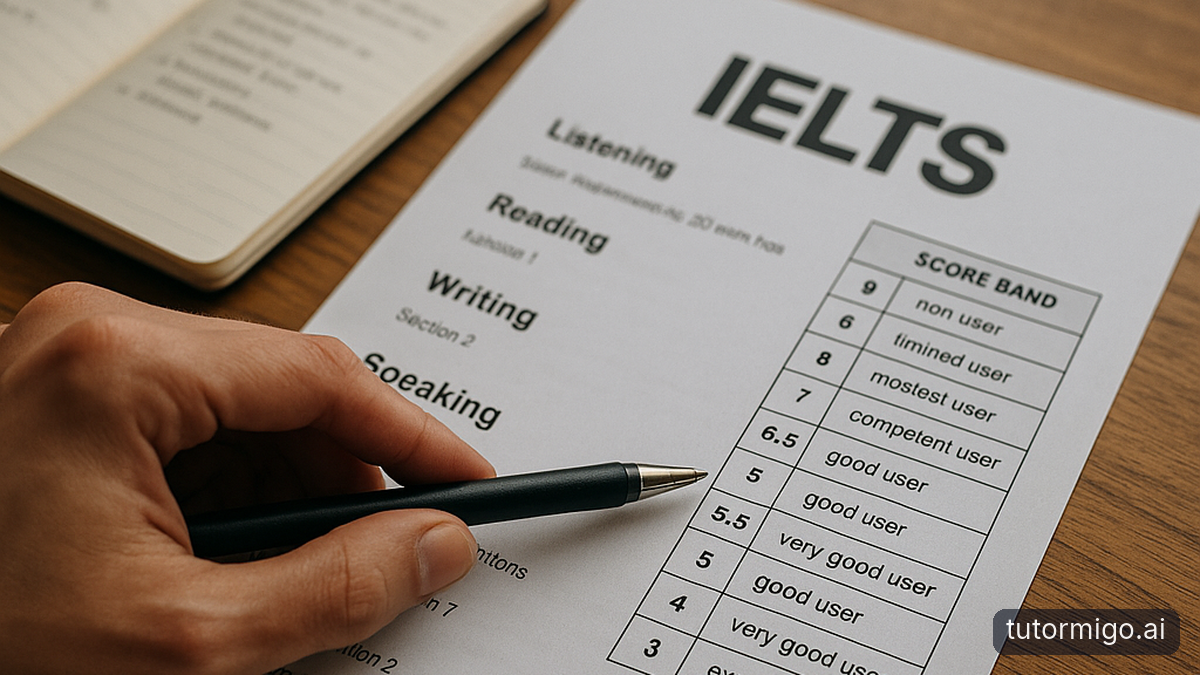
The IELTS test evaluates your ability in four areas. Listening tests how well you understand spoken English in various accents and contexts. Reading checks your comprehension of written material. Writing measures your ability to express ideas clearly in written form. Speaking evaluates your oral communication skills through a short interview.
To understand scoring, know that bands are whole or half numbers. An overall band of 6.5 means you are a competent user who can use English effectively but with some errors. For instance, if your scores are 7 in Listening, 6 in Reading, 7 in Writing, and 6.5 in Speaking, the average is 6.625 which rounds to 6.5.
A concrete example is a student who wants to work in an English-speaking country. They take a diagnostic test and find they are at band 5.5 overall. This tells them they need to focus on all areas but especially Reading and Writing to reach the required 6.5. You can learn more about building good habits through smarter daily studying.
Tip: Download the official band descriptors from the IELTS website to see exactly what is expected at each level for every skill.
Create Your 8-Week IELTS Study Plan

This structured approach differs from a typical sat study plan as it targets language proficiency rather than subject knowledge. You will build your skills gradually over eight weeks to avoid burnout and ensure steady progress.
Week 1 is for getting to know the test. Spend time reading about the format and taking a full practice test to establish your starting point. For example, complete the listening section in one sitting and note which parts were difficult, like following fast speech or understanding accents.
In weeks 2 and 3, focus on Listening and Reading. Practice listening to short clips daily and answer questions. For reading, choose one passage per day and work on different question types. You might find it helpful to consult an AI Tutor during your planning to get customized suggestions based on your current level.
Weeks 4 and 5 shift to Writing. Learn the requirements for each task and practice planning your responses quickly. Write one task per day and review it for structure and language.
Week 6 and 7 are for Speaking and full mock tests. Record your answers to cue cards and compare them to sample high-scoring responses. In week 8, review your weakest areas and do several complete practice tests under timed conditions.
Consistency is more important than long sessions. Even 60 minutes a day can add up if you stay focused on the plan.
Targeted Practice for IELTS Listening and Reading
Listening and Reading require specific techniques to handle the time pressure and question variety. Start with Listening by practicing note-taking. When you hear a lecture about a new museum opening, jot down key facts like the opening date, ticket prices, and special features mentioned.
Improve your Listening by exposing yourself to different English accents through podcasts or videos. A good drill is to listen once without pausing, answer the questions, then listen again to check what you missed. This builds your ability to catch details on the first go.
For Reading, practice skimming and scanning. Skim the passage in under two minutes to get the main ideas, then scan for specific information to answer questions. For instance, in a text about renewable energy, you might scan for numbers related to cost savings or percentages of usage.
Common question types include multiple choice, matching, and summary completion. For matching, focus on synonyms because the text rarely uses the exact words from the questions. smarter daily studying methods can help you build these quick reading habits over time.
Combine practice by doing one Listening and one Reading section together in a 90-minute block to mimic test conditions. Review your answers to see patterns in mistakes, such as mishearing numbers or overlooking negative words.
Step-by-Step Strategies for IELTS Writing Tasks
IELTS Writing has two tasks that you must complete in 60 minutes. Task 1 is shorter at 150 words and involves describing visual data or writing a letter. Task 2 is an essay of at least 250 words on a given topic.
For Task 1, begin by identifying the main trends or features in the visual. Write an overview sentence first, then support it with specific details. For example, if a line graph shows temperature changes over a year, note the highest and lowest points and any sudden increases or decreases.
Task 2 requires a clear structure with an introduction, two or three body paragraphs, and a conclusion. Always address all parts of the question. If it asks to discuss both sides of an issue, make sure you cover both before giving your opinion.
Use a range of vocabulary and complex sentences but keep your meaning clear. A step-by-step approach is to spend five minutes planning, 40 minutes writing, and five minutes checking for errors. Practice this timing in your sessions.
Review model answers to see how high band responses organize ideas and use linking words like however and therefore. This will help you avoid common pitfalls like repeating the same words.
Build Confidence in the IELTS Speaking Section
The Speaking section is your chance to show how well you can communicate in English. It lasts 11 to 14 minutes and has three parts that increase in difficulty.
Part 1 involves answering simple questions about yourself, like your home or hobbies. Give full answers rather than one-word replies. For example, instead of saying yes, explain why you like a certain activity and add a short story.
In Part 2, you get a cue card and one minute to prepare before speaking for up to two minutes. Pick a topic like describing a person who influenced you. Structure your talk with an introduction, details, and a conclusion to keep it organized.
Part 3 is a discussion where the examiner asks deeper questions related to the Part 2 topic. Practice thinking on your feet by discussing abstract ideas. An AI Tutor can help by asking follow-up questions and giving you feedback on your responses.
To build confidence, practice every day for at least 10 minutes. Record yourself and listen for pauses or simple vocabulary that you can replace with more precise words. This preparation makes the real test feel familiar.
Fix Common IELTS Mistakes with Focused Drills
Common mistakes can lower your band score even if your English is good. In Listening, people often fail to read the questions in advance. To fix this, use the time before the audio starts to underline key words in the questions so you know what to listen for.
In Reading, a frequent issue is getting stuck on difficult vocabulary. Instead of looking up every word, try to guess the meaning from the sentence around it or move to the next question and return later if time allows.
For Writing, many forget to check the word count or fully answer the prompt. Your drill is to write the response and then count the words, ensuring you have addressed every part of the question. If the task asks for solutions, provide at least two with explanations.
Speaking mistakes include giving short answers and not using a range of grammar. Practice expanding every response with reasons, examples, and opinions. For instance, when asked about your favorite season, say more than just summer and explain the reasons with a personal example.
Focused drills mean repeating these fixes until they become automatic. smarter daily studying can support this by helping you review errors effectively.
While a sat study plan might focus on math and reading comprehension, your IELTS study plan hones language skills. Stick with it and you will see improvement by test day. Try Tutor for free today.
Frequently asked questions
Consistent practice across all skills using a structured study plan is key. Focus on your weak areas and take regular mock tests to measure progress.
Record yourself answering sample questions and listen back to identify areas for improvement. You can also use online resources for simulated conversations.
Yes, always start with an overview of the main trends or features, then provide specific details with data. Use a variety of vocabulary to describe changes.
Vocabulary is crucial for all sections, especially Writing and Speaking. Learn topic-specific words and practice using them in context to avoid repetition.
Explore TutorMigo
Enjoyed this read?
Like, share, or comment below.



Comments
0Sign in required · respectful discussion · replies supported
Loading comments…