


Why swarm robotics starts with a crowd of simple machines
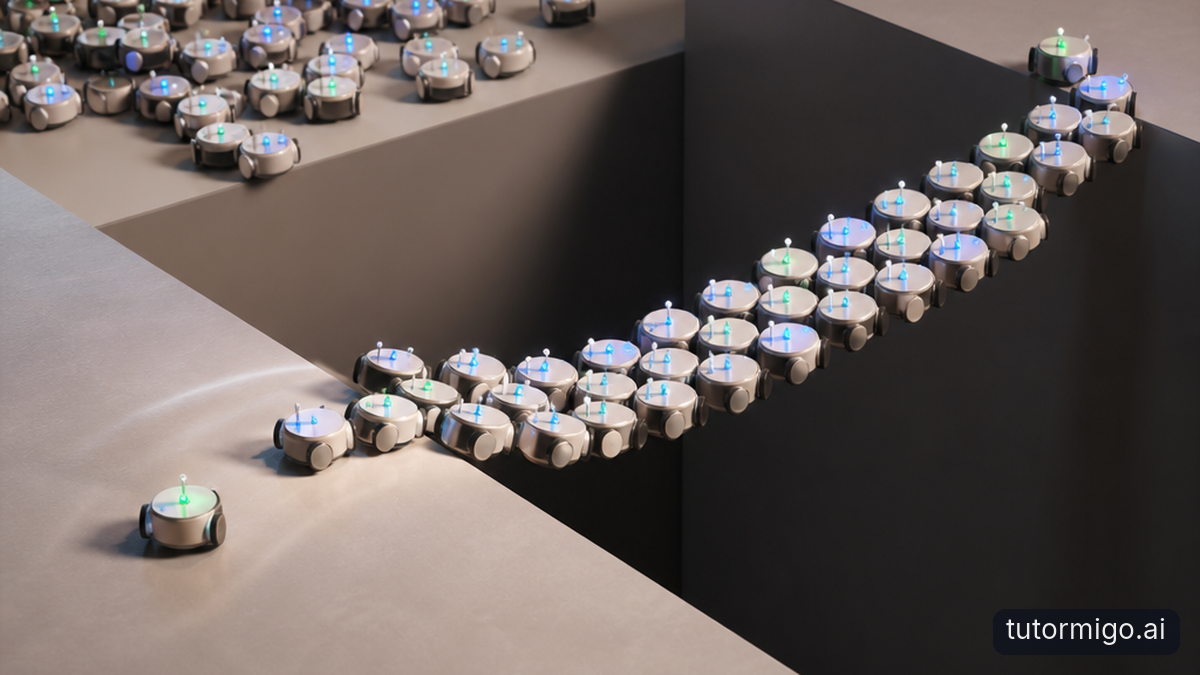
If one robot cannot search a large, damaged, or changing area quickly enough, you may need a different strategy: send many inexpensive robots instead of building one highly capable machine. Swarm robotics: inspired by social insects, uses that approach. Each robot follows a small set of local rules, shares limited information with nearby neighbors, and contributes to a larger group behavior.
An individual robot might have modest sensors, a short operating range, and only enough computing power to avoid obstacles, estimate its position, and communicate with nearby machines. The group can still cover a broad forest, inspect a warehouse, or map a contaminated shoreline. If one unit stops working, the mission can often continue because other units fill the gap.
The key idea is not simply “more robots.” It is distributing responsibility. Instead of waiting for a central computer to assign every movement, the robots make frequent small decisions based on what they sense locally. A unit may slow down when another robot is close, turn toward an unvisited area, or follow a weak signal from a neighboring machine. Repeated across hundreds of units, those choices can produce organized movement without a single commanding robot.
What ants and bees teach robot designers
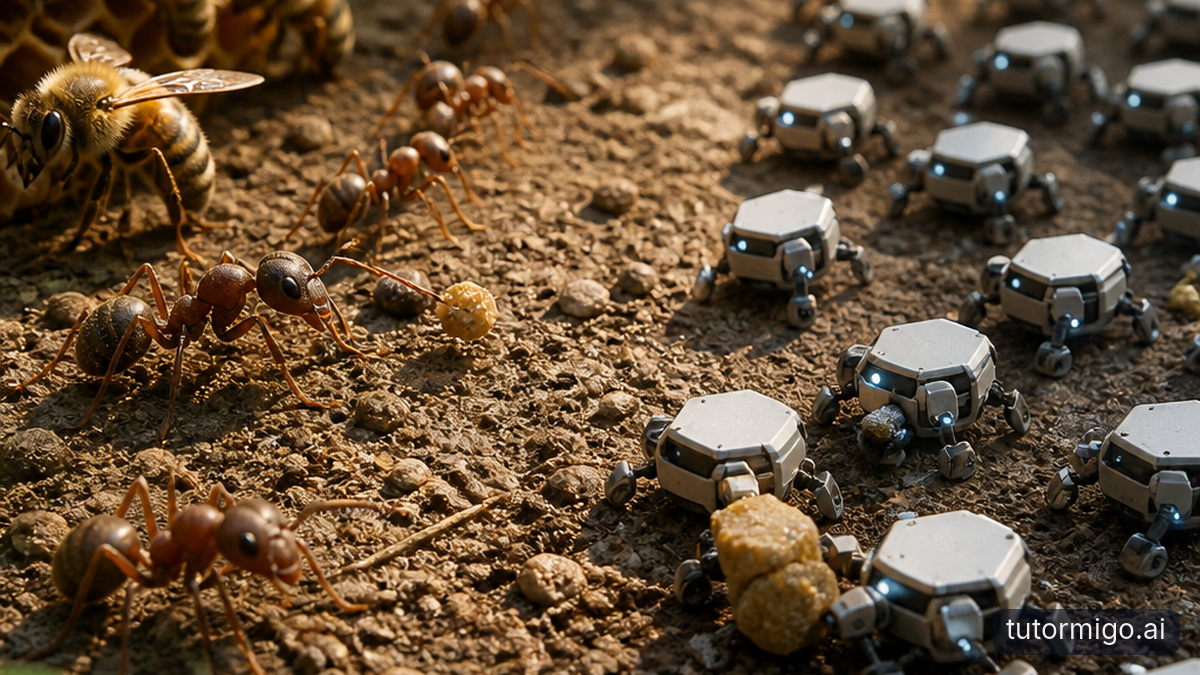
Social insects solve coordination problems with simple behaviors rather than a detailed plan for every individual. Ants can create efficient trails by leaving chemical markers, while bees use local signals and repeated visits to distribute work across a colony. Robot designers borrow the underlying principles, not a literal insect blueprint.
One important principle is indirect coordination, often called stigmergy. A robot changes its environment, and another robot responds to that change. In a warehouse, for example, robots could mark a recently inspected aisle in a shared digital map. Nearby units then give that aisle lower priority and move toward unexplored space. No robot needs a complete list of every other robot’s intentions.
Another principle is task allocation. Bees do not all perform the same job at once; some forage, some care for the hive, and some respond to changing conditions. A robotic swarm can use similar flexibility. If several units detect a heat source after an earthquake, nearby robots may converge to measure it while distant units continue searching. The group shifts effort according to local evidence rather than following a fixed schedule.
> Tip: When evaluating a swarm design, ask what each robot knows locally, what signal it can share, and how the group changes course when conditions shift.
How local communication creates coordinated movement
A swarm does not need every robot to communicate with every other robot. That kind of all-to-all network would become expensive and fragile as the population grows. Instead, most systems use short-range communication, allowing each unit to exchange small packets of information with nearby neighbors.
Imagine 500 robots surveying a coastal marsh. Each robot reports its approximate location, battery level, sensor readings, and whether it has already visited a patch of ground. A robot that detects an oil-like residue can broadcast a nearby alert. Its neighbors investigate the signal, while other parts of the swarm continue the wider survey. The information spreads through local contacts, much like a message passed across a crowd.
Designers must manage several complications. Signals may be blocked by buildings, vegetation, smoke, or terrain. Radio traffic can become congested, and location estimates can drift. The swarm therefore needs rules for stale data, conflicting reports, and temporary silence. Robots may rely on time limits, confidence scores, or repeated confirmation before changing the group’s behavior.
This local approach also improves resilience. A damaged communication link does not automatically disable the entire operation. The swarm may divide into smaller working groups, reconnect when units move closer, or continue with less precise information until a link returns.
Where swarms can make a practical difference
Environmental monitoring is a natural application because the work is spatial and repetitive. A group of small robots could sample soil across a mine site, track algae in a lake, or inspect a forest after a storm. Instead of sending one large vehicle along a rigid route, operators can release many units and let them spread according to terrain and sensor readings.
Search and rescue presents a more urgent example. After a building collapse, small ground robots might enter narrow spaces that are unsafe for people. Some could look for heat or movement, while others create a rough map or relay messages back toward the entrance. The value comes from coverage and redundancy: losing a few machines is less damaging when many others remain active.
Automated construction is more difficult but especially revealing. A swarm of small robots could place bricks, move lightweight components, or inspect a structure as it grows. The system would need accurate positioning and strict safety boundaries, yet local coordination could let the robots work around obstacles or adjust when materials arrive late.
In each case, the swarm is useful because the environment is too large, uncertain, or hazardous for a single machine. The robots do not need to perform every task independently. They need to perform a narrow task reliably and combine their results without creating new risks.
The engineering problems that still matter
Swarm robotics can sound effortless when described as a set of elegant insect-inspired rules. In practice, the difficult work is making those rules reliable under imperfect conditions. A robot may have a weak battery, a dirty camera, a damaged wheel, or a sensor reading distorted by rain. The swarm must distinguish a real event from a faulty report.
Scalability is another challenge. A behavior that works with ten robots may become unstable with 10,000. Units can cluster in one location, block one another, repeat the same search pattern, or consume too much bandwidth. Engineers test simulations and physical prototypes to find density limits, communication delays, and failure patterns before deployment.
Safety requires special attention when robots operate near people, wildlife, vehicles, or fragile structures. Each unit needs emergency behaviors such as stopping, returning to a safe zone, or reducing speed. Operators also need a way to set boundaries and intervene without turning the swarm into a centrally controlled fleet.
Verification remains hard because emergent behavior can be difficult to predict. A swarm may produce a useful pattern that was not explicitly programmed, but it may also produce an unexpected one. Testing therefore combines individual-robot checks, controlled group trials, simulated hazards, and clear measures such as coverage, time, energy use, and recovery after failures.
What to watch next in swarm robotics
The next advances will likely come from better coordination between physical robots, simulation, and human operators. Digital models can test thousands of agents against changing terrain before a real deployment. Operators can then provide high-level goals, such as “inspect this zone” or “maintain a safe distance,” while the swarm handles local routing and task assignment.
Hardware is also becoming more capable without necessarily becoming larger. Small improvements in cameras, low-power processors, positioning systems, and short-range radios can make a simple robot more useful. A fleet may combine different types of units: aerial robots for a quick overview, ground robots for close inspection, and stationary sensors for long-term monitoring.
If you want to judge a proposed swarm system, look past the robot count. Ask whether the machines can continue after failures, whether communication remains useful at the intended scale, and whether success can be measured in the real environment. A demonstration with ten robots moving in a clean laboratory is not proof that thousands can search rubble or map a wetland.
The most promising systems will be modest in their claims. They will use simple machines where repetition, coverage, and resilience matter most, while leaving sensitive decisions and safety oversight to human teams. That balance is what turns insect-inspired coordination from an intriguing idea into dependable field technology.
Frequently asked questions
Swarm robotics is an approach in which many relatively simple robots coordinate through local sensing and communication to complete a larger task. The system does not depend on one central controller making every decision.
Ants and bees demonstrate how simple local behaviors can produce organized group results. Designers study ideas such as indirect coordination, flexible task allocation, and resilience when individual members fail.
Usually not. Most swarm systems rely on nearby communication, with information spreading through local contacts. This reduces network demands and helps the group keep working when some connections fail.
Potential uses include environmental monitoring, search and rescue, infrastructure inspection, warehouse operations, and automated construction. These applications benefit from broad coverage, repeated tasks, and tolerance for individual robot failures.
Related reading
Enjoyed this read?
Like, share, or comment below.



Comments
0Sign in required · respectful discussion · replies supported
Loading comments…