
Why Self Testing Beats Rereading Notes

Rereading can feel productive because the material looks familiar, but familiarity is not the same as being able to recall an answer. A better approach is to close your notes and ask yourself questions. If you are studying cell biology, for example, do not just scan a page about mitochondria. Try explaining its role, then check whether your answer includes energy production, structure, and context.
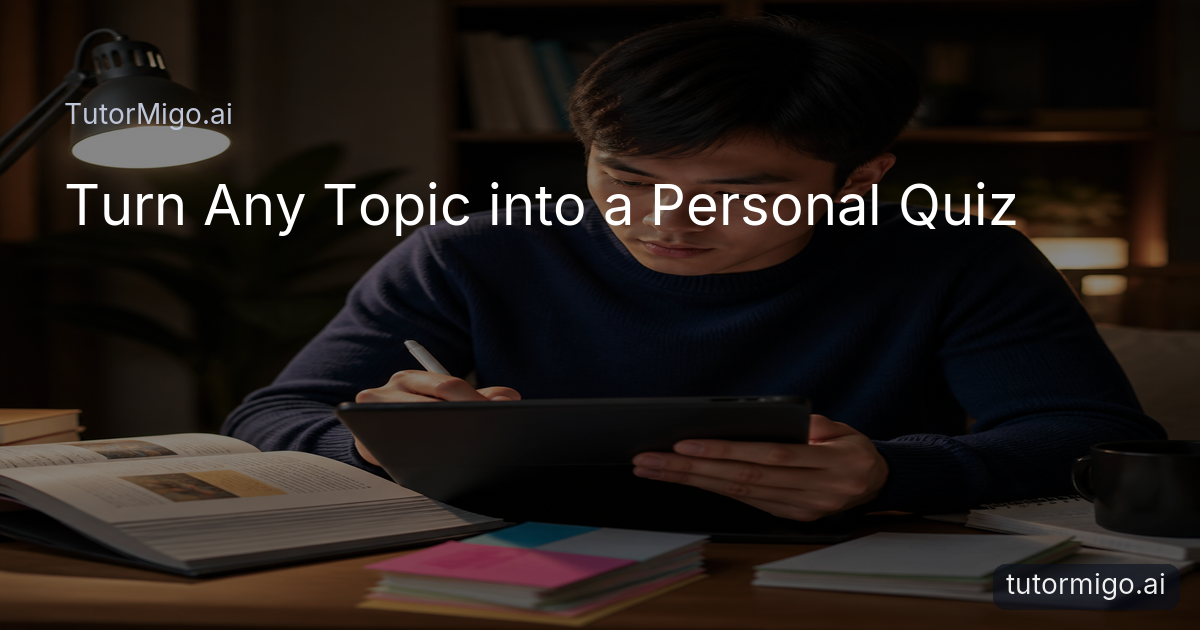
TutorMigo.ai makes this shift easier by letting you turn a topic into a focused quiz through an AI Tutor conversation. You can ask for ten questions on a particular concept, request one question at a time, and answer before seeing an explanation. That small pause matters: it gives you a clear picture of what you know without prompts from the page.
The most useful result is not a perfect score. It is a list of uncertain areas. Perhaps you remember a definition but cannot apply it to an example, or you can solve a familiar problem but cannot explain the first step. Those are the gaps worth studying next. This practical cycle—retrieve, check, correct, and try again—helps you spend less time reviewing everything and more time working on what needs attention.
Build a Quiz That Matches Your Goal

A personal quiz works best when the request is specific. Instead of asking for questions about “history,” name the topic, level of detail, and type of thinking you want to practise. You might ask for questions on the causes of the French Revolution, with a mix of factual recall, comparison, and short explanations. For algebra, you could request problems that focus on factoring quadratic expressions and include hints only after you attempt each one.
In the TutorMigo.ai workspace, give the AI Tutor useful boundaries: the topic, your current confidence, and whether you want multiple-choice, short-answer, or worked-problem practice. You can also ask it to avoid revealing answers until you respond. If a question is too easy, ask for a more challenging version. If it is confusing, ask for simpler wording or a related example.
This is one of the clearest TutorMigo.ai benefits: practice can adapt to the question you are asking right now rather than forcing you through a fixed worksheet. A parent or teacher can suggest a topic, while a student can shape the quiz around an upcoming lesson or a mistake from class. For more ideas on using questions to deepen understanding, see how students can follow questions deeper with AI tutoring.
Practise One Question at a Time
Answering one question at a time keeps a quiz active instead of turning it into a passive answer key. Start by making your best attempt, even if it is incomplete. Then ask TutorMigo.ai to evaluate the reasoning, identify the missing idea, and explain the correction in plain language. For instance, when practising a chemistry question, you might identify the right formula but use the wrong units. That is a more useful discovery than simply marking the whole response wrong.
Ask for a short explanation first, then request a second question that tests the same idea in a new situation. This prevents you from memorizing the wording of one question. You can also ask the AI Tutor to vary the difficulty: begin with a direct definition, move to an example, and finish with a problem that requires you to combine concepts.
Study tip: Keep a simple “not yet” list. Add concepts you missed, guessed, or could not explain without help. Review that list before starting a new quiz, then test yourself again without looking at the earlier explanation.
For questions that involve working, use an interactive study tool when it fits. A math step editor, whiteboard, or code sandbox can make your reasoning visible instead of reducing practice to a final answer.
Turn Missed Questions into Spaced Review
A quiz is most valuable when missed questions come back later. After a session, convert the ideas you struggled with into flashcards rather than copying every question into a large deck. A useful card asks one focused question, such as “What evidence supports this conclusion?” The answer should be short enough to recall and specific enough to reveal whether you understand it.
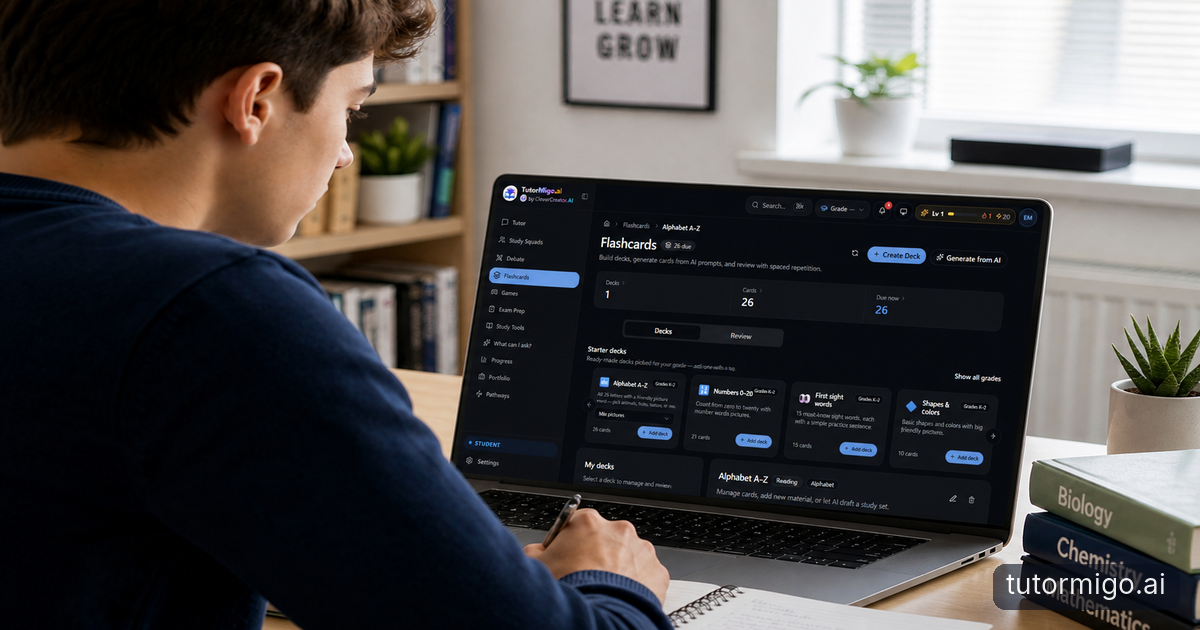
TutorMigo.ai flashcards use spaced repetition and review scheduling, so difficult cards can return sooner while familiar ones appear less often. You can ask for AI-assisted card creation from a topic or study session, then edit the wording so it matches your class materials. If you missed a question about supply and demand, one card might test the definition and another might ask what happens in a concrete scenario. Separating those ideas makes each review more informative.
Use the deck as a follow-up to quiz practice, not a replacement for it. First try to explain the concept from memory. Then review the card, correct your answer, and schedule another attempt. Over several sessions, you will see which ideas remain difficult. That pattern can guide your next personal quiz and help you avoid spending equal time on material you already know well.
For broader study habits, compare this approach with practical ways AI can help students learn better and faster.
Track Progress Without Guessing
Self-testing becomes easier to manage when you record what happened. After a quiz, note the topic, the questions you missed, and the reason for each miss: forgotten fact, unclear vocabulary, weak process, or careless error. A short record can reveal that your real problem is not “biology” but interpreting diagrams, or not “math” but translating word problems into equations.
If you are preparing for a structured exam, TutorMigo.ai exam preparation provides practice sets and progress tracking for SAT, ACT, AP, and IELTS preparation. Use those tools alongside topic quizzes: a practice set can show your broader performance, while a personal quiz can target one weak skill. For example, after noticing repeated errors in reading questions, ask the AI Tutor for a short quiz on identifying evidence and explaining why one option is stronger than another.
Progress does not have to mean a dramatic score increase after one session. Look for smaller signals: you need fewer hints, your explanations become more precise, or you can solve a new version of a problem. Review your record once a week and choose one or two priorities. A focused plan is easier to follow than trying to “study everything” before every test.
Make Practice Visible to Supporters
Students often know they should practise but have difficulty explaining what they need. A parent or teacher can support the process more effectively when they can see patterns rather than only a final grade. TutorMigo.ai parent and teacher dashboards provide visibility into progress, which can make a conversation more concrete: “You are doing well on definitions, but application questions still need practice” is more useful than “study harder.”
A teacher might assign a topic for review, check how students are progressing, and use the results to plan a follow-up explanation. A parent might notice that a learner is repeatedly returning to the same concept and ask whether the difficulty is vocabulary, confidence, or the underlying skill. The goal is not to take over the quiz. It is to help the learner choose a sensible next step.
Session continuity also matters. When your AI Tutor conversation keeps the context of your earlier questions, you can return to a topic without starting from zero. You can say, “Quiz me again on the two ideas I missed last time,” then continue with a new example. That makes an AI learning tool feel more like an ongoing study workspace than a one-off answer generator, while still leaving you responsible for attempting each answer.
To get started, choose one topic you need to understand this week, request five questions, answer them one at a time, and turn only the missed concepts into spaced-repetition cards. Repeat the quiz in a day or two and compare your reasoning, not just your score.
Pros and cons
Pros
- Topic-based quizzes can target the exact concept you find difficult.
- One-question-at-a-time practice gives feedback on reasoning, not only final answers.
- Spaced-repetition cards help missed ideas return for later review.
- Progress visibility can support useful conversations with parents and teachers.
Cons and limitations
- You still need to make an honest attempt for self-testing to work.
- AI feedback should be checked against your course materials when accuracy matters.
- A broad quiz request may produce less useful practice than a specific one.
Frequently asked questions
You can ask the AI Tutor to create topic-based questions for the subject you are studying. Be specific about the topic, question style, difficulty, and whether you want answers or hints after attempting each question.
Answer without checking your notes, then ask for feedback on your reasoning. Follow with a new question that tests the same idea in a different way so you practise understanding rather than memorizing wording.
No. Make cards for concepts you missed, guessed, or could not explain. Focused cards keep reviews manageable and let spaced repetition bring difficult ideas back when they need attention.
TutorMigo.ai includes parent and teacher dashboards with visibility into progress. This can help supporters identify patterns and discuss practical next steps without replacing the learner’s own practice.
Related reading
Enjoyed this read?
Like, share, or comment below.


Comments
0Sign in required · respectful discussion · replies supported
Loading comments…