


When Learning by Explaining Stops Feeling Certain

You read a page, follow every sentence, and recognize the key terms. While the book is open, the concept feels clear. Then you close it and someone asks, “Can you explain that in your own words?” Your answer starts confidently, then stalls. You remember a phrase from the chapter, but not quite how the ideas fit together.
This experience does not mean you learned nothing. It shows that recognition and explanation are different signals. Recognizing information means it feels familiar when you see it. Explaining it independently asks you to reconstruct the idea, decide what matters, and communicate the relationships among its parts. That is why AI tutoring for students can be useful as a practice setting: not because an AI tutor can measure your mind perfectly, but because a conversation can give you a reason to put your understanding into words.
The goal is not to perform as a perfect teacher. It is to notice which parts are solid, which are vague, and which need another look.
Recognition Can Feel Like Understanding

Rereading often feels productive because the material becomes easier to recognize. A definition looks familiar. A worked example seems obvious. You may even think, “I know this,” because the page gives you helpful cues. But when those cues disappear, you may find that you cannot reproduce the main idea or explain why the example works.
Recognition is still useful. It can help you notice important vocabulary and reconnect with a topic you studied earlier. The caution is simply that familiarity is not the same as independent understanding. A student reviewing the water cycle might recognize terms such as evaporation and condensation without being able to describe how temperature and movement connect those processes.
A practical check is to look away from the page and write three sentences from memory. What is the central idea? How do the parts relate? What example would make sense to someone new to the topic? If your answer depends on copying the textbook’s wording, that is information worth noticing rather than a reason for embarrassment. These small study techniques turn a vague feeling of confidence into a more specific picture of student understanding.
What Changes When You Explain a Concept?
Explaining requires more than repeating a definition. You have to choose the main point, arrange supporting details, simplify terminology, and decide which example will make the idea clearer. Not every student will do all of this automatically, but attempting the explanation can make those decisions visible.
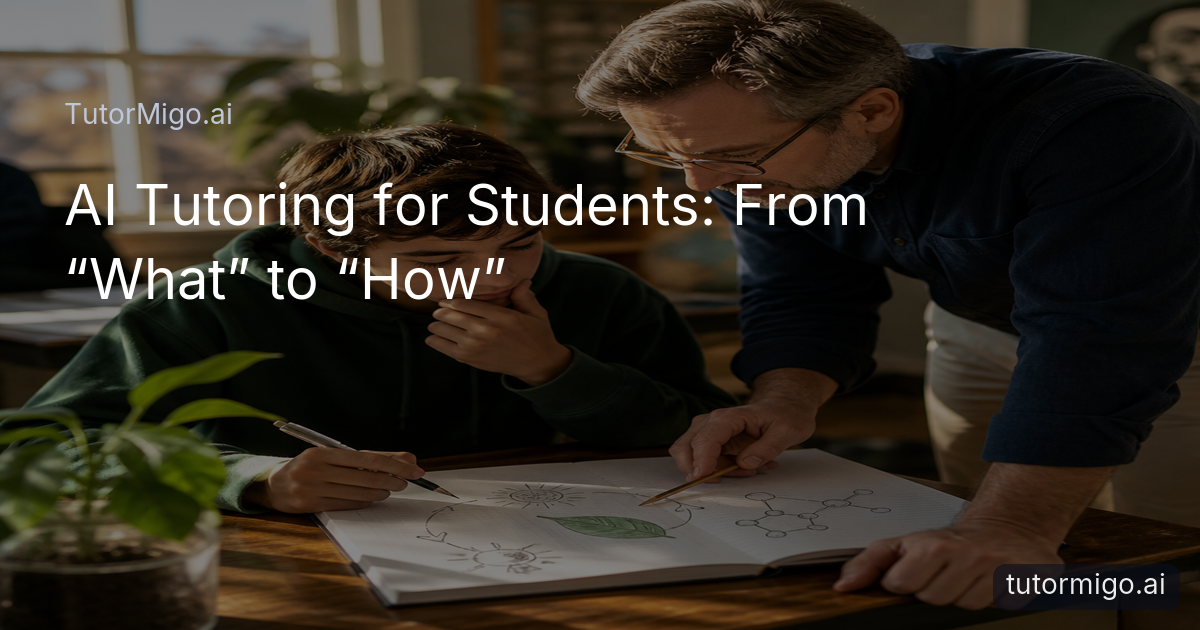
Imagine explaining why a plant’s leaves need light to a younger student. Saying “photosynthesis needs light” repeats a phrase. A fuller explanation might connect light energy with the plant’s process for making food, then distinguish that process from simply absorbing water through the roots. If you cannot explain what connects those pieces, you have found a specific question to revisit.
The same pattern appears in mathematics. You may remember that a certain procedure comes after another one, yet struggle to explain why. You may solve a familiar problem by following its surface pattern without recognizing when the method no longer applies. Learning by explaining does not guarantee that every gap will appear, and it does not replace practice. It gives you another kind of evidence: evidence about whether you can organize and reconstruct the idea without the original wording in front of you.
Try to explain the concept before checking your notes. The moment your explanation becomes vague is a useful place to pause, mark, and investigate.
A Simple Teach-Back Test for Your Next Study Session
The teach-back method is a practical reflection exercise: after studying, explain a concept as if you were teaching it to someone who has never encountered it. You can speak aloud, write a short explanation, or discuss it with a study partner. It is not a formal assessment, and it is not a promise of better grades. Its value comes from making uncertainty easier to locate.
Start with the book closed. Ask yourself: Can I state the main idea without copying the source? Can I give a concrete example? Can I explain why the process works rather than only name its steps? Can I answer a basic follow-up question? Finally, where does my explanation become uncertain, circular, or dependent on a term I have not defined?
Suppose you are reviewing a historical cause-and-effect chain. If you can name the events but cannot explain how one contributed to the next, your next step is clearer: revisit the relationship, not the entire chapter. You might also compare your explanation with class notes or an authoritative source. This approach supports active learning while leaving room for a simple truth: explaining one concept well does not prove that you understand every related concept.
Can an AI Tutor Be Your Conversation Partner?
An AI tutor can provide a low-pressure place to practice explaining. You might type, “I think I understand this concept,” and then give your explanation. The AI can ask a follow-up such as, “What causes that step?” or “Can you give an example?” You respond, clarify a sentence, and revise the explanation. The sequence is simple: student explains, AI asks, student clarifies, student revises.
This kind of AI tutoring may be especially helpful when no teacher or study partner is immediately available. A tutor workspace with conversation history can also make it easier to return to a topic and continue a discussion instead of starting from nothing each time. That continuity is one possible TutorMigo benefit for learners who want a place to practice ideas over multiple sessions.
Still, treat the exchange as practice, not a final verdict. AI responses can contain mistakes, misunderstand what you meant, or ask an unhelpful question. Check important explanations against your course materials, a teacher, or another authoritative source. An AI Tutor should support reflection and questioning; it should not replace teachers, careful reading, or subject-specific verification.
For a related look at using follow-up questions to deepen study conversations, see how students can follow questions deeper with AI tutoring.
Where TutorMigo.ai Fits—and What Explaining Cannot Prove
TutorMigo.ai can serve as a conversational practice partner through its personalized AI Tutor workspace, where students can discuss ideas and use session history to return to earlier learning. Students can also move from conversation to interactive study tools such as a whiteboard, code sandbox, or math step editor when an explanation needs a diagram, worked process, or more hands-on exploration. These tools do not create a dedicated teach-back test, and they cannot diagnose every knowledge gap.
Explaining is also not the same as performing. A student may describe the idea behind a difficult science process but still need practice applying it to unfamiliar questions. Another student may solve a familiar equation by following a remembered pattern while struggling to explain why the method works. Different activities reveal different kinds of learning, so explanation should sit alongside practice, feedback, and careful review.
What should you do next? Choose one concept, close the source, and explain it in plain language. Mark the first place you hesitate. Then revisit that part, check a reliable source, and try again. If you use an AI tutor, ask it to question your explanation rather than simply provide a replacement answer. The useful conclusion may be modest: “I know this part. I am unsure about this part. I need to revisit this part.”
For another practical way to check whether familiarity has become understanding, read this guide to testing your understanding in STEM subjects.
Pros and cons
Pros
- Makes vague uncertainty easier to notice
- Encourages independent reconstruction of ideas
- Can provide a low-pressure conversation for practice
- Works alongside notes, examples, and other study techniques
Cons and limitations
- Does not prove complete understanding
- Does not guarantee better grades or memory
- AI responses may contain mistakes
- Explaining does not replace solving unfamiliar problems or checking authoritative sources
Frequently asked questions
Explaining requires students to organize an idea, connect its parts, choose examples, and communicate without relying fully on the original wording. That process can make uncertainty more noticeable.
Teach-back is a reflection method in which you explain a concept as if teaching it to someone new. It is a practical check, not a formal assessment or guarantee of improved grades.
Close the book and state the main idea, give an example, explain why it works, and answer a basic follow-up question. Notice where the explanation becomes vague, incomplete, or dependent on copied language.
Yes. Students can explain an idea to an AI tutor, respond to follow-up questions, and revise their explanation. AI can make mistakes, so important information should be checked with teachers or authoritative sources.
No. Recognition means information feels familiar when you see it. Understanding may also involve reconstructing the idea independently, explaining relationships, and applying it in an appropriate context.
Related reading
Enjoyed this read?
Like, share, or comment below.


Comments
0Sign in required · respectful discussion · replies supported
Loading comments…