

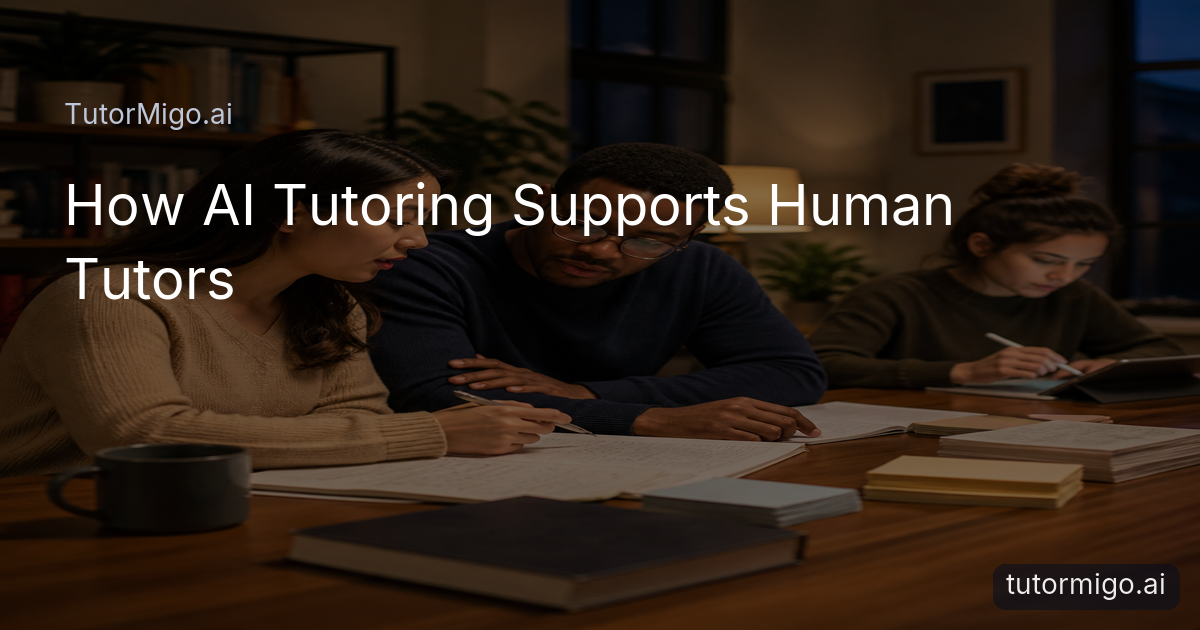
The Challenges Human Tutors Face

A tutor may have only an hour with a student each week, but the student’s questions do not stop when the session ends. A learner might forget a key step, need another example, or discover a new difficulty while completing homework. The tutor then has to balance explanation, practice, encouragement, and preparation within a limited window.
Students also arrive with different levels of confidence and different gaps in understanding. One may need a slower explanation of a foundational concept, while another is ready for a more demanding application. Preparing useful materials for both can take significant time. Supporting learners between appointments is even harder when a tutor cannot respond immediately to every question.
These pressures do not mean human tutoring is ineffective. They show why tutoring support tools can be useful around the lesson. The right technology can handle some low-stakes practice and review, giving the tutor more time to focus on decisions that require experience, context, and human connection. The goal is not to automate the relationship, but to make each shared session more focused.
What AI Tutoring Can Help With

AI tutoring can give students another way to explore a concept after a lesson. Depending on the tool, a student may ask for an additional explanation, request a simpler example, practice a skill, or review an earlier topic. An AI Tutor can be especially useful when a learner wants to try a question privately before bringing it to a human tutor.
For example, after a lesson on algebra, a student could use an interactive math tool to work through a problem, then use spaced-repetition flashcards to review vocabulary or rules. A learner studying code might experiment in a code sandbox, while someone preparing for a structured test could complete practice sets and review progress through an exam-preparation environment. These uses are different from asking a general-purpose chatbot for a quick answer because they are connected to specific study activities.
AI in tutoring works best when the student treats responses as support rather than unquestionable authority. The tool can offer another explanation or a starting point, but the tutor should still help confirm whether the reasoning is accurate. In practice, AI tools for tutors are most valuable when they create more opportunities for guided practice without pretending to replace professional teaching.
Featured answer: AI tools can give students extra explanations, low-stakes practice, question prompts, and concept review between lessons. This helps human tutors spend session time on diagnosis, encouragement, feedback, and personalized instruction while students arrive with clearer questions and a better sense of what they still need.
Why AI Cannot Replace the Human Tutor
A human tutor does more than deliver information. During a conversation, the tutor notices hesitation, changes in tone, repeated errors, and moments when a student is pretending to understand. Those signals help the tutor decide whether to revisit a prerequisite, change the example, pause for encouragement, or challenge the learner further.
Context matters too. A tutor may know that a student is anxious about an upcoming assessment, has recently changed schools, or learns best through diagrams and discussion. That knowledge shapes personalized instruction in ways a tool may not fully see. A human tutor can also judge when a technically correct answer is not a useful answer for this learner at this moment.
Relationships create motivation. A student may persist with a difficult topic because a trusted tutor notices improvement, sets a realistic next step, and communicates confidence. Technology can provide prompts and practice, but it does not replace empathy, accountability, professional judgment, or the shared understanding built over time.
For a balanced perspective, tutors and families can also review how AI tutoring compares with a human tutor before deciding where technology belongs in a learning routine.
Supporting Learning Between Tutoring Sessions
The most practical role for AI-supported learning may be session continuity. Instead of waiting a week to revisit every uncertain point, a student can use independent practice to identify what feels easy and what remains confusing. That information can make the next tutoring session more productive.
Imagine a learner who completes a set of fraction problems after a lesson. The student may notice that adding fractions is manageable but converting mixed numbers is still difficult. Rather than arriving with a vague feeling of being stuck, the learner can bring two specific examples and ask the tutor to explain the pattern. The tutor now has a clearer starting point.
Spaced-repetition flashcards can also help students revisit definitions, formulas, or terminology over time instead of cramming before a lesson. Interactive whiteboard, math, and code tools may give learners a place to try ideas actively. The purpose is not to keep students busy or measure every minute. It is to help them return to the human tutor with useful observations, attempted solutions, and focused questions.
Parents and educators can find additional context in this guide to making extra student practice easier to manage.
How Human Tutors and AI Can Work Together
A simple partnership can follow four stages. First, the human tutor explains a concept, models a strategy, and checks the student’s initial understanding. Second, the student completes independent practice with an appropriate AI-supported tool. Third, the tutor and student discuss the work, including mistakes, uncertainty, and any conflicting explanation. Fourth, the tutor assigns targeted review for the next session.
For example, a tutor teaching essay evidence might explain how to connect a quotation to a claim. Between sessions, the student could practice identifying that connection and save questions about weak examples. In the next meeting, the tutor reviews the reasoning, corrects misunderstandings, and helps the student transfer the skill to a new prompt.
The same approach works for exam preparation. A learner can use structured practice between meetings, while the tutor interprets the result and decides which skill deserves attention next. A teacher dashboard may support class management and reporting for educators, but it should not replace the educator’s knowledge of individual learners.
Families can use a parent-focused approach to learning visibility while keeping conversations about goals and wellbeing human-led. The best TutorMigo benefits come from combining convenient practice with thoughtful follow-up.
Where TutorMigoAI Fits Into This Partnership
TutorMigoAI is designed to complement human teaching through a set of focused learning tools. Its AI Tutor Workspace provides personalized tutoring chat, streaming responses, expert personas, and session history. A student can use that space to explore a question or revisit an explanation, then bring the remaining uncertainty to a private tutor or teacher.
The Study Tools Hub includes an interactive whiteboard, code sandbox, and math step editor. These tools can support active practice, especially when writing out reasoning or testing an approach is more useful than simply reading an answer. Flashcards add spaced-repetition decks, AI-assisted card creation, and review scheduling for concept reinforcement.
For learners working toward the SAT, ACT, AP, or IELTS, TutorMigoAI’s Exam Preparation tools provide structured practice sets and progress tracking. Parent and teacher dashboards offer relevant visibility and management options: parents can view child progress and learning controls, while educators can manage classes, monitor students, assign knowledge bases, and access reporting.
These capabilities do not make a tutor unnecessary. They give students more structured ways to practice and give adults a clearer basis for discussion. A human tutor remains responsible for interpreting needs, checking understanding, and deciding how technology fits the learner.
Keeping Learning Human-Centered
Responsible use starts with accuracy. Students should compare uncertain answers with course materials, worked examples, or a trusted tutor. A fluent explanation is not automatically a correct one, and completing an activity is not proof that a concept has been mastered. Tutors should ask learners to explain their reasoning, apply the idea in a new situation, or correct a deliberate mistake.
Privacy also deserves attention. Families, tutors, and educators should understand what information they choose to share and use appropriate controls for the learning context. Parents and teachers can set expectations about when AI support is acceptable, when independent work must be completed without assistance, and how students should acknowledge tool use.
Human-centered AI tutoring is also transparent about limits. A tool can support practice, but a tutor provides interpretation, encouragement, safeguarding, and accountability. Guidance from resources such as UNESCO’s guidance on generative AI in education and the U.S. Department of Education’s AI resources can help schools and families establish thoughtful expectations.
What should you do next? Choose one small task between sessions, such as reviewing flashcards or attempting two practice questions. Ask the student to bring both successes and uncertainties to the next meeting. Used this way, TutorMigoAI supports continuity while the human tutor keeps learning personal, purposeful, and grounded in real understanding.
Pros and cons
Pros
- Extends practice and concept review between sessions
- Helps students bring more specific questions to a human tutor
- Supports active learning through flashcards and interactive study tools
- Can provide structured exam practice and relevant visibility for adults
Cons and limitations
- AI responses still need checking for accuracy and fit
- Tool usage does not prove genuine understanding
- Students may need clear boundaries around acceptable assistance
- Human judgment and relationship-building remain essential
Frequently asked questions
They can offer additional explanations, practice questions, flashcard review, or interactive work on a concept, depending on the tool. The student can then bring specific questions and attempted solutions to the next tutoring session.
No. An AI Tutor can be useful for low-stakes exploration and independent practice, but a human tutor should remain the main source of personalized guidance, judgment, encouragement, and feedback.
Ask the student to explain the reasoning without assistance, solve a related problem, apply the concept in a new context, or identify and correct an error. Tool usage alone does not demonstrate understanding.
TutorMigoAI provides structured preparation for the SAT, ACT, AP, and IELTS, including practice sets and progress tracking. A tutor can use the student’s work as a starting point for targeted discussion and review.
Set clear expectations for acceptable use, protect student privacy, verify important information, and keep an adult involved in interpreting progress. AI should extend learning opportunities without replacing human oversight.
Related reading
Enjoyed this read?
Like, share, or comment below.
Comments
0Sign in required · respectful discussion · replies supported
Loading comments…