


Why Questions Open New Paths
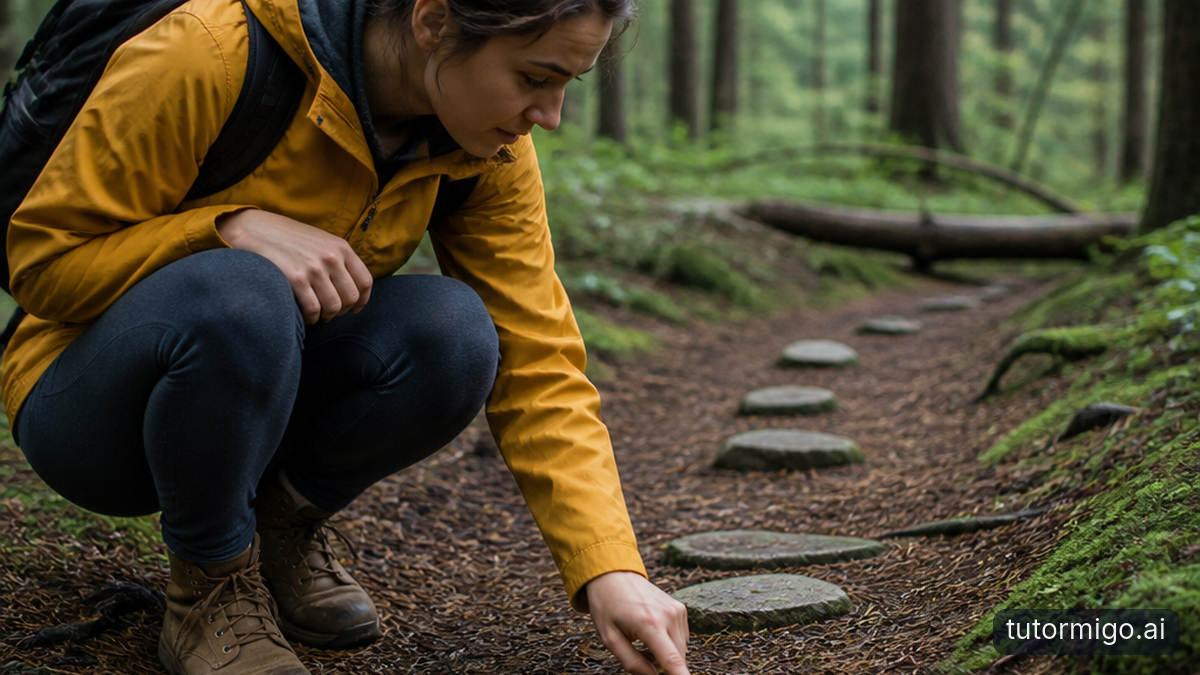
You may know the frustration of facing a difficult problem and feeling that you should already have the answer. That pressure can make you stop exploring too soon. Yet curiosity is more valuable than a quick answer because it keeps you looking, testing, and learning when the first explanation fails.
A question changes your role. Instead of trying to prove that you are right, you begin collecting clues. A student who asks, “Why did this plant grow better near the window?” may notice light, temperature, watering, and soil rather than memorizing a single fact. A mechanic who asks, “What changed just before the engine stopped?” has a better starting point than someone who guesses immediately.
Questions also make knowledge active. When you wonder why the Moon seems to change shape, you are more likely to observe it over several nights, compare diagrams, and revise your explanation. The answer becomes something you understand because you followed a trail to reach it, not something you briefly stored and forgot.
“A good question does not show what you know. It reveals what you are ready to discover.”
How Curiosity Drives Scientific Discovery

Many scientific advances began with an observation that did not fit the expected story. Alexander Fleming noticed that mold had stopped bacteria growing in a dish. The important moment was not simply seeing mold; it was asking what the mold was doing and whether that effect could be understood and used. That question helped open the path to penicillin.
Marie Curie investigated strange emissions from uranium and wondered whether the energy came only from the element’s known properties. Her persistence led to the study of radioactivity and the discovery of new elements. In both cases, the researchers did not begin with a complete explanation. They began by treating an unexpected result as an invitation rather than an inconvenience.
You can practice the same habit on a smaller scale. When an experiment produces a surprising result, do not erase it and start over immediately. Record what happened, identify the assumption that failed, and ask what evidence would distinguish two possible explanations. “Why?” is useful, but “What else could cause this?” and “How could I test that?” often move an investigation forward.
Curiosity makes science self-correcting. It gives you permission to change your mind when better evidence appears.
Inventions Begin with Better Questions
Inventions rarely appear because someone simply knows a collection of facts. They emerge when a person notices a limitation and asks whether it has to remain a limitation. The Wright brothers did not know the final design of a powered airplane. They studied bicycles, tested wing shapes, measured failures, and kept asking how control could improve while a machine was in the air.
That pattern appears in ordinary problem-solving too. Suppose a school backpack becomes uncomfortable halfway through the day. “Which bag should I buy?” is a reasonable question, but “What makes the weight feel uneven?” may lead to a better solution: rearranging heavy books, changing the strap position, or designing a different support system. The sharper question reveals more possible inventions.
When you want to create something, begin with the person’s real difficulty rather than a feature you hope to add. Ask who experiences the problem, when it appears, what they have already tried, and what would count as improvement. Then make a small prototype and invite criticism. A failed attempt is valuable if it tells you which question needs refining.
Curiosity protects invention from premature certainty. It keeps you focused on discovering what works instead of defending your first idea.
Exploration Starts at the Edge of the Unknown
Exploration depends on curiosity because the destination is often less important than the questions encountered along the way. Astronomers studying distant galaxies ask how stars form, how light changes across space, and what an unusual pattern might mean. The Hubble Space Telescope became especially powerful not because it answered every question, but because its images revealed new questions scientists had not known to ask.
The same process applies beyond astronomy. A naturalist walking through a local park might notice that one group of insects appears only under certain leaves. An ocean researcher may ask why two nearby areas have different temperatures. An adult learning a language may wonder why a familiar phrase changes in a new context. Each question turns a broad world into an investigation.
You do not need a remote expedition to explore well. Choose a familiar place and look at it with unfamiliar attention. Write down five observations before searching for explanations. Mark which details are certain, which are guesses, and which would require more evidence. This simple pause helps you avoid mistaking a familiar story for a complete one.
Curiosity makes exploration disciplined. It is not wandering without purpose; it is moving toward the unknown with an open, testable question.
Turn Curiosity into a Learning Practice
Curiosity can feel natural, but you can also build routines that make it easier to use. When you begin a lesson, article, or problem, write one question you genuinely want answered. It could be “Why does this argument depend on that assumption?” or “What would happen if this variable changed?” Keep the question visible while you study.
Next, use a three-column note: What I notice, What I think, and What I need to check. For example, while learning about ecosystems, you might notice that removing one species affects several others, think that the species is a keystone, and mark the definition or evidence you need to verify. This separates observation from interpretation and makes gaps in understanding easier to see.
When you reach an answer, ask one follow-up question before moving on. If you learn that metal expands when heated, ask whether every metal expands at the same rate and where that fact matters. If you solve a mathematics problem, ask how the result would change if one condition changed. Follow-up questions turn a finished task into a connected set of ideas.
For parents and teachers, praise the quality of a learner’s investigation, not only the correctness of the final response. “What made you test that?” often teaches more than “You got it right.”
What to Do When You Want to Keep Going
Start with one unanswered question that matters to you, then make it specific enough to investigate. Instead of “How does weather work?” ask, “Why did yesterday’s storm produce heavy rain in one neighborhood but not another?” Gather two or three reliable sources, record what they agree on, and note where uncertainty remains. Curiosity grows when you can see your own trail of evidence.
Share the question with someone who may challenge your assumptions. A classmate, colleague, parent, or teacher can suggest an experiment, a different explanation, or a connection you missed. You do not need to protect your first idea; you need to make it stronger.
If you want structured support for asking questions, testing explanations, and revisiting difficult ideas, TutorMigo.ai can provide a guided place to continue that kind of learning. Use it as a starting point for investigation, then bring your own observations and follow-up questions.
The goal is not to avoid answers. Answers are useful landmarks. The goal is to remain curious enough to notice when a landmark is incomplete—and brave enough to keep exploring.
Frequently asked questions
Curiosity keeps you investigating when an answer is incomplete or wrong. It helps you notice evidence, ask follow-up questions, test explanations, and build understanding that lasts longer than memorization.
Scientists often begin with an observation that does not fit expectations. Curiosity encourages them to investigate the anomaly, design tests, and revise their explanations instead of ignoring the unexpected result.
Yes. Write questions before studying, separate observations from guesses, ask one follow-up question after finding an answer, and treat mistakes as clues about what to investigate next.
Ask learners how they reached an idea, invite them to compare possible explanations, and praise careful investigation rather than only correct answers. Give them time to observe and test their own questions.
Related reading
Related reading
Related reading
Enjoyed this read?
Like, share, or comment below.



Comments
0Sign in required · respectful discussion · replies supported
Loading comments…