

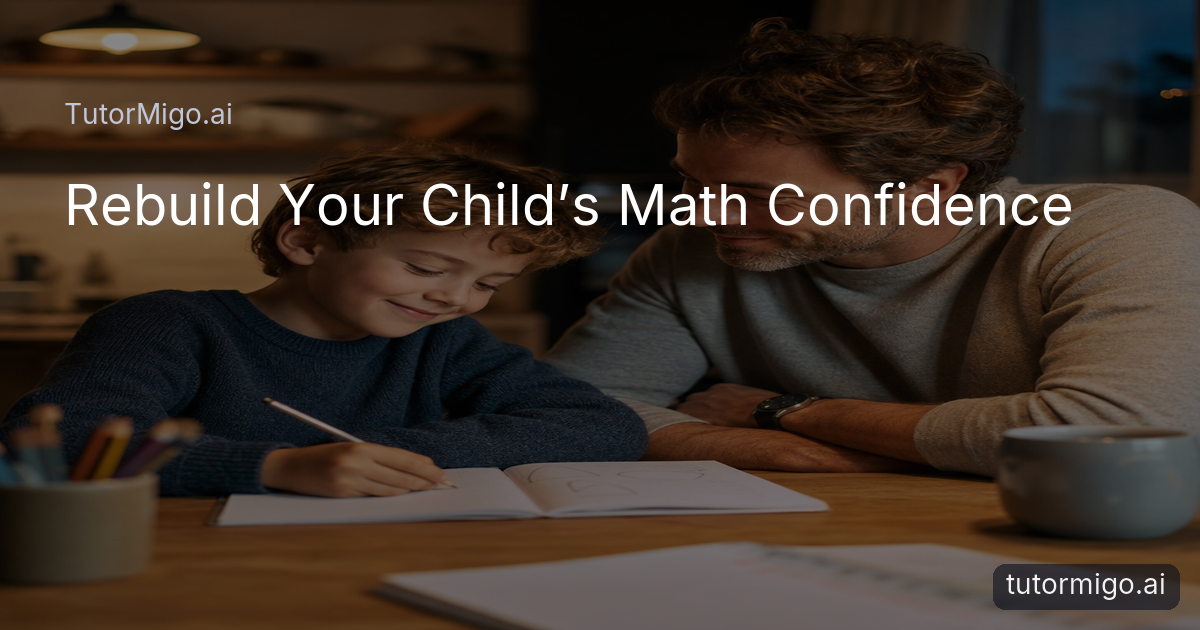
Building Math Confidence When a Child Says, “I’m Bad at Math

At 7:42 on a Tuesday evening, Maya pushed her workbook away and folded her arms over the page. “I’m bad at math. I hate it,” she said, looking more frightened than defiant. Her father felt the familiar rush of helplessness: Should he explain the problem again, call the teacher, or simply end the homework?
Many parents know this moment. The room gets quieter, the pencil stops moving, and one difficult question begins to sound like a verdict on a child’s future. It is easy to hear the statement as giving up. Often, though, it is a child trying to protect herself from another experience of feeling stuck.
That distinction matters. “I’m bad at math” is usually not evidence about intelligence, effort, or potential. It can be a shield against shame: if a child decides the subject is impossible, a wrong answer feels less like a surprise. You did not cause this by failing to teach the right method, and your child is not failing because confidence is low.
For more ideas on easing tension around homework, see this guide to reclaiming the kitchen table. The first goal is not finishing every question. It is helping your child experience one safe, successful next step.
Why Math Anxiety Turns One Tough Problem into a Fixed Identity

Math can feel uniquely unforgiving because new ideas often build on earlier ones. If place value, multiplication, or fractions still feel uncertain, the next lesson may seem to arrive without a stable starting point. Reading and history can also be challenging, but a child may not feel that one missed skill immediately blocks the next page.
Speed adds another layer. Timed drills and quick classroom responses can make a child believe that fast means smart. When an answer is either accepted or marked wrong, there may seem to be no room for a partially useful strategy, a careful drawing, or a question about the first step.
Over time, these experiences can form a “math identity”: the story a student tells about who they are as a learner. One low grade, a blank quiz, or repeated correction can become “I’m not a math person.” Once that story takes hold, a new worksheet may trigger anxiety before the first number is written.
A better story grows through micro-wins. Instead of demanding mastery of a whole unit, a parent can aim for two focused minutes: identify what the question asks, solve one part, or explain why a wrong answer changed. Small successes give the brain evidence that effort can lead somewhere. That evidence is more persuasive than a pep talk.
Three Calm Words Parents Can Use During a Math Meltdown
When Maya’s workbook closed, her father first wanted to say, “Math is easy.” He stopped. To a worried child, reassurance that contradicts the feeling can sound like criticism. Calm, specific language works better because it lowers the pressure before asking for more thinking.
“I see this is frustrating.” This acknowledges the experience without agreeing that the child cannot learn. Follow it with, “Let’s take a two-minute breather.” A drink of water, a stretch, or a short look away from the page can help a child return with more working memory available.
“You don’t know how to do fractions yet.” The word “yet” is not magic, but it keeps the future open. It changes the sentence from an identity claim into a description of a skill still developing. Use it naturally, without turning it into a correction or a demand to feel positive.
“Is the whole problem tricky, or just step two?” This isolates the friction point. Maybe the child understands multiplication but not how to line up the numbers. Maybe the story problem is confusing, while the calculation is fine. Naming the precise snag makes the task smaller and gives both of you something concrete to address.
If the exchange regularly ends in tears, it can help to read more about rebuilding student confidence around math anxiety. The aim is connection first, correction later.
The Micro-Win Blueprint: One Problem, One Hint, One Step Forward
Once the room is calm, use a repeatable three-step routine. First, shrink the assignment. Cover nine questions with a sheet of paper and say, “We are only looking at this one.” A ten-question worksheet is still waiting, but it no longer has to be solved all at once. One completed problem can become the bridge to the next.
Second, praise the process you can actually see. “You underlined the information that mattered,” is more useful than “You’re so smart.” Notice persistence, a useful diagram, a careful check, or the moment your child changed strategies. If the answer is wrong, ask, “What part makes sense so far?” A child learns that an imperfect attempt can contain progress.
Third, offer one non-judgmental hint rather than a full rescue. A parent hovering over every line can unintentionally make the pencil feel like a performance. Sit nearby, but let the learner try. Ask what the first step might be, or invite the child to explain the problem aloud before solving it.
An AI Tutor can provide that patient pause when a parent is tired, unsure of the modern method, or both. In TutorMigo.ai’s personalized tutor workspace, a student can work through a problem in smaller exchanges, receive guidance, and try again without the emotional weight of disappointing someone at the kitchen table.
Keep a tiny record of wins: “identified the operation,” “explained the drawing,” or “checked the answer.” This is not a grade chart. It is visible proof that confidence is being rebuilt through action.
TutorMigo Benefits: Patient, Personalized Math Help That Builds on Every Session
After dinner, Maya tried a short session with TutorMigo.ai before returning to her worksheet. She did not begin by tackling everything. She brought one fraction problem to the AI Tutor, explained what she thought the question was asking, and received a step-by-step prompt that helped her examine the next move rather than simply copy an answer.
That small change mattered. When she made a mistake, the exchange gave her a chance to see what she had missed and try again. The goal was not to make the problem disappear; it was to turn “I can’t do this” into “I know what to check next.” Ten minutes later, she solved one similar problem and told her father, “This one looks like the other one.”
Those are the practical TutorMigo benefits families are looking for: personalized support, room to make mistakes, and a session history that can help learning continue instead of restarting from zero. The tutor workspace is designed for an ongoing learning conversation, not a single rushed answer.
Parents can stay informed through the Parent Dashboard, which provides visibility into progress and learning controls without requiring a parent to stand over every problem. That gives a child independence while keeping adults connected. For a broader look at how an AI Tutor can support quieter practice, explore how AI can help quiet math anxiety.
TutorMigo.ai vs. General-Purpose Chatbots: A Fair Look at Step-by-Step Support and Progress Visibility
A general-purpose chatbot can be useful for asking a quick question or requesting an explanation. The fair comparison is not that one category can answer and the other cannot. The more useful question for a child rebuilding math confidence is what kind of learning structure surrounds the answer.
TutorMigo.ai is built around a personalized tutor workspace, session continuity, and study support that can keep a learner working through a problem in manageable steps. A general chatbot may offer a strong response in one conversation, but families may need to create their own routine for recording progress, revisiting skills, and deciding what to practice next.
For Maya, the difference was practical. She needed a calm prompt, a chance to correct herself, and a way for her parent to notice progress without turning homework into an inspection. The tool did not replace encouragement from home; it gave that encouragement a steadier structure.
Use the table below as a starting point, not a verdict. The right choice depends on whether your family needs a one-off explanation or a more continuous learning companion.
| What a learner may need | TutorMigo.ai | General-purpose chatbot |
|---|---|---|
| A continuing learning conversation | Personalized AI tutoring chat with session history | May provide a useful answer within an individual chat; continuity depends on the user’s setup |
| Step-by-step support | Tutor workspace can guide a learner through manageable exchanges instead of only presenting a result | Can explain steps when prompted, but the learner may need to design the step-by-step routine |
| Progress visibility for families | Parent Dashboard offers visibility into child progress and learning controls | Parents may need to track practice and progress separately |
| A focused study routine | Designed as an AI tutoring workspace for repeated learning support | Often serves broader questions across many topics and tasks |
Pros and cons
Pros
- Personalized tutoring support with session history
- A calmer way to practice one step at a time
- Parent visibility into progress and learning controls
Cons and limitations
- A digital tutor works best alongside caring adult encouragement
- Families should still choose the amount of practice that feels manageable for the child
The goal was not to make the problem disappear; it was to turn “I can’t do this” into “I know what to check next.”
Related reading
Enjoyed this read?
Like, share, or comment below.



Comments
0Sign in required · respectful discussion · replies supported
Loading comments…