


Turn English learning into speaking practice
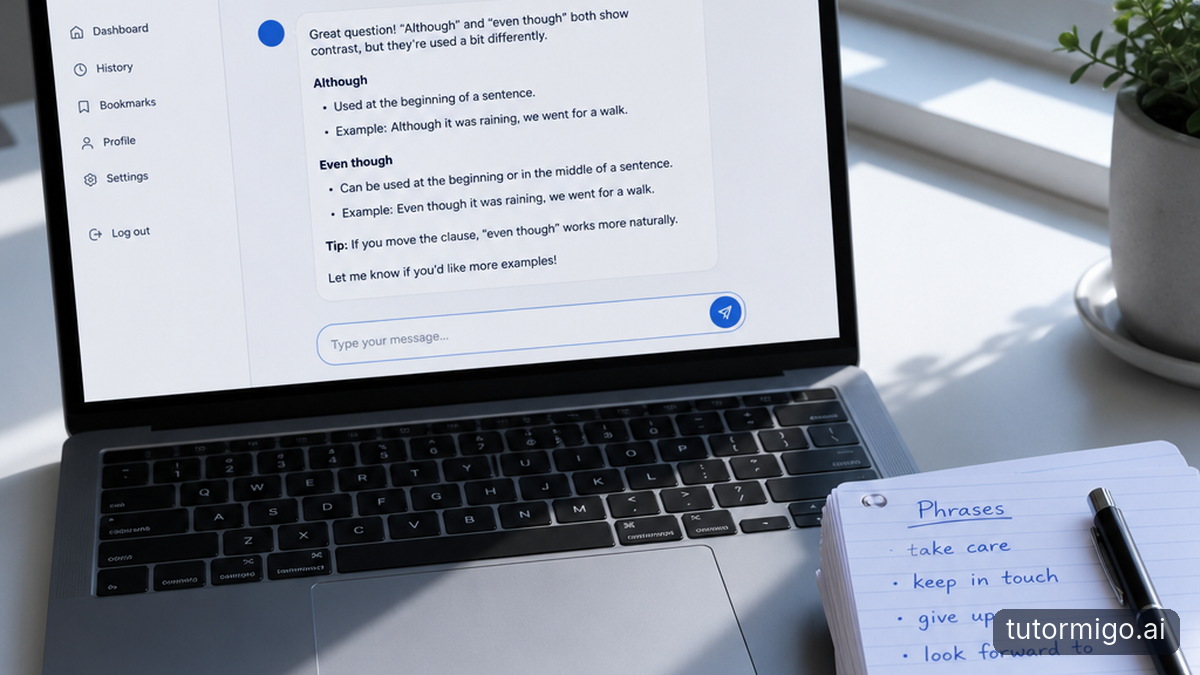
You understand an English video, but when someone asks your opinion, the words disappear. AI can help you bridge that gap through focused conversation, vocabulary review, and low-pressure rehearsal. TutorMigo.ai supports this work through personalized tutoring, session history, and flashcards, while debate-style exercises give your practice a clear purpose.
The goal is not to produce perfect English immediately. It is to make useful language easier to retrieve when you need it. An AI Tutor can help you break a broad ambition, such as “speak more fluently,” into a manageable task: explain your weekend, ask a follow-up question, or defend an opinion using one clear reason.
In TutorMigo.ai's tutor workspace, start by describing your current comfort level and a real situation. You might write, “I can understand everyday English, but I hesitate when explaining my ideas. Ask me one question at a time about hobbies.” Read each question, answer aloud, and then type what you said if you want feedback on the wording.
Session history gives you something concrete to revisit. Before your next practice, reopen an earlier exchange and identify one expression you struggled with. Try it again in a different sentence. This makes continuity an active learning habit rather than an assumption that the tool will automatically recognize every recurring difficulty.
Make speaking practice feel like a real conversation

Good speaking practice involves more than answering disconnected questions. Real conversations require you to listen, respond, clarify, and keep an exchange moving. Ask your AI Tutor to play a specific conversational role: a classmate planning a shared activity, a neighbor asking about your interests, or someone who disagrees politely with your suggestion.
Give the exercise a small complication. For example: “Let's plan a picnic, but we have different preferences. Ask me to explain my choice and suggest a compromise.” Speak your reply before typing it. If you get stuck, request one useful phrase rather than a complete answer. “Could we meet halfway?” is more reusable than memorizing an entire scripted conversation.
Keep feedback selective. Ask for one correction that improves clarity and one more natural alternative. If you say, “I am agree because it is more easy,” a useful revision is, “I agree because it is easier.” Repeat the corrected sentence aloud, then use the same pattern with a new idea. That second attempt helps you move beyond copying.
When comparing tools, look at the practice workflow rather than assuming general-purpose chatbots cannot help. Many can role-play and explain language. TutorMigo.ai benefits become clearer when personalized tutoring, accessible session history, and dedicated review tools support a repeatable routine. Judge any tool by whether it helps you practice consistently and notice specific improvements.
Work on pronunciation without chasing a perfect accent
Pronunciation practice should help other people understand you, not erase your accent. Start with a short phrase you actually need, such as “I'd like to explain my reason.” Listen to a reliable dictionary recording or another trusted spoken model, then say the phrase slowly and again at a comfortable conversational pace.
AI-generated explanations can help you understand syllables, word stress, and mouth positioning. Ask a narrow question: “Where is the stress in ‘important,’ and how can I practice it in a sentence?” Treat the explanation as guidance to check against a reliable recording. Text alone cannot establish exactly how you pronounced a sound.
Keep that distinction in mind when using TutorMigo.ai. The tutor workspace can support text-based explanations and practice planning; do not assume that a typed conversation measures your accent or listens to your speech. You can record yourself separately, compare your attempt with a trusted model, and bring questions about confusing words back into tutoring.
Practice phrases rather than isolated sounds alone. Say “What do you think?” as a friendly invitation, then as a genuine request for clarification. Notice how stress and pauses change the message. Choose one pronunciation focus for each session, such as making the ending of “asked” audible. You will learn more from a few attentive repetitions than from rushing through a long list.
Build vocabulary you can retrieve while speaking
Knowing a word when you see it is different from finding it during a conversation. Build vocabulary around situations and useful phrases, not just definitions. If you want to discuss opinions, collect expressions such as “From my experience,” “One drawback is,” and “I see your point, but…” Each phrase gives you a starting structure when your attention is already busy forming an idea.
TutorMigo.ai's Flashcards provide spaced-repetition decks, AI-assisted card creation, and review scheduling. Use them to revisit language over time rather than reviewing everything in one sitting. Check AI-assisted cards for accuracy and keep the wording relevant to conversations you expect to have.
A useful card might show, “Politely disagree with a friend's suggestion,” on the front, with “I see your point, but I'd prefer…” on the back. Before revealing the answer, say your own response aloud. After checking it, finish the sentence with a different reason. This turns a recognition exercise into a small speaking exercise.
Keep your deck selective. Add phrases that solved a genuine problem in your last conversation, and include a short example that makes their meaning clear. If you repeatedly avoid explaining disadvantages, practice “The main drawback is…” in several contexts. The aim is not to collect impressive words; it is to make useful language available when you need it.
Use debate practice to develop clearer spoken English
Debate gives speaking practice a purpose: you have to make a point someone else can follow. You do not need advanced English or a formal competition. A question such as “Is studying alone better than studying with others?” creates opportunities to explain preferences, give examples, acknowledge another view, and respond respectfully.
Use TutorMigo.ai's tutor workspace for a debate-style exchange. Try this prompt: “Help me rehearse a friendly debate in clear English. Discuss whether group study is helpful. Ask for my opinion first, then offer one counterargument at a time. After my reply, suggest one language improvement.” Say each response aloud before typing a version for feedback.
Build your first contribution around an opinion, a reason, and an example: “I prefer group study because I can ask questions. Last week, a friend explained a difficult idea to me.” Then practice responding to an objection: “That's true, but a small group can still stay focused.” You are developing communication skills alongside vocabulary and sentence structure.
Keep the challenge constructive. Ask for simpler language when needed and avoid turning every exchange into a contest to win. Repeat the same topic from the opposite viewpoint to stretch your phrasing. Our guide to building debate confidence in Bangladesh offers another perspective on preparing to speak. Confidence grows when you discover you can handle disagreement without having a perfect answer.
Start a routine and notice what gets easier
Your next step can be small: choose one topic, speak about it briefly, and identify one thing to improve. On your next visit, revisit the exchange in session history, review a few relevant flashcards, and try the topic again. Finish with a new question so that you practice adapting rather than simply memorizing yesterday's answer.
Track observable changes. Can you explain your opinion without abandoning the sentence? Can you ask someone to clarify? Can you use a recently learned phrase in a fresh context? These are more useful signs of progress than expecting confidence to rise every day. Keep a short personal note about what became easier and what still needs attention.
If IELTS is your goal, TutorMigo.ai's structured exam preparation offers practice sets and progress tracking. Keep everyday conversation practice alongside that preparation rather than treating a successful chat as proof of exam readiness. Parents can use the Parent Dashboard for visibility into a child's progress, while educators can use the Teacher Dashboard for student monitoring and reporting.
Support should stay encouraging: ask what the learner managed to express before pointing out errors. For more ideas, explore helping children speak English with confidence or how AI tutoring supports human tutors. Start today with one opinion, one reason, and one follow-up question.
Frequently asked questions
AI can provide low-pressure opportunities to rehearse answers, explore useful phrases, and practice responding to questions. Speak your answers aloud, request focused feedback on the wording, and use what you learn in conversations with people.
Ask the tutor workspace to run a friendly debate-style conversation on a familiar topic, offering one counterargument at a time. Say your response aloud, then type it for feedback on clarity and language. This is a suggested tutoring exercise, not a claim about a separate voice or debate assessment tool.
A typed exchange does not show how you actually pronounced a word. Use tutoring for explanations and practice ideas, then compare your speech with reliable recordings or seek feedback from a qualified teacher.
Spaced-repetition flashcards help you revisit useful language over time. To connect review with speaking, answer each prompt aloud before revealing the back, then use the phrase in a new sentence.
Enjoyed this read?
Like, share, or comment below.



Comments
0Sign in required · respectful discussion · replies supported
Loading comments…